The Hellenic Navy (HN) (Greek: Πολεμικό Ναυτικό, Polemikó Naftikó, abbreviated ΠΝ) is the naval force of Greece, part of the Greek Armed Forces. The modern Greek navy has its roots in the naval forces of various Aegean Islands, which fought in the Greek War of Independence. During the periods of monarchy (1833–1924 and 1936–1973) it was known as the Royal Navy (Βασιλικόν Ναυτικόν, Vasilikón Naftikón, abbreviated ΒΝ).The total displacement of all the navy's vessels is approximately 150,000 tons.The motto of the Hellenic Navy is "Μέγα το της Θαλάσσης Κράτος" from Thucydides' account of Pericles' oration on the eve of the Peloponnesian War. This has been roughly translated as "Great is the country that controls the sea". The Hellenic Navy's emblem consists of an anchor in front of a crossed Christian cross and trident, with the cross symbolizing Greek Orthodoxy, and the trident symbolizing Poseidon, the god of the sea in Greek mythology. Pericles' words are written across the top of the emblem. "The navy, as it represents a necessary weapon for Greece, should only be created for war and aim to victory."...............The Hellenic Merchant Marine refers to the Merchant Marine of Greece, engaged in commerce and transportation of goods and services universally. It consists of the merchant vessels owned by Greek civilians, flying either the Greek flag or a flag of convenience. Greece is a maritime nation by tradition, as shipping is arguably the oldest form of occupation of the Greeks and a key element of Greek economic activity since the ancient times. Nowadays, Greece has the largest merchant fleet in the world, which is the second largest contributor to the national economy after tourism and forms the backbone of world shipping. The Greek fleet flies a variety of flags, however some Greek shipowners gradually return to Greece following the changes to the legislative framework governing their operations and the improvement of infrastructure.Blogger Tips and Tricks
This is a bilingual blog in English and / or Greek and you can translate any post to any language by pressing on the appropriate flag....Note that there is provided below a scrolling text with the 30 recent posts...Αυτό είναι ένα δίγλωσσο blog στα Αγγλικά η/και στα Ελληνικά και μπορείτε να μεταφράσετε οποιοδήποτε ποστ σε οποιαδήποτε γλώσσα κάνοντας κλικ στη σχετική σημαία. Σημειωτέον ότι παρακάτω παρέχεται και ένα κινούμενο κείμενο με τα 30 πρόσφατα ποστς....This is a bilingual blog in English and / or Greek and you can translate any post to any language by pressing on the appropriate flag....Note that there is provided below a scrolling text with the 30 recent posts...Αυτό είναι ένα δίγλωσσο blog στα Αγγλικά η/και στα Ελληνικά και μπορείτε να μεταφράσετε οποιοδήποτε ποστ σε οποιαδήποτε γλώσσα κάνοντας κλικ στη σχετική σημαία. Σημειωτέον ότι παρακάτω παρέχεται και ένα κινούμενο κείμενο με τα 30 πρόσφατα ποστς.........

Monday, April 8, 2013

Greek Banks...[ 3079 ]


National Bank and Eurobank Fall as Merger Halted: Athens Mover


National Bank of Greece SA, the country’s biggest lender, and Eurobank Ergasias SA (EUROB) both lost as much as a record 30 percent of their value in Athens trading after their plan for a merger was put on hold. 
;
Eurobank fell 17 percent to 13 euro cents at 12:03 p.m. local time, the lowest since April 1999, while National Bank declined 30 percent to 36 cents, the most since September 1992. Alpha Bank SA fell 7 percent and Piraeus Bank SA (TPEIR) dropped 11 percent. 
'
National Bank and Eurobank will be recapitalized separately, meaning their plan to merge has been halted, according to separate company statements on the website of the Athens Stock Exchange today. Both said they will hold shareholder meetings tomorrow to decide on capital increases. 
'
Greece’s four biggest lenders need to raise 27.5 billion euros ($35.8 billion) after suffering losses in the country’s sovereign-debt restructuring last year. National Bank and Eurobank need a total of 15.6 billion euros, according to a Bank of Greece report released in December. The banks need to secure 10 percent of the common equity from private investors, with the Hellenic Financial Stability Fund providing the remainder. 
'
“We estimate that there will be inability to gather 10 percent private-sector participation, so this is the basic assumption,” Konstantinos Manolopoulos, an analyst at Investment Bank of Greece, said by telephone today. “It will make no sense to invest in these two banks as investors will suffer dilution without the upside potential of warrants.” 
'
The country’s stability fund, or HFSF, may prepare to recapitalize both banks if they are not able to raise set funds from the private sector, an official from the country’s finance ministry said yesterday. The HFSF will determine whether the merger will continue if it becomes the main shareholder in the two banks, the official said.
To contact the reporter on this story: Eleni Chrepa in Athens at echrepa@bloomberg.net
To contact the editor responsible for this story: Jerrold Colten at jcolten@bloomberg.net

Saturn and Its Moon Titan...[ 3078 ]

Pioneer 11 Image of Saturn and Its Moon Titan

Sunday, April 7, 2013

Korean peninsula....[ 3077 ]

An accident, then war with North Korea?

By Wesley Clark, Special to CNN
April 6, 2013 -- Updated 1453 GMT (2253 HKT)
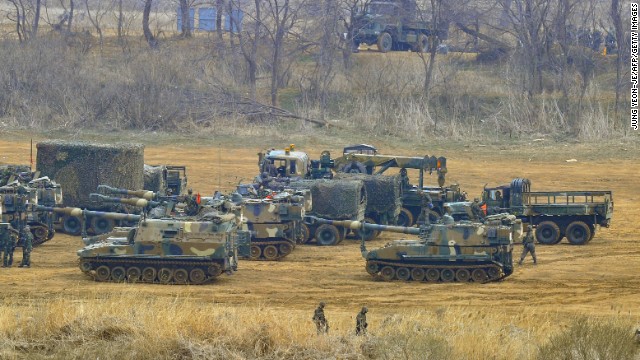
South Korean soldiers with K-55 self-propelled Howitzers stage at a military training field in the border city of Paju on Friday, April 5, as tensions continue to mount on the Korean peninsula. South Korean soldiers with K-55 self-propelled Howitzers stage at a military training field in the border city of Paju on Friday, April 5, as tensions continue to mount on the Korean peninsula.
--- 
Wesley Clark: What if war is triggered by accident or some kind of miscalculation?
Wesley Clark 
 Wesley Clark
Editor's note: Wesley K. Clark, a retired Army general and NATO's former supreme allied commander in Europe, is a senior fellow at the Burkle Center for International Relations at the University of California, Los Angeles. Clark consults and advises companies in the satellite communications, biotechnology and energy fields, some with government and Department of Defense contracts.
-

(CNN) -- What if war is triggered by accident or some kind of miscalculation on the Korean peninsula?
This is a possibility that has provoked worry, analysis and preparations for more than 50 years. The recent bellicose rhetoric from the young, unproven leader of North Korea raises this possibility to a new height. What precisely is the risk, and what should be done about it?
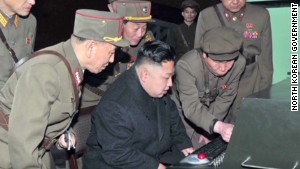
The angry rhetoric of Kim Jong Un has set a record for extremism. And yet, going all the way back to the negotiating tactics used in the Korean War, the North has used an extreme, abusive and contradictory style.
'
Anything conceded to them was taken, but they conceded nothing. Anything up for negotiation was met with ever heightening demands. Every offer of compromise was met with an angry rhetoric of denial. Repeated rounds or negotiations over the succeeding decades have seen little change. And their public rhetoric has always been harsh and hyperbolic.
'
But it hasn't been only rhetoric over the years. In the 1960s, U.S. soldiers serving in Korea were authorized to wear their division's insignia on the right shoulder, the so-called combat patch. A U.S. Navy ship was attacked, boarded and seized with its crew held captive in 1968. A U.S. Army major and another soldier were beaten to death in the Korean Demilitarized Zone in 1976.
'
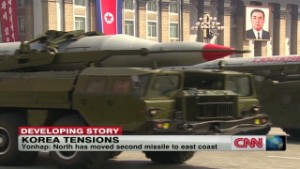
Again and again, North Korea has defied international accords, laws and common sense, creating and exporting long-range missiles, building nuclear capabilities and engaging in kidnappings, sabotage and cyberattack.
But there has been no war.
'
We attribute this to three factors. First, we believe the overwhelming power of the United States guarantees that any North Korean attack would, eventually, result in the utter destruction of the regime. Second, the South Korean leadership has shown remarkable restraint in the face of humiliating North Korean provocations. Third, the North Koreans may not have ever intended to attack, though we have no way of knowing, or they understand that the combined U.S.-South Korean forces would destroy North Korea should war begin.
The U.S. and South Korean deterrent remains strong -- in both rhetoric and deployable, effective military power.
'
But what about miscalculation?
 
Life in North Korea
 
Korea tensions ramp up
Yes, it is always possible that Kim may doubt that the United States would act, despite all the evidence to the contrary. Or, perhaps he miscalculates how far he can push the South Koreans. It is possible that a North provocation could be so extreme that the South would be compelled by its own domestic politics to respond militarily -- say a tit-for-tat ship-sinking. Or maybe such an incident occurs by accident, if overzealous commanders make a wrong move.
'
And then Kim, fearing that his own associates would mistake forbearance for weakness, would escalate in turn, thus initiating a cycle of intensifying moves that could spread conflict and turn into a war that neither side could back away from.
The risk is higher now than before because Kim's bellicose rhetoric may mask real weaknesses in his authority or in his understanding.
The rising rhetoric raises tensions (as it is probably designed to do). These tensions increase the risks of fear or pride, which could lead to an inadvertent incident. Should an incident occur, there will be pressure on leaders of both sides to retaliate and even escalate hostility. The consequences of conflict are higher than before, given the North's nuclear and missile capabilities.
What should be done?
First, ensure that the U.S. deterrent is capable and credible. This requires that we have the capability to both defend ourselves and strike back, and that we make it as clear as possible to the North Koreans our resolve to use these capabilities if challenged.
Second, assure our South Korean allies that we will stand with them, so they can afford politically to be restrained.
Third, strike a balance between demonstrating resolve in public and, simultaneously, working to reduce tensions. North Korea must always be given an "out" from the box of escalating threats it has constructed, but the out must not involve U.S.-South Korean concessions, apologies or any signs of hesitancy, weakness or lack of resolve. This requires artful balancing of military demonstrations, deployments, statements and behind-the-scenes dialogue with China and others in the region.
The odds are that there will be no conflict. Good odds. The U.S. and South Korean leadership is experienced. And so are those behind the young leader in the North. This is a familiar game, but one whose risks far outweigh any actual benefits to the North.
Follow us on Twitter: @CNNOpinion.
Join us at Facebook/CNNOpinion.

Wednesday, April 3, 2013

Neanderthal Bones Found...[ 3076 ]

Trove of Neanderthal Bones Found in Greek Cave

//
Corbis
A trove of Neanderthal fossils including bones of children and adults, discovered in a cave in Greece hints the area may have been a key crossroad for ancient humans, researchers say.
The timing of the fossils suggests Neanderthals and humans may have at least had the opportunity to interact, or cross paths, there, the researchers added.
Neanderthals are the closest extinct relatives of modern humans, apparently even occasionally interbreeding with our ancestors. Neanderthals entered Europe before modern humans did, and may have lasted there until about 35,000 years ago, although recent findings have called this date into question.
To learn more about the history of ancient humans, scientists have recently focused on Greece.
"Greece lies directly on the most likely route of dispersals of early modern humans and earlier hominins into Europe from Africa via the Near East," paleoanthropologist Katerina Harvati at the University of Tübingen in Germany told LiveScience. "It also lies at the heart of one of the three Mediterranean peninsulae of Europe, which acted as refugia for plant and animal species, including human populations, during glacial times — that is, areas where species and populations were able to survive during the worst climatic deteriorations."
"Until recently, very little was known about deep prehistory in Greece, chiefly because the archaeological research focus in the country has been on classical and other more recent periods," Harvati added.
Harvati and colleagues from Greece and France analyzed remains from a site known as Kalamakia, a cave stretching about 65 feet (20 meters) deep into limestone cliffs on the western coast of the Mani Peninsula on the mainland of Greece. They excavated the cave over the course of 13 years. (Amazing Caves: Photos Reveal Earth's Innards)
The archaeological deposits of the cave date back to between about 39,000 and 100,000 years ago to the Middle Paleolithic period. During the height of the ice age, the area still possessed a mild climate and supported a wide range of wildlife, including deer, wild boar, rabbits, elephants, weasels, foxes, wolves, leopards, bears, falcons, toads, vipers and tortoises.
In the cave, the researchers found tools such as scrapers made of flint, quartz and seashells. The stone tools were all shaped, or knapped, in a way typical of Neanderthal artifacts.
Now, the scientists reveal they discovered 14 specimens of child and adult human remains in the cave, including teeth, a small fragment of skull, a vertebra, and leg and foot bones with bite and gnaw marks on them. The teeth strongly appear to be Neanderthal, and judging by marks on the teeth, the ancient people apparently had a diet of meat and diverse plants.
"Kalamakia, together with the single human tooth from the nearby cave site of Lakonis, are the first Neanderthal remains to be identified from Greece," Harvati said. The discoveries are "confirmation of a thriving and long-standing Neanderthal population in the region."
These findings suggest "the fossil record from Greece potentially holds answers about the earliest dispersal of modern humans and earlier hominins into Europe, about possible late survival of Neanderthals and about one of the first instances where the two might have had the opportunity to interact," Harvati said.
In the future, Harvati and her colleagues will conduct new fieldwork in other areas in Greece to address mysteries such as potential coexistence and interactions between Neanderthals and modern humans, the spread of modern and extinct humans into Europe and possible seafaring capabilities of ancient humans.
"We look forward to exciting discoveries in the coming years," Harvati said.
The scientists detailed their findings online March 13 in the Journal of Human Evolution.

Saturday, March 30, 2013

Tanzania building collapse...[ 3075 ]

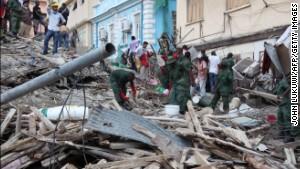
Rescuers dig through rubble seeking missing in Tanzania building collapse

From Mwondoshah Mfanga, for CNN
March 29, 2013 -- Updated 2050 GMT (0450 HKT)
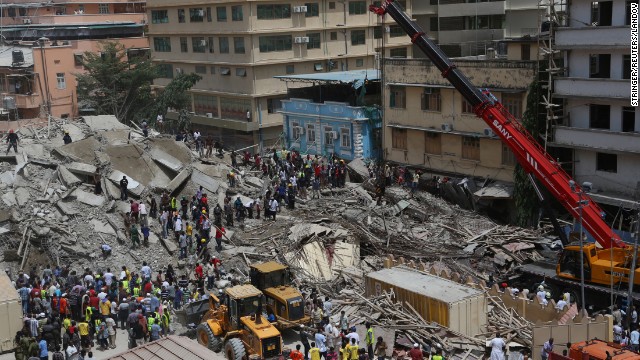
Rescue workers search for survivors as bystanders watch, after a building under construction in the Kariakoo district of central Dar es Salaam, Tanzania, collapsed on March 29. Rescue workers search for survivors as bystanders watch, after a building under construction in the Kariakoo district of central Dar es Salaam, Tanzania, collapsed on March 29.

Dar es Salaam, Tanzania (CNN) -- Rescuers planned to search for survivors under a mountain of concrete and twisted metal Friday night after a high-rise building collapsed in Tanzania.

At least four people were dead and 60 were missing after the 16-story building under construction collapsed in Tanzania's largest city, government and emergency officials said.

Five children are believed to be among the missing, rescue official Walji Ali said.

The building collapsed Friday with a "huge whoosh and then thump," said eyewitness Ali Jawad Bhimani, a hotel owner who lives near the building in Dar es Salaam's normally bustling Kariakoo central business district.

"The fallen building is next to our mosque. There is a small field there where the young boys play football. The building fell right on top," he said. "But 10 to 15 of the boys playing got away safely and are unharmed."

Building collapses in Tanzania

© NAVTEQ 2012 Terms of Use

A statement from the nearby mosque said that four of the boys believed to have been playing there were still missing.

Police and search dogs quickly flooded the scene, Bhimani said. By Friday evening, the dogs were gone, replaced by heavy equipment being used to remove debris, he said.

The Tanzanian Red Cross said rescue efforts would continue through the night. But the group also expressed relief that the casualty figures could have been far higher but the streets were relatively empty of vendors and shoppers due to a holiday.

"So far we have managed to rescue live at least 13 people and four dead bodies, two were seriously injured," Stella Marealle from the Red Cross said.

In addition to the deaths, at least 17 people were injured, said Suleiman Kova, a regional police commander.

Construction workers were among those injured, Ali said.
CNN's Sara Mazloumsaki and Brian Walker contributed to this report.