The Hellenic Navy (HN) (Greek: Πολεμικό Ναυτικό, Polemikó Naftikó, abbreviated ΠΝ) is the naval force of Greece, part of the Greek Armed Forces. The modern Greek navy has its roots in the naval forces of various Aegean Islands, which fought in the Greek War of Independence. During the periods of monarchy (1833–1924 and 1936–1973) it was known as the Royal Navy (Βασιλικόν Ναυτικόν, Vasilikón Naftikón, abbreviated ΒΝ).The total displacement of all the navy's vessels is approximately 150,000 tons.The motto of the Hellenic Navy is "Μέγα το της Θαλάσσης Κράτος" from Thucydides' account of Pericles' oration on the eve of the Peloponnesian War. This has been roughly translated as "Great is the country that controls the sea". The Hellenic Navy's emblem consists of an anchor in front of a crossed Christian cross and trident, with the cross symbolizing Greek Orthodoxy, and the trident symbolizing Poseidon, the god of the sea in Greek mythology. Pericles' words are written across the top of the emblem. "The navy, as it represents a necessary weapon for Greece, should only be created for war and aim to victory."...............The Hellenic Merchant Marine refers to the Merchant Marine of Greece, engaged in commerce and transportation of goods and services universally. It consists of the merchant vessels owned by Greek civilians, flying either the Greek flag or a flag of convenience. Greece is a maritime nation by tradition, as shipping is arguably the oldest form of occupation of the Greeks and a key element of Greek economic activity since the ancient times. Nowadays, Greece has the largest merchant fleet in the world, which is the second largest contributor to the national economy after tourism and forms the backbone of world shipping. The Greek fleet flies a variety of flags, however some Greek shipowners gradually return to Greece following the changes to the legislative framework governing their operations and the improvement of infrastructure.Blogger Tips and Tricks
This is a bilingual blog in English and / or Greek and you can translate any post to any language by pressing on the appropriate flag....Note that there is provided below a scrolling text with the 30 recent posts...Αυτό είναι ένα δίγλωσσο blog στα Αγγλικά η/και στα Ελληνικά και μπορείτε να μεταφράσετε οποιοδήποτε ποστ σε οποιαδήποτε γλώσσα κάνοντας κλικ στη σχετική σημαία. Σημειωτέον ότι παρακάτω παρέχεται και ένα κινούμενο κείμενο με τα 30 πρόσφατα ποστς....This is a bilingual blog in English and / or Greek and you can translate any post to any language by pressing on the appropriate flag....Note that there is provided below a scrolling text with the 30 recent posts...Αυτό είναι ένα δίγλωσσο blog στα Αγγλικά η/και στα Ελληνικά και μπορείτε να μεταφράσετε οποιοδήποτε ποστ σε οποιαδήποτε γλώσσα κάνοντας κλικ στη σχετική σημαία. Σημειωτέον ότι παρακάτω παρέχεται και ένα κινούμενο κείμενο με τα 30 πρόσφατα ποστς.........

Wednesday, November 21, 2012

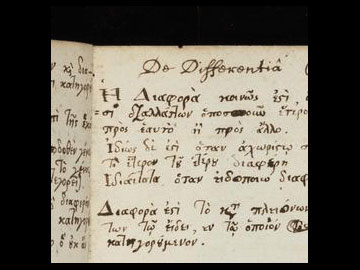
Newton was writing in Greek! ...[ 2999 ]


Newton’s manuscripts were written in Greek!
 

Cambridge University puts Sir Isaac Newton's Notebooks written in Greek online
  by Archaeology newsroom - Friday, 20 July 2012


On the image above you see part of a handwritten note of Isaac Newton. This is a notebook Newton acquired while he was an undergraduate at Trinity College and used from about 1661 to 1665. 
-
It includes many notes from his studies and, increasingly, his own explorations into mathematics, physics and metaphysics.
-
While observing Newton’s note, you will notice something quite surprising: The notes are written in Greek! While the titles/subjects he was working on are presented in Latin –as well as the brief explanations at the margins of the pages- the subject analysis itself is given in a brief well written Greek text, in lowercase letters, with the necessary diacritics.
-
 It seems therefore that Greek language knowledge was so widespread that a scholar could use it effortlessly even in simple notes.
-
Due to the way it is written, the above mentioned notebook was judged ‘Not fit to be printed’. It was condemned to oblivion until 1872, when it was presented to the Library of Cambridge. In 2011 it was digitised and put online by Cambridge University
More manuscripts
 
-

The euro fell against the dollar,Yen Weakens..[ 2998 ]

Euro Drops Versus Dollar as Greek Aid Talks Falter; Yen Weakens

Bloomberg

The euro fell against the dollar, snapping a two-day gain, after European finance ministers failed to agree on a debt-reduction package for Greece during more than 11 hours of talks in Brussels.
The shared currency declined versus 13 of its 16 major counterparts after Luxembourg’s Finance Minister Luc Frieden said euro-area finance ministers will resume discussions next week. The yen weakened beyond 82 per dollar for the first time since April after Japan’s exports dropped for a fifth month. New Zealand’s dollar depreciated after whole-milk powder prices slid, cutting revenue from a key export.
  Euro Drops Versus Dollar as Greek Aid Talks Falter
The euro has declined 6.5 percent during the past 12 months, the second worst performer of the 10 currencies tracked by Bloomberg Correlation-Weighted indexes. Photographer: Simon Dawson/Bloomberg
“European policy makers raised expectations that something would happen on Greece and then they didn’t deliver,” said Ned Rumpeltin, head of Group-of-10 currency strategy at Standard Chartered Group Plc in London. “What we are seeing is European risk coming back on to the agenda. It does put downward pressure on the euro.”
The euro dropped 0.4 percent to $1.2765 at 8:33 a.m. in London after strengthening 0.6 percent during the previous two days. The shared currency was little changed at 104.71 yen. The yen fell 0.4 percent to 82.03 per dollar after depreciating to 82.11, the weakest since April 6.
“We have a series of options on the table on how to close the financing gap,” German Finance Minister Wolfgang Schaeuble told reporters in Brussels. “We discussed the issue very intensively, but since the questions are so complicated we didn’t come to a final agreement.”
A further meeting has been arranged for Nov. 26, and an aid payment for Greece held up since June remains frozen.

Euro’s Decline

The euro has declined 6.5 percent during the past 12 months, the second worst performer of the 10 currencies tracked by Bloomberg Correlation-Weighted indexes. The yen dropped the most, sliding 7.5 percent, and the dollar fell 0.6 percent.
The yen weakened for a sixth day versus the dollar after Japan’s Ministry of Finance said exports fell 6.5 percent in October from a year earlier, leaving a trade deficit of 549 billion yen. The median estimate of economists surveyed by Bloomberg News was for a shortfall of 360 billion yen.
“The trade numbers have added to the case for yen weakness,” said Sean Callow, a senior currency strategist at Westpac Banking Corp. in Sydney “The struggles of the Japanese exporters are becoming increasingly clear.”
The 14-day relative strength index for the dollar against the yen was above 70 for a fourth day today, the level that some traders see as a sign an asset is about to change direction.

‘Look Overbought’

“Dollar-yen and cross-yen look overbought,” said Yoshitsugu Fujita, assistant vice president of global markets at Sumitomo Mitsui Trust Bank Ltd. in New York. “The weak yen trend will reverse in the not-so-distant future.”
The New Zealand currency dropped against most of its major peers after Auckland-based Fonterra Cooperative Group Ltd., the world’s biggest dairy producer, said milk powder for January delivery fell 2.5 percent.
The near-term contract for the New Zealand product declined to $3,255 a metric ton, the lowest since Oct. 2. Sales of dairy product make up about a quarter of New Zealand exports.
New Zealand’s dollar dropped 0.4 percent to 81.42 U.S. cents after sliding 0.4 percent yesterday.
Markets in the U.S. will be shut tomorrow for a holiday.
To contact the reporters on this story: Mariko Ishikawa in Tokyo at mishikawa9@bloomberg.net; Kristine Aquino in Singapore at kaquino1@bloomberg.net
To contact the editor responsible for this story: Paul Dobson at pdobson2@bloomberg.net

Greek PM : Aid delay not justified...[ 2997 ]

Greek PM says aid delay not justified


Greece's Prime Minister Antonis Samaras delivers his speech during a business presentation organised by the youths of his conservative New Democracy party in Athens November 20, 2012. REUTERS/John Kolesidis

-.
ATHENS | Wed Nov 21, 2012 2:17am EST
(Reuters) - Greek Prime Minister Antonis Samaras on Wednesday said the lack of a debt deal between the country's lenders over technical reasons did not justify holding up aid to Athens.
-
"Greece did what it had committed it would do . Our partners, together with the IMF, also have to do what they have taken on to do," Samaras said in a statement.
-
" Any technical difficulties in finding a technical solution do not justify any negligence or delays. "
 (Reporting by Maria Paravantes, Writing by Deepa Babington)

Tuesday, November 20, 2012

Sun eruptions...[ 2996 ]


Double Prominence Eruptions


Monday, November 19, 2012

Greek Gap to close...[ 2995 ]

European Finance Chiefs Seek to Close Greek Gap Amid IMF

Bloomberg

 
European finance ministers aim to stitch together Greece’s next aid payment as a sputtering euro- area economy and a spat with the International Monetary Fund cloud efforts to resolve the debt crisis.
The finance chiefs meet in Brussels tomorrow for the second time in a week after they agreed seven days ago to keep Greece’s bailout aid flowing. In addition to a disagreement between the European Union and IMF over extending Greece’s debt-reduction target, the ministers will try to re-engineer the bailout without asking taxpayers to put up more money.
  IMF Director Christine Lagarde
International Monetary Fund Director Christine Lagarde took issue with European governments’ decision to push back Greece’s debt-reduction target by two years to 2022 against the fund’s recommendations. Photographer: Kiyoshi Ota/Bloomberg
Greek Bank Recapitalization Will Spur Growth
 Nov. 16 (Bloomberg) -- Konstantinos Boukas, director of asset management at BETA Securities SA, discusses the outlook for the Greek economy and bank recapitalization. He speaks from Athens with Guy Johnson on Bloomberg Television's "The Pulse." (Source: Bloomberg)
The talks are “likely to be tense as all players set out their positions,” Thomas Costerg, an economist at Standard Chartered in London, said in an e-mail. “Greece’s debt can is likely to be kicked further down the road, but we could see some constructive statements.”
The meeting of the ministers from the 17-member euro area underscores skirmishing among EU officials confronting rising unemployment and a slowing economy as they struggle with the three-year-old debt crisis. The talks precede a Nov. 22-23 EU summit to resolve the bloc’s budget, a project threatened by a dispute with the U.K.
With tens of thousands of Europeans staging protests last week against austerity measures and unemployment, shifting dynamics in other European countries could foreshadow renewed conflict -- an early election in Italy, a regional vote in Spain and an approaching bailout package for Cyprus.
Greek Gains
Greek bonds rallied as analysts at Commerzbank AG, BNP Parisbas SA and Societe Generale speculated the finance ministers will achieve their aims. The yield on 10-year Greek notes fell 22 basis points to 17.25 percent.
“Greece, despite the exaggerated view in the German press, is in a tough situation yet where the indicators are pointing up,” German Deputy Finance Minister Steffen Kampeter said today in Frankfurt.
IMF Director Christine Lagarde took issue with European governments’ decision to push back Greece’s debt-reduction target by two years to 2022 against the fund’s recommendations, raising questions over whether the IMF would keep financing Greece.
Lagarde, who cut short a visit to Southeast Asia to return to Europe, signaled a potential clash in an interview in Manila on Nov. 17 by saying she’ll defend the IMF’s credibility.
Lagarde said that she was approaching the talks feeling “patient and resilient.” Even so, “we never leave the table,” she said when asked about dropping support.
IMF Target
The IMF target is for a reduction of Greece’s debt to 120 percent of gross domestic product by 2020, from a projected peak of 190 percent of GDP in 2014. An agreement on what qualifies as sustainable debt in Greece is required to plug a finance gap of as much as 32.6 billion euros ($42 billion).
Greece will probably need another aid package for after 2014, European Central Bank Board Member Joerg Asmussen said in an interview with German broadcaster ZDF yesterday.
Even though European leaders have pledged to do all they can to avert a Greek exit from the single currency, they’ve refused to return to parliaments for more funding. Finnish Premier Jyrki Katainen, speaking on YLE Radio Suomi at the weekend, again rejected further funds to Greece.
German Finance Minister Wolfgang Schaeuble told reporters last week that the current package could be re-jigged by cutting rates on loans or giving Greece extra time. In an interview on ARD television yesterday, he reiterated his rejection of a third option: write-offs of the country’s debt held by public institutions.
Debt Restructuring
Greece, which has already undergone the biggest sovereign restructuring in history after private investors forgave more than 100 billion euros of debt in March, may need another write- off, European Central Bank Governing Council member Jens Weidmann said at an event in Berlin on Nov. 16.
Luxembourg Prime Minister Jean-Claude Juncker, who oversees the finance chief meetings of the 17 euro nations, last week predicted a “definite decision” on releasing the next aid payment. He said the ministers might have to consult once more, possibly by teleconference, by the end of November to formally sign off on the updated rescue package.
“We have to find a common line and we have to do it on Tuesday,” Schaeuble said on ARD. “We’re working at full steam. I think we’ll do it.”

To contact the reporter on this story: Patrick Donahue in Berlin at pdonahue1@bloomberg.net
To contact the editor responsible for this story: James Hertling at jhertling@bloomberg.net