The Hellenic Navy (HN) (Greek: Πολεμικό Ναυτικό, Polemikó Naftikó, abbreviated ΠΝ) is the naval force of Greece, part of the Greek Armed Forces. The modern Greek navy has its roots in the naval forces of various Aegean Islands, which fought in the Greek War of Independence. During the periods of monarchy (1833–1924 and 1936–1973) it was known as the Royal Navy (Βασιλικόν Ναυτικόν, Vasilikón Naftikón, abbreviated ΒΝ).The total displacement of all the navy's vessels is approximately 150,000 tons.The motto of the Hellenic Navy is "Μέγα το της Θαλάσσης Κράτος" from Thucydides' account of Pericles' oration on the eve of the Peloponnesian War. This has been roughly translated as "Great is the country that controls the sea". The Hellenic Navy's emblem consists of an anchor in front of a crossed Christian cross and trident, with the cross symbolizing Greek Orthodoxy, and the trident symbolizing Poseidon, the god of the sea in Greek mythology. Pericles' words are written across the top of the emblem. "The navy, as it represents a necessary weapon for Greece, should only be created for war and aim to victory."...............The Hellenic Merchant Marine refers to the Merchant Marine of Greece, engaged in commerce and transportation of goods and services universally. It consists of the merchant vessels owned by Greek civilians, flying either the Greek flag or a flag of convenience. Greece is a maritime nation by tradition, as shipping is arguably the oldest form of occupation of the Greeks and a key element of Greek economic activity since the ancient times. Nowadays, Greece has the largest merchant fleet in the world, which is the second largest contributor to the national economy after tourism and forms the backbone of world shipping. The Greek fleet flies a variety of flags, however some Greek shipowners gradually return to Greece following the changes to the legislative framework governing their operations and the improvement of infrastructure.Blogger Tips and Tricks
This is a bilingual blog in English and / or Greek and you can translate any post to any language by pressing on the appropriate flag....Note that there is provided below a scrolling text with the 30 recent posts...Αυτό είναι ένα δίγλωσσο blog στα Αγγλικά η/και στα Ελληνικά και μπορείτε να μεταφράσετε οποιοδήποτε ποστ σε οποιαδήποτε γλώσσα κάνοντας κλικ στη σχετική σημαία. Σημειωτέον ότι παρακάτω παρέχεται και ένα κινούμενο κείμενο με τα 30 πρόσφατα ποστς....This is a bilingual blog in English and / or Greek and you can translate any post to any language by pressing on the appropriate flag....Note that there is provided below a scrolling text with the 30 recent posts...Αυτό είναι ένα δίγλωσσο blog στα Αγγλικά η/και στα Ελληνικά και μπορείτε να μεταφράσετε οποιοδήποτε ποστ σε οποιαδήποτε γλώσσα κάνοντας κλικ στη σχετική σημαία. Σημειωτέον ότι παρακάτω παρέχεται και ένα κινούμενο κείμενο με τα 30 πρόσφατα ποστς.........

Friday, October 26, 2012

Turkey's 'inkblot' test...[ 2975 ]


Turkey's 'inkblot' test
 Turkey's 'inkblot' test

October 24th, 2012/05:22 PM ET

By Soner Cagaptay, Special to CNN
Editor's note: Soner Cagaptay is a senior fellow at the Washington Institute for Near East Policy and a GPS contributor. You can find his other posts here. The views expressed are solely those of the author.
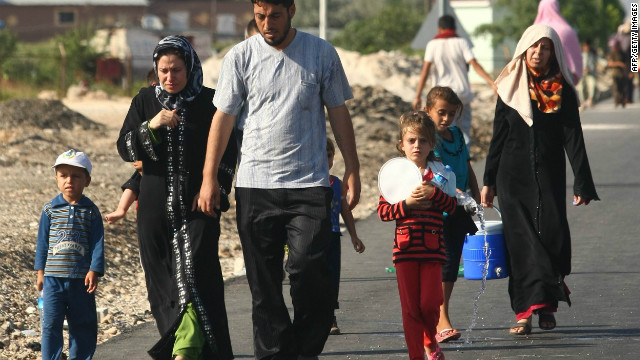
Ankara is struggling to accommodate the tide of Syrian refugees looking to enter Turkey.   As of this month, there were more than 100,000 Syrian refugees in the country, a number that Turkey has already declared as the “psychological limit” in terms of the number it can host. Ankara can also be expected to try to accommodate many refugees on the Syrian side of the border. Indeed, without apparent interference from the Syrian government, temporary zones are already forming like inkblots across the national boundary from Turkey into Syria.  But can Turkey cope?
The refugee influx poses potential security concerns for Turkey, not least because of the potential for armed Kurdistan Workers Party (PKK) members in Syria to use this as an opportunity to cross into Turkey. As a result, Ankara has already temporarily closed some of its border crossings and increased security controls for refugees fleeing across the border.  This has translated to increased waiting times for entry, which has in turn only added to the back-log of refugees on the Syrian side of the border.
As the Sunni Arab exodus from Syria continues, areas with favorable geography and nearby border crossings have been confronted with the greatest numbers of refugees, leading to the formation of what could be described as “inkblot” zones, where refugees on both sides of the border live under Turkish care.  The Syrian government has all but abandoned such areas.
Since August, Turkey’s official humanitarian relief agency, the Disaster and Emergency Management Directorate (AFAD), has been dispensing aid at key crossings, including to camps inside Syria.  Meanwhile, signaling a defensive posture over the “inkblots,” Turkish military forces equipped with anti-aircraft installations have been positioned within range of the camps.  According to some reports, helicopters used by forces loyal to Bashar al-Assad have periodically been chased from these areas by Turkish fighter jets.
But as they grow in size and number, these “inkblots” will further erode the integrity of the Turkish-Syrian border, a border that seems to be merging into the terrain itself, especially in areas where large Sunni Arab communities live on both sides of the border crossings.
These areas also have the potential to place genuine strains on ties between Ankara and Washington.  After all, there are already policy differences between the two countries on Syria: Ankara appears to want to move fast and potentially with force vis-à-vis Damascus, whereas Washington is exercising caution.  So far, Turkey has managed the relationship well, publicly at least. But last month, Turkish Prime Minister Recep Erdogan chided U.S. President Barack Obama for "lacking initiative" on Syria.
An expansion in the number of “inkblots” could put pressure on Ankara to press publicly for U.S. assistance against the al-Assad regime, including asking for U.S. backing to convert the refugee settlements into internationally sanctioned safe havens.
Ultimately, these settlements might best be seen as something of a Rorschach test of U.S.-Turkish, with Ankara viewing them as the stepping stone to the next stage of the push against al-Assad, and Washington seeing them as merely a temporary fix in the ongoing Syria crisis.

Post by:
Topics: Middle East • Syria • Turkey

Thursday, October 25, 2012

Storm on Saturn...[ 2974 ]

Image of the Storm on Saturn


NASA's Cassini spacecraft has tracked the aftermath of a rare massive storm on Saturn. Data reveal record-setting disturbances in the planet's upper atmosphere long after the visible signs of the storm abated, in addition to an indication the storm was more forceful than scientists previously thought.

These red, orange and green clouds (false color) in Saturn's northern hemisphere indicate the tail end of the massive 2010-2011 storm. Even after visible signs of the storm started to fade, infrared measurements continued to reveal powerful effects at work in Saturn's stratosphere.

The Cassini mission is part of NASA's long tradition of exploring our solar system, now being celebrated at the NASA History Symposium: Solar System @50.

Sunday, October 21, 2012

Lebanese politicians have accused Syria...[ 2973 ]

Syria denounced at Beirut funeral rally for slain official


A Sunni Muslim man hangs up a poster with an image of senior intelligence official Wissam al-Hassan, in the Tariq al-Jadideh district in Beirut October 20, 2012. REUTERS/Hussam Shebaro
BEIRUT | Sun Oct 21, 2012 7:45am EDT
- 
(Reuters) - Thousands of people gathered in central Beirut on Sunday for the funeral of an assassinated senior intelligence officer, accusing Syria of involvement in the killing and calling for Lebanese Prime Minister Najib Mikati to quit.
--
Heavily armed troops and police stood guard as people flocked to Martyrs' Square in central Beirut.
Many waved the sky-blue flag of the Sunni-based opposition Future Party. Others carried Lebanon's cedar tree national flag but Syrian rebel flags were also seen.
One banner read "Go, go Najib" echoing the slogans of the Arab Spring.
--
Brigadier General Wissam al-Hassan was killed by a powerful car bomb in Beirut's Ashrafiyeh district on Friday. A Sunni Muslim close to the Hariri political clan, he had helped uncover a bomb plot that led to the arrest and indictment in August of a pro-Damascus former Lebanese minister.
He also led an investigation that implicated Syria and its Lebanese ally Hezbollah in the assassination of former prime minister Rafik al-Hariri in 2005.
--
Lebanese politicians have accused Syria's leadership of having a role in Hassan's killing, which deepened fears the civil war there is spreading over its borders.
People in the crowd at Martyrs' Square echoed that view.
"We blame Bashar al-Assad, the president of Syria," said Assmaa Diab, 14, from the northern city of Tripoli, Hassan's hometown. She was in the square with her sister and father.
"He is responsible for everything - in the past, now, and if we don't stand up to him, the future," she said.
The prime minister was also a focus of their anger.
Diab and other protesters said they wanted him to step down, saying he was too close to Shi'ite Hezbollah, who are part of his government, and to Assad.
--
"We are here to tell Mikati we don't need him any more and to tell Hezbollah we don't want any more of their games," said Hamza Akhrass, a 22-year-old student who had come from south Lebanon for the funeral. "Mikati takes too much pressure for Syria."
--
One banner read "People want the overthrow of Najib".
Mikati said on Saturday he had offered to resign to make way for a government of national unity but he had accepted a request by President Michel Suleiman to stay in office to allow time for talks on a way out of the political crisis.
SECTARIAN TENSIONS
The 19-month-old uprising in Syria against Assad has exacerbated deep-seated sectarian tensions in Lebanon, which is still scarred from its 1975-90 civil war.
Sunni-led rebels in Syria are fighting to overthrow Assad, who is from the Alawite minority, which has its roots in Shi'ite Islam. Lebanon's religious communities are divided between those that support Assad and those that back the rebels.
Mikati sought in vain to insulate the country from turmoil in its larger neighbor, which has long played a role in Lebanese politics.
--
Sunday's funeral march set off from Hassan's Internal Security Force headquarters in Ashrafiyeh and will pass the site of Friday's bombing before reaching Martyrs' Square where he will be buried alongside slain prime minister Hariri.
Mikati himself said he suspected Hassan's assassination was linked to his role in uncovering Syrian involvement in the August bomb plot.
--
Samir Geagea, a Christian political leader and critic of Assad, demanded that Lebanon suspend all security and military agreements with Damascus and expel the Syrian ambassador.
--
In Paris, French Foreign Minister Laurent Fabius also pointed to a Damascus connection. "We don't yet know exactly who is behind this but everything indicates that this is an extension of the Syrian tragedy," he told French television.
"I think this is a part of what is happening in Syria and shows again how the departure of Bashar al-Assad is urgent."
Hassan's killing has already provoked unrest in Lebanon.
In the streets of Beirut and other cities on Saturday, gunmen and demonstrators blocked roads with burning tires.
In the northern city of Tripoli, four people were wounded on Saturday by sniper fire on Jebel Mohsen, a neighborhood which is home to members of the Alawite faith. A pro-Hezbollah religious figure was killed in clashes in Tripoli on Friday, residents said.
Soldiers opened fire on a group who took over a road in the Bekaa Valley, wounding two people.
--
"The situation is fragile. I don't know if this is the first in a series of attacks - history would suggest it is," a Western diplomat said.
"Of all the people to go for, Hassan was the most dangerous target in terms of hitting Lebanon's stability."
(Additional reporting by Dominic Evans; Editing by Alison Williams)

Saturday, October 20, 2012

Sea Ice ...[ 2972 ]

Image of the Sea Ice Off Eastern Greenland

Friday, October 19, 2012

Merkel says no back-dated bank recapitalisation..[ 2971 ]

Merkel says no back-dated bank recapitalisation via ESM possible


BRUSSELS | Fri Oct 19, 2012 7:20am EDT
 
Oct 19 (Reuters) - German Chancellor Angela Merkel said on Friday banks could not be retrospectively recapitalised via the euro zone's permanent bailout fund once a pan-European bank watchdog in place.
-
"There will not be any back-dated direct recapitalistion. If recapitalisation is possible, it will only be possible for the future so I think that when the banking supervisor is in place we won't have any more problems with the Spanish banks, at least I hope not," she said at a news conference on the second day of summit of EU leaders in Brussels.
-
Merkel said banks could also only be directly recapitalised via the European Stability Mechanism (ESM) once a fund which banks pay into had been set up.

The point when the European Central Bank effectively becomes the bloc's banking supervisor is important because it would open the way for the ESM to inject capital directly into troubled banks without adding to their host government's debts.
-
European Union leaders agreed earlier on Friday that a single supervisor would take responsibility for overseeing euro zone banks from next year.