The Hellenic Navy (HN) (Greek: Πολεμικό Ναυτικό, Polemikó Naftikó, abbreviated ΠΝ) is the naval force of Greece, part of the Greek Armed Forces. The modern Greek navy has its roots in the naval forces of various Aegean Islands, which fought in the Greek War of Independence. During the periods of monarchy (1833–1924 and 1936–1973) it was known as the Royal Navy (Βασιλικόν Ναυτικόν, Vasilikón Naftikón, abbreviated ΒΝ).The total displacement of all the navy's vessels is approximately 150,000 tons.The motto of the Hellenic Navy is "Μέγα το της Θαλάσσης Κράτος" from Thucydides' account of Pericles' oration on the eve of the Peloponnesian War. This has been roughly translated as "Great is the country that controls the sea". The Hellenic Navy's emblem consists of an anchor in front of a crossed Christian cross and trident, with the cross symbolizing Greek Orthodoxy, and the trident symbolizing Poseidon, the god of the sea in Greek mythology. Pericles' words are written across the top of the emblem. "The navy, as it represents a necessary weapon for Greece, should only be created for war and aim to victory."...............The Hellenic Merchant Marine refers to the Merchant Marine of Greece, engaged in commerce and transportation of goods and services universally. It consists of the merchant vessels owned by Greek civilians, flying either the Greek flag or a flag of convenience. Greece is a maritime nation by tradition, as shipping is arguably the oldest form of occupation of the Greeks and a key element of Greek economic activity since the ancient times. Nowadays, Greece has the largest merchant fleet in the world, which is the second largest contributor to the national economy after tourism and forms the backbone of world shipping. The Greek fleet flies a variety of flags, however some Greek shipowners gradually return to Greece following the changes to the legislative framework governing their operations and the improvement of infrastructure.Blogger Tips and Tricks
This is a bilingual blog in English and / or Greek and you can translate any post to any language by pressing on the appropriate flag....Note that there is provided below a scrolling text with the 30 recent posts...Αυτό είναι ένα δίγλωσσο blog στα Αγγλικά η/και στα Ελληνικά και μπορείτε να μεταφράσετε οποιοδήποτε ποστ σε οποιαδήποτε γλώσσα κάνοντας κλικ στη σχετική σημαία. Σημειωτέον ότι παρακάτω παρέχεται και ένα κινούμενο κείμενο με τα 30 πρόσφατα ποστς....This is a bilingual blog in English and / or Greek and you can translate any post to any language by pressing on the appropriate flag....Note that there is provided below a scrolling text with the 30 recent posts...Αυτό είναι ένα δίγλωσσο blog στα Αγγλικά η/και στα Ελληνικά και μπορείτε να μεταφράσετε οποιοδήποτε ποστ σε οποιαδήποτε γλώσσα κάνοντας κλικ στη σχετική σημαία. Σημειωτέον ότι παρακάτω παρέχεται και ένα κινούμενο κείμενο με τα 30 πρόσφατα ποστς.........

Sunday, February 19, 2012

Australia's darkest day...[ 2719 ]

Darwin bombing Australia's darkest day: PM


Xavier La Canna
AAP.,February 19, 2012 - 5:29PM
-
The bombing of Darwin by Japanese aircraft 70 years ago was Australia's darkest day, Prime Minister Julia Gillard says.
Speaking at the 70th anniversary of the attack, which killed at least 243 people and caused hundreds more to flee in panic, Ms Gillard said the events were unimaginable.
"Nineteen forty-two was the darkest year in Australia's history. And if that darkest year had a darkest day, it was February 19," she told the crowd of about 5000.
-
She said Australia's peacetime complacency was a potent setback during war and people were unprepared for the attack.
The Bombing of Darwin was in fact the battle for Australia.
"Our distance from the hatreds of old Europe was no longer a protection," the prime minister said.
-
About 90 veterans from the bombing were among the crowd gathered in the hot, humid conditions at Darwin's cenotaph to remember the events of 70 years ago.
Craftsman Keith Barton, aged 90, said the bombing raid was frightening.
"It was deafening and when the Neptuna blew up bits landed all over town," Mr Barton said.
-
Eighty-eight-year-old Ray Chin who was working in a general store when the raids began said at first there was no siren or alarm.
"They just kept on coming over the water and when they started dropping black objects I realised they were not our planes."
Mr Chin, whose school in China had also been bombed while he studied there in 1937, fled to Katherine after the Darwin raids and he was again caught in a Japanese attack on that city.
-
Opposition leader Tony Abbott said there were more aircraft used and more tonnage of bombs dropped on Darwin than on Pearl Harbour.
"The defences were inadequate, the warning was ignored, the surprise was complete, the confusion, total, at least initially," Mr Abbott said.
-
Governor-General Quentin Bryce told the crowd the bombing of Darwin fundamentally changed Australia by heralding an appreciation that its security rested on a military alliance with the United States.
She said the post-war immigration policies were also a result of the bombing, which highlighted that Australia needed a much bigger population to occupy the vast expanse of the continent.
-
Japanese journalist Makiko Yanada, from the Yomiuri Shimbun newspaper, travelled to Darwin for the event because she felt it was important her compatriots knew about their wartime past.
"In the history textbooks we are told we advanced to Papua New Guinea or the Solomon Islands," she said.
"I am sorry that the Japanese people are not so familiar that the Japanese military bombed here."
Last year the Australian parliament voted to make February 19 a national day of observance to remember the bombing of Darwin.
-
Brought to you by aap

Saturday, February 18, 2012

Fukushima victims' complains ...[ 2718 ]

Fukushima victims complain of stingy response

TEPCO employees apologize to people affected by the Fukushima nuclear disaster by getting down on their knees, in Toride, Ibaraki Prefecture, at an explanatory meeting about provisional compensation on April 27, 2011. (Mainichi)

TEPCO employees apologize to people affected by the Fukushima nuclear disaster by getting down on their knees, in Toride,  at an explanatory meeting about provisional compensation
-
(Mainichi Japan) February 18, 2012
-


I've just spent weeks looking into the issue of compensation for the Fukushima nuclear disaster and it is a very unhappy picture.
Eleven months since the destruction of their land, income and way of life in the crisis at the Fukushima No. 1 nuclear plant, many people have received about 1.6 million yen in total compensation.
-
From September, they had to wade through a 160-page manual to apply for compensation that demanded receipts (actual, not copied) for transportation and other fees incurred during the evacuation and bank or tax statements proving pre-disaster income levels.
-
Tokyo Electric Power Co. (TEPCO) admitted a month later they had received just 7,600 completed forms and was forced to simplify the manual and distribute a four-page explanatory guide.
About 114,000 people from Fukushima are entitled to apply -- people who were forced to abandon their farms, homes, schools and jobs between March-May 2011 and who now mostly live in temporary housing elsewhere.
-
Another 50,000-120,000, according to many observers, have moved voluntarily because of radiation fears, ignoring official claims that life inside or around Fukushima Prefecture is safe. They are so far not entitled to compensation.
Typically, mothers have taken their children out of the prefecture and started new lives as far away as Tokyo, Osaka or Kyushu, splitting up families, often in the teeth of protesting fathers and in-laws.
-
"My husband didn't agree to the move and tells us to come back home," explained Akemi Sato, a housewife from Fukushima City (about 60km from the nuclear plant) who now lives in Tokyo with her two children, aged 9 and 7.
-
"I have to pay my bills in Tokyo and travel to Fukushima to see my husband three or four times a month. It's very expensive and stressful but I didn't see any other choice."
The Dispute Reconciliation Committee for Nuclear Damage Compensation, the organization designed to establish guidelines -- and boundaries -- for compensation claims, has not stipulated compensation for loss of assets such as homes or farms, nor for people like Mrs. Sato who have left Fukushima voluntarily.
-
There is speculation that over half the population of Fukushima Prefecture (roughly 1 million people) may be offered 80,000 yen per person and children, 400,000 yen.
The compensation process is terribly complicated and no doubt arduous for TEPCO and the government too. But put yourself in the shoes of Mrs. Sato, or Fumitaka Naito.
Mr. Naito paid 9.8 million yen for a 6,800-tsubo (2.2 hectare) plot of land in the village of Iitate in 2009. His life is now in limbo because while his farm is too contaminated to work, he cannot move or buy another one.
-
Mr. Naito calculated the cost of his land, equipment and ruined produce and claimed 70 million yen. TEPCO eventually offered 150,000 yen. "I told them not to send it. I'm going to fight in the courts instead."
He won't be the last person to take that option. (By David McNeill)

Profile: David McNeill writes for The Independent and Irish Times newspapers and the weekly Chronicle of Higher Education. He has been in Japan since 2000 and previously spent two years here, from 1993-5 working on a doctoral thesis. He was raised in Ireland.

Greek rescue hopes rise...[ 2717 ]

Greek cabinet tackles austerity, rescue hopes rise

Youths take part in an anti-austerity rally in front of the parliament in Athens February 17, 2012. REUTERS-John Kolesidis
Policemen rush to detain a protester during an anti-austerity rally at central Syntagma square in Athens February 17, 2012.    REUTERS-John Kolesidis

ATHENS | Sat Feb 18, 2012 8:23am EST
(Reuters) - Greece's cabinet tackled on Saturday how to implement austerity demanded by the EU and IMF as a 130-billion-euro ($171-billion) rescue seemed within reach, while the euro zone considered modifying a deal with private creditors to help Athens reduce its huge debts.
-

After months of often acrimonious negotiations, Greek hopes were rising that euro zone finance ministers Monday will endorse the rescue which Athens needs to avoid bankruptcy next month when major debt repayments fall due.

A statement from the office of Prime Minister Lucas Papademos said the cabinet would discuss implementing the bailout package which demands pay, pension and job cuts on top measures that have already hit many Greeks' living standards.

The cabinet is due to approve measures that already provoked rioting on the streets of Athens last Sunday before they go into a supplementary budget due to be put to parliament next week.
-

"The Greek people have done everything they can and we are determined to make good on our commitments," Public Order Minister Christos Papoutsis told reporters as he arrived. Many EU officials remain deeply skeptical of Athens's will to reform.
-

Also on the agenda is the future of the old Athens airport, a prime seafront site that lies derelict more than a decade after the new airport opened, symbolizing the wasted opportunities which have helped to reduce Greece to its knees.
-
Friday German Chancellor Angela Merkel, Italian Prime Minister Mario Monti and Papademos all voiced optimism about a Greek accord during a three-way conference call, Monti's office said in a statement.
However, Jean-Claude Juncker, who will chair Monday's meeting of the Eurogroup in Brussels, made clear that urgent work was still needed to get a program to reduce Greece's crippling debts back on track.
-
^^^^^^^^^^^^^^^^^^^^^^^^^^^^^^^^^^^^^^^^^^^^^^^^^^^^^^^

Interactive timeline link.reuters.com/pys56s
^^^^^^^^^^^^^^^^^^^^^^^^^^^^^^^^^^^^^^^^^^^^^^^^^^^^^^^^^^
MISSING THE TARGET
At stake is a target of lowering the debt from the equivalent of 160 percent of annual Greek economic output now to a more manageable 120 percent by 2020.
"All the discussions I will have ... until Sunday night will try to move the figure nearer to the target," Juncker told reporters.
-
At the moment, EU and IMF officials believe that target - which assumes that Greece will run a budget surplus next year, excluding the massive cost of its debts - will be missed.
Under the main scenario of an analysis by the European Commission, the European Central Bank and the International Monetary Fund, Greek debt will fall to only 129 percent of gross domestic product in 2020, one official said.
-
The euro zone is therefore looking at modifying a deal negotiated over many months with private creditors under which they would accept a cut of around 70 percent in the real value of their Greek bondholdings.
-
Senior euro zone finance officials meet Sunday to discuss the analysis and find ways to bring the debt closer to the 120 percent target before the finance ministers gather Monday.
-
"If you do a number of things you can bring the 129 close to 120," one euro zone official familiar with the document said.
-
These might include changes to interest accrued on privately held bonds, but the EU and its national institutions might also play their part, the official said. Interest rates on EU loans to Greece could be cut, and those national central banks in the euro zone which hold Greek bonds might accept similar terms to the private creditors on some of their holdings.  

-
The national central banks own an estimated 12 billion euros of Greek debt. The European Central Bank has refused to take part in the complex deal for the private creditors - involving swapping old bonds for new ones with a lower face value, lower interest rates and longer maturities - and would need to approve the national central bank decision. Officials also are considering a cut in the cash "sweetener" which would be offered to the private creditors in return for accepting the cut in the value of their bond holdings  
-
ROCK-BOTTOM MORALE  

With Greek morale at rock bottom, the national mood darkened yet further after armed thieves looted a museum Friday in Olympia, birthplace of the Olympic Games. They stole bronze and pottery artifacts weeks after the National Gallery was burgled. A Greek newspaper suggested the state could no longer look after the nation's immense cultural heritage properly. "The Greek state has gone bankrupt, let's face it," the daily Kathimerini said. "If the state cannot guard the country's great cultural heritage for financial or other reasons it must find other ways to do it," the conservative daily said. "It could, for example, turn to large foundations and ask them to assume the cost of security at the country's important museums in the next two to three difficult years.
-
" Critics say years have been wasted arguing and dithering over major national decisions. This is symbolized by the old Athens airport, which is supposed to be rebuilt as a Monte Carlo-style development of housing, tourist facilities and a marina, but remains a wasteland. Athens opened a new airport in 2001, well in time for the 2004 Olympic games, but longstanding plans to privatize it have also yet to materialize.
-
(Additional reporting by Dina Kyriakidou, Angeliki Koutantou and Harry Papachristou and Jan Strupczweski in Brussels; Editing by Michael Roddy)

Germany, Who will it sell to now ?..[ 2717 ]

Europe is in dire need of lazy spendthrifts

Germany's economic success over the past decade is largely due to exporting more than it imports. Who will it sell to now?
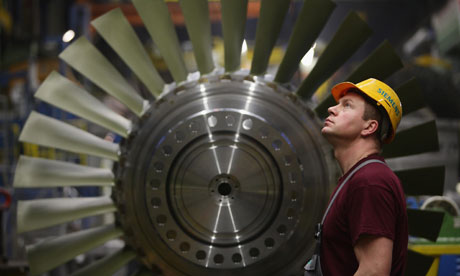
A factory in Germany 
-
Workshop of Europe ... a factory in Germany. Photograph: Sean Gallup/Getty Images
Greece's economic crisis is a gift from heaven for the German government. The country is the ideal conservative dystopia of an irresponsible government financing a supposedly overblown welfare state by ever increasing debt, where workers enter retirement in their mid-50s, the dead continue receiving pension payments and public employees earn bonuses for arriving punctually at work. 
-
Never mind that, exceptions aside, public expenditure as a proportion of GDP is lower in Greece than Germany and the average Greek works longer hours and retires only half a year earlier than the average German. That did not stop those stories from being widely reported by the German media. It strengthened the moral tale of the hard-working Germans being abused by lazy southerners. 
-
The tale is convenient because it diverts attention from Germany's responsibility for the eurozone's current economic woes.
The tale goes like this: while Greeks wasted their time on the beach drinking Ouzo, Germans implemented painful economic reforms. Indeed, in the 2000s Germany deregulated its labour markets, reduced real wages to increase competitiveness, shrunk the public sector, cut pension entitlements and implemented a debt break into the constitution. 
-
After almost a decade of dismal economic growth and heavy belt-tightening, Germany has negotiated the 2008 global economic crisis successfully almost without employment losses, has since grown strongly and now registers the lowest unemployment rate since 1991. If southerners would have just followed the German model, the whole crisis could have been avoided.
Actually, Germany's good performance in the 2008 global economic crisis and after is hardly due to belt-tightening but to the adoption of a large fiscal expansion package in the crisis and generous government subsidies for companies to safeguard employment. That such a pragmatic strategy could also help today's eurozone crisis countries has not even been considered by the government. Having supposedly had good experiences with austerity itself, Germans believe the same bitter medicine could lead even lazy Greeks to economic success – if only wholeheartedly applied.
-
But can it? Last week the Greek parliament passed its fifth austerity package in just two years. Greek austerity is especially harsh. Although Greece is in its fourth year of a severe recession with real output down by 12% since 2007, the fiscal deficit as a proportion of GDP has been reduced by seven percentage points, a historically almost-unique achievement. But those policies were self-defeating. The debt-to-GDP ratio has exploded, government bond yields have stayed sky-high and both measures of business and consumer confidence are in freefall. 
-
The unemployment rate now stands at 21%. Young people are especially hard hit: unemployment among those aged younger than 25, already high before the crisis, stood at 40% in 2011. Consequently, company bankruptcies, suicide rates and crime have risen.
Heavily influenced by the German finance ministry, the solution of the troika (the EU Commission, the IMF and the ECB) to austerity's failure is even more austerity. Together with the EU Commission and the ECB, German finance minister Wolfgang Schäuble still strongly believes in the confidence-creating power of fiscal austerity, although they have been proved wrong.
-
Those beliefs underlay all of the troika's growth forecasts upon which the goals for deficit reduction were based. Since there was no upswing in confidence, growth fell precipitously and the government systematically missed the agreed goals.
All this was predictable – and actually predicted. In a 2003 study that analysed 133 IMF austerity programmes, the IMF's independent evaluation office found exactly the same scheme of self-defeating austerity caused by the underestimation of its disastrous effects on economic growth.
-
Unimpressed by those facts, German policy-makers have begun blaming Greek ineptitude for the failure to consolidate the budget. This is why they have proposed a budget viceroy for Greece and an extra account for Greek tax incomes dedicated to service the public debt, far away from the government's reach. Because Germans believe their belt-tightening in the 2000s was such a success, its failure in other countries has to be due to those governments' moral flaws.
-
However, both the tale of the successful German reforms and their prescription to the rest of the eurozone are based on a fallacy: the fallacy that every country can export more than it imports. 
-
A closer look at Germany's economic experience for most of its eurozone membership reveals that only trade surpluses were keeping Germany from economic collapse. Half of Germany's dismal economic growth of just 1.7% on average between 1999 and 2007 – the second lowest in the eurozone – was driven by trade surpluses. Those are, by definition, the deficits of someone else.
-
Far from being a growth engine, the reforms of the 2000s depressed German internal demand and thus imports, much the same as they do in Greece nowadays. They also depressed German loan demand and squeezed bank profits. At the time, the southern economies were the perfect solution for Germany's self-inflicted economic problems. 
-
German banks could expand their business by lending them the money to purchase the goods that Germans could no longer afford themselves. Manufacturers and banks were happy. Germany's beggar-thy-neighbour policies only worked because others pursued the exact opposite policies.
-
This is why the eurozone-wide adoption of austerity cannot work. Greek demand for German goods is small, but Spanish, Italian, French, Portuguese and Irish imports amounts to a large share of German exports. Germany's flawed policies for the eurozone are bound to backfire. Europe is in dire need of new lazy spendthrifts. Unfortunately, today nobody is willing to play that part.

Suicide attack on U.S. Capitol..[ 2716 ]


Authorities: Suicide attack on U.S. Capitol foiled

From Carol Cratty, CNN
February 18, 2012 -- Updated 0130 GMT (0930 HKT)


Washington (CNN) -- A 29-year-old man from Morocco was arrested Friday and charged with attempting to bomb the U.S. Capitol building in a suicide attack, authorities said.
-
Suspect Amine El Khalifi made an initial appearance in court and, if convicted, faces a maximum penalty of life in prison, according to the Justice Department.
He allegedly went to a parking garage near the Capitol on Friday and received what he thought was a vest with explosives and a firearm, both of which had been rendered inoperable by law enforcement. He was arrested before leaving the garage.
-
"Today's case underscores the continuing threat we face from homegrown violent extremists," said Assistant Attorney General for National Security Lisa Monaco. "Thanks to a coordinated law enforcement effort, El Khalifi's alleged plot was thwarted before anyone was harmed."
The suspect was charged with attempting to use a weapon of mass destruction against government property. Authorities say the public was never in any danger.
 -
Read more ...