The Hellenic Navy (HN) (Greek: Πολεμικό Ναυτικό, Polemikó Naftikó, abbreviated ΠΝ) is the naval force of Greece, part of the Greek Armed Forces. The modern Greek navy has its roots in the naval forces of various Aegean Islands, which fought in the Greek War of Independence. During the periods of monarchy (1833–1924 and 1936–1973) it was known as the Royal Navy (Βασιλικόν Ναυτικόν, Vasilikón Naftikón, abbreviated ΒΝ).The total displacement of all the navy's vessels is approximately 150,000 tons.The motto of the Hellenic Navy is "Μέγα το της Θαλάσσης Κράτος" from Thucydides' account of Pericles' oration on the eve of the Peloponnesian War. This has been roughly translated as "Great is the country that controls the sea". The Hellenic Navy's emblem consists of an anchor in front of a crossed Christian cross and trident, with the cross symbolizing Greek Orthodoxy, and the trident symbolizing Poseidon, the god of the sea in Greek mythology. Pericles' words are written across the top of the emblem. "The navy, as it represents a necessary weapon for Greece, should only be created for war and aim to victory."...............The Hellenic Merchant Marine refers to the Merchant Marine of Greece, engaged in commerce and transportation of goods and services universally. It consists of the merchant vessels owned by Greek civilians, flying either the Greek flag or a flag of convenience. Greece is a maritime nation by tradition, as shipping is arguably the oldest form of occupation of the Greeks and a key element of Greek economic activity since the ancient times. Nowadays, Greece has the largest merchant fleet in the world, which is the second largest contributor to the national economy after tourism and forms the backbone of world shipping. The Greek fleet flies a variety of flags, however some Greek shipowners gradually return to Greece following the changes to the legislative framework governing their operations and the improvement of infrastructure.Blogger Tips and Tricks
This is a bilingual blog in English and / or Greek and you can translate any post to any language by pressing on the appropriate flag....Note that there is provided below a scrolling text with the 30 recent posts...Αυτό είναι ένα δίγλωσσο blog στα Αγγλικά η/και στα Ελληνικά και μπορείτε να μεταφράσετε οποιοδήποτε ποστ σε οποιαδήποτε γλώσσα κάνοντας κλικ στη σχετική σημαία. Σημειωτέον ότι παρακάτω παρέχεται και ένα κινούμενο κείμενο με τα 30 πρόσφατα ποστς....This is a bilingual blog in English and / or Greek and you can translate any post to any language by pressing on the appropriate flag....Note that there is provided below a scrolling text with the 30 recent posts...Αυτό είναι ένα δίγλωσσο blog στα Αγγλικά η/και στα Ελληνικά και μπορείτε να μεταφράσετε οποιοδήποτε ποστ σε οποιαδήποτε γλώσσα κάνοντας κλικ στη σχετική σημαία. Σημειωτέον ότι παρακάτω παρέχεται και ένα κινούμενο κείμενο με τα 30 πρόσφατα ποστς.........

Friday, July 22, 2011

Greece aid package agreed by eurozone...[ 2346 ]


Greece aid package agreed by eurozone


The latest Greek bail-out involves a 'calculated risk' by European leaders, says the BBC's Nigel Cassidy
Details of how Greece will restructure its massive debts have emerged as eurozone leaders agree a package they hope will help resolve the debt crisis.
Private lenders will be forced to contribute to the aid package which is designed to give Greece decades more to repay its debts.
It comes after leaders agreed to lend Greece a further 109bn euros ($155bn, £96.3bn).
Asian stock markets reacted quietly to the news, while the euro held gains.
The Nikkei rose 0.7% in morning trading, while the Hang Seng was up 1.7%. Meanwhile the euro stayed near a two-week high against the dollar.
It comes after European markets rallied strongly in anticipation of the deal on Thursday.
The share prices of banks seen as most exposed to distressed eurozone government debts rose by more than 5%, led by Barclays, which ended the day 7.8% higher.

Barclays

Last Updated at 21 Jul 2011, 15:30 GMT Barclays one month chart
price change %
239.85 p +
+17.25
+
+7.75
The latest Greek bail-out by the 17 eurozone governments and the International Monetary Fund is part of a comprehensive package to shore up the single currency unveiled on Thursday.
Debt relief The Institute of International Finance - a global trade body representing big banks and other major lenders - said the planned debt restructuring would target participation by 90% of Greece's private sector lenders.
French President Nicolas Sarkozy said private lenders will contribute a total of 135bn euros of financing to Greece.
The plan is expected to provide some 50bn euros of debt relief to Greece.
The debt swaps - which will be offered by the European Financial Stability Facility (EFSF), the eurozone's bail-out fund - mimic the "Brady bond" debt exchanges provided to insolvent governments in Latin America, Eastern Europe and Africa since the 1980s.
Three of the four options offered to lenders to swap or relend existing debts would extend Greece's repayment terms by 30 years, while the fourth would do so by 15 years.
They all offer a much lower interest rate than Greece's current 15%-25% cost of borrowing in financial markets.
Two of the options would also involve "haircuts" - reducing the principal amount of debt Greece has to repay.
The terms of the deal imply a loss to Greece's lenders equivalent to 21% of the market value of their debts, said the IIF.
First default The restructuring is widely expected to be declared by credit rating agencies to be a default by Greece on its debts - something European leaders have been at pains to avert until now.
Herman Van Rompuy: "This situation was... threatening the stability of the eurozone"
The ECB and France had been particularly opposed to a default, but it was ultimately insisted on by Germany.
It would make Greece the first ever EU country to default, and could have a number of serious repercussions:
  • banks would be forced overnight to recognise in their financial accounts billions of euros in losses on Greek debts they own
  • these losses could in turn leave banks short of capital - making it difficult for them to lend - and could leave the Greek banks insolvent
  • Greek banks would also be unable to use their government's debts as security to borrow cash from the ECB
  • the ECB itself stands to make major losses on Greek debts it has bought or accepted as collateral from the Greek banks
  • separately, the debt restructuring could also trigger payouts on billions of dollars of credit derivative contracts, used by financial markets to hedge against or speculate on a Greek default
The Greek bail-out package will be used to soften the blow to the Greek banks, with 20bn euros being used to recapitalise them, and 35bn euros to facilitate their continued borrowing from the ECB.
Irish interest rates The biggest fear of European leaders is that imposing losses on Greece's lenders could lead to contagion - a sharp increase in the rate at which markets are willing to lend to other eurozone borrowers, in particular Italy and Spain.

Debt to GDP ratios

  • Greece 142.8%
  • Italy 119%
  • Belgium 96.8%
  • Ireland 96.2%
  • Portugal 93%
  • Germany 83.2%
  • France 81.7%
  • Spain 60.1%
Source: Eurostat. Government debt expressed as a percentage of economic output.
"We would like to make it clear that Greece requires an exceptional and unique solution," the eurozone leaders said in a statement following their meeting.
Despite their fears, markets rallied as details of the new bail-out emerged, with the cost of borrowing for all of Europe's heavily-indebted borrowers falling.
However, the borrowing costs of Portugal and the Republic of Ireland still remain at levels that suggest markets think they are likely to default in the next five years.
French president Nicolas Sarkozy said on Thursday there will be no imposition of losses on private sector lenders to the Irish Republic or Portugal.
Thursday's announcement should make life easier for both countries, with the repayment dates of their rescue loans being doubled to 15 years.
It also included a 2% reduction in the Irish Republic's interest payments, something that the Republic's Prime Minister, Enda Kenny said would save it a "substantial" 600-800m euros a year.
'Marshall plan' Among the other changes announced on Thursday were plans to ultimately turn the Eurozone's bail-out fund into a European equivalent of the IMF.
The EFSF was granted new powers to buy up bonds - necessary for it to carry out the Greek debt restructuring - and to make credit available to countries such as Spain and Italy that are not at immediate risk of insolvency.
Greece's bail-out will be complemented by what was billed as a "Marshall plan" to boost the economy of the recession-mired country.
EU development funds and loans from the European Investment Bank would be used to finance Greek infrastructure and development projects.
The move responds to criticisms from some economists that the eurozone's previous approach of insisting that Greece implement deeper and deeper budget cuts was killing the Greek economy, and therefore self-defeating.
European Commission President Jose Manuel Barroso also indicated plans to rein in the power of the credit rating agencies.
"We... endorsed the plan of reducing overreliance on external credit ratings," he said, adding that policymakers would come forward in the autumn "with further proposals".
Countries most exposed to Greek debt

Thursday, July 21, 2011

Spain: jellyfish along the coast ..[2345 ]

A stinging attack at the spainish coast.


a bank of jellyfish

Thursday, July 21, 2011


Not on the mountains in the Tour de France this time but on the local beaches. 
-

Yesterday, a bank of jellyfish along the Orihuela coast forced the Red Cross to close six of the beaches to bathers. After treating 90 bathers: 18 at Punta Prima, 15 at La Mosca, 12 at Playa Flamenca, 9 at Cala Cerrada, 24 at La Zenia and 12 at Cala Capitan in the space of 40 minutes, they decided enough was enough and raised the red flags to warn bathers not to go into the sea. None of the injuries were serious. 
-

Today, they will inspect the beach to see if the jellyfish are still close in to the shore. 

'Aircraft carrier Admiral Gorshkov shaping up for sea trials'...[ 2344 ]


'Aircraft carrier Admiral Gorshkov shaping up for sea trials'


New Kerala.com,
New Delhi, July 20 :

The aircraft carrier Admiral Gorshkov

The aircraft carrier Admiral Gorshkov that India bought in 2004 is shaping up well to begin its sea trials in a couple of months, Indian Navy chief Admiral Nirmal Verma has concluded after a six-day visit to Russia, where the warship is undergoing a refit.

   
Verma, who visited the aircraft carrier for which India has agreed to pay $2.34 billion, returned to India Monday, a navy press release issued Wednesday said.

He had gone to the Sevmash shipyard and taken a tour of Gorshkov, a 45,000 tonne warship of the Kiev class that has already been rechristened INS Vikramaditya by Indian Navy.

Apart from the shipyard, the navy chief also visited Vladivostok, Moscow, St. Petersburg and Kaliningrad.

"Admiral Verma took an extensive tour of Vikramaditya on his visit to the Sevmash Shipyard, where he observed that significant progress had been made and the ship was shaping up well for the preliminary sea trials," the release said.

During his visit to Kaliningrad, he reviewed the progress of the Talwar class follow-on frigates, under construction at the Yantar shipyard. He was reassured that the first ship INS Teg would commence trials shortly and be delivered in six to eight months, it said.

The admiral made a first hand assessment of all projects and held vital discussions with officials at the highest leadership levels of the Russian armed forces and defence industry.

"Reviewing ongoing projects, he observed that they were progressing satisfactorily and had reached critical stages of maturity. He also expressed satisfaction with the quality of construction and repairs," the release added.

In his discussions with the Russian Navy commander-in-chief on operational exchanges between the two navies, they agreed that the Indra naval war exercises series formed an important aspect of their bilateral relationship, and would need to be continued and extended in scope and participation.

They also discussed possible avenues of co-operation including anti-piracy operations, the release said.
--IANS

Eurozone Economical Summit ..[ 2343 ]

Eurozone leaders set for crunch debt summit

German Chancellor Angela Merkel 
Angela Merkel wants private investors to share taxpayers' burden if Greece restructures its debts
BBC., 21/7/11
Eurozone leaders are set to meet for a crunch summit to try to resolve the Greek debt crisis and prevent any further contagion to other so-called peripheral economies.
-
Policymakers will discuss a range of measures, including a new loan package to Greece and the role of private investors in any debt restructuring.
Reports suggest a new tax on banks will also be debated.
But German Chancellor Angela Merkel has cautioned against over optimism.
'Very serious' Greece received its first aid package in May last year, but the debt crisis continues to undermine confidence in global financial markets, with some commentators suggesting it threatens the future of the euro itself.
-
Politicians and investors are calling for decisive action to help bring the crisis to an end.
"Nobody should be under any illusion; the situation is very serious," European Commission President Jose Manuel Barroso said on Wednesday.
"It requires a response. Otherwise, the negative consequences will be felt in all corners of Europe and beyond."
The Governor of the Bank of England, Sir Mervyn King, has said that the crisis in the eurozone posed the most serious and immediate risk to the UK's financial system.
President Barack Obama has also weighed in, calling Mrs Merkel on Tuesday night to stress the importance of tackling the debt crisis in sustaining the global economic recovery.
The International Monetary Fund has also called on European leaders to take swift and decisive action.
Delaying such action further would be "very costly" for the world economy, it said.
Spending cuts However, there are divisions among policymakers about the best way to resolve the crisis.
There appears to be consensus on the need for a new loan agreement, analysts say, thought to be similar in size to the 110bn euro ($156bn; £97bn) package agreed last year.
-
However, there is also a growing consensus that this will merely act a sticking plaster, and that the fundamental problem of Greece's indebtedness needs to be addressed.
-
Athens has already implemented a raft of wide ranging austerity measures, including spending cuts and tax rises, and earlier this month agreed to further drastic action to cut its debt.
Bank tax But there is a growing sense that these will not be enough. The only way to resolve the problem is to restructure Greece's debts, many observers argue.
-
Germany has proposed allowing Athens more time to repay, effectively rolling over existing debts into new bonds.
It wants private investors, largely banks, to participate in this restructuring.
But the European Central Bank has strongly opposed this plan, arguing that such a rollover would constitute a default in the eyes of the international credit ratings agencies and, as such, would undermine investor confidence and the euro itself.
-
An alternative way get private investors to contribute to any aid package would be to introduce a new bank tax.
Reports suggest leaders will discuss precisely such a tax, even though this would prove hugely unpopular with the banks.

It is these divisions that explain Mrs Merkel's attempts to dampen expectations ahead of the summit.
The summit will take place in Brussels at 1300 local time (1100 GMT).

Atlantis flies into the rising Sun...[ 2342 ]

Sun Rising on the Final Shuttle Mission


July 21, 2011
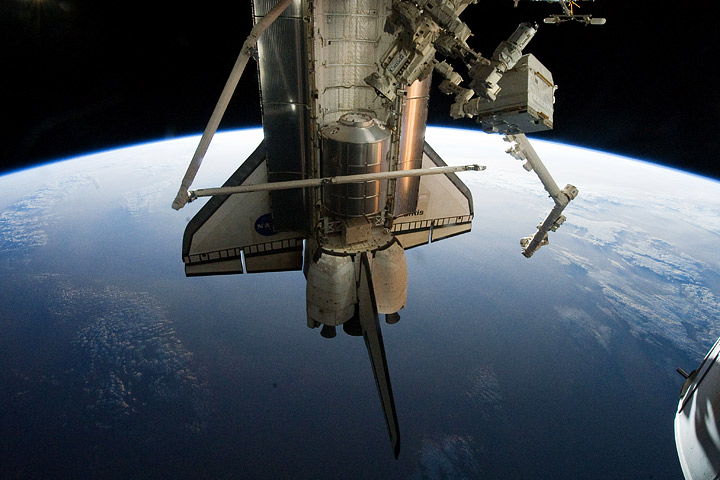
Silhouetted against the Earth, Atlantis flies into the rising Sun


Silhouetted against the Earth, Atlantis flies into the rising Sun in this photograph taken by an astronaut on the International Space Station on July 19, 2011. On July 20, the shuttle undocked from the station for the final time and began preparations to return home. During their 13 days in space, the shuttle astronauts supplied the International Space Station with a new logistics module, tested tools, technologies, and techniques to refuel satellites in space, and collected old equipment from the space station.
Atlantis is scheduled to land at Kennedy Space Center at 5:56 a.m. local time on July 21, concluding NASA’s 30-year space shuttle program. In addition to the science the shuttle and earlier programs enabled, human space flight has given us a unique view of planet Earth, which includes the now iconic spectacle of Earth rising over the Moon taken during the first lunar landing on July 20, 1969, and the photographs taken from Atlantis during its last full day in space on July 20, 2011. In fact every flight is a mission to planet Earth, as described in the Earth Observatory’s tribute to the shuttle program.
Observing Earth from space is one of the NASA’s longest-standing science experiments. Astronauts have used handheld cameras to photograph the Earth since the Mercury missions in the early 1960s, taking more than 800,000 photographs of Earth. Half of that total has come from the 135 flights of the Space Shuttle program.
Astronauts are like tourists going to an exotic place, and we know they are going to take photos,” said Kam Lulla. “Early in the space program, NASA decided that if they were going to do this anyway, let’s get some science content out of it.” That was a wise decision.
Astronauts are still being trained for the view from space. The Space Shuttle program is ending, but the International Space Station offers its own vantage point of the planet—and astronauts will still be heading there for another decade.
Astronaut photograph ISS028-E-017845 was acquired on July 19, 2011, and is provided by the ISS Crew Earth Observations experiment and Image Science & Analysis Laboratory, Johnson Space Center. The image was taken by the Expedition 28 crew. The image has been cropped and enhanced to improve contrast. The animation has been motion-stabilized. The International Space Station Program supports the laboratory as part of the ISS National Lab to help astronauts take pictures of Earth that will be of the greatest value to scientists and the public, and to make those images freely available on the Internet. Additional images taken by astronauts and cosmonauts can be viewed at the NASA/JSC Gateway to Astronaut Photography of Earth. Caption by Holli Riebeek.
Instrument: 
ISS - Digital Camera