The Hellenic Navy (HN) (Greek: Πολεμικό Ναυτικό, Polemikó Naftikó, abbreviated ΠΝ) is the naval force of Greece, part of the Greek Armed Forces. The modern Greek navy has its roots in the naval forces of various Aegean Islands, which fought in the Greek War of Independence. During the periods of monarchy (1833–1924 and 1936–1973) it was known as the Royal Navy (Βασιλικόν Ναυτικόν, Vasilikón Naftikón, abbreviated ΒΝ).The total displacement of all the navy's vessels is approximately 150,000 tons.The motto of the Hellenic Navy is "Μέγα το της Θαλάσσης Κράτος" from Thucydides' account of Pericles' oration on the eve of the Peloponnesian War. This has been roughly translated as "Great is the country that controls the sea". The Hellenic Navy's emblem consists of an anchor in front of a crossed Christian cross and trident, with the cross symbolizing Greek Orthodoxy, and the trident symbolizing Poseidon, the god of the sea in Greek mythology. Pericles' words are written across the top of the emblem. "The navy, as it represents a necessary weapon for Greece, should only be created for war and aim to victory."...............The Hellenic Merchant Marine refers to the Merchant Marine of Greece, engaged in commerce and transportation of goods and services universally. It consists of the merchant vessels owned by Greek civilians, flying either the Greek flag or a flag of convenience. Greece is a maritime nation by tradition, as shipping is arguably the oldest form of occupation of the Greeks and a key element of Greek economic activity since the ancient times. Nowadays, Greece has the largest merchant fleet in the world, which is the second largest contributor to the national economy after tourism and forms the backbone of world shipping. The Greek fleet flies a variety of flags, however some Greek shipowners gradually return to Greece following the changes to the legislative framework governing their operations and the improvement of infrastructure.Blogger Tips and Tricks
This is a bilingual blog in English and / or Greek and you can translate any post to any language by pressing on the appropriate flag....Note that there is provided below a scrolling text with the 30 recent posts...Αυτό είναι ένα δίγλωσσο blog στα Αγγλικά η/και στα Ελληνικά και μπορείτε να μεταφράσετε οποιοδήποτε ποστ σε οποιαδήποτε γλώσσα κάνοντας κλικ στη σχετική σημαία. Σημειωτέον ότι παρακάτω παρέχεται και ένα κινούμενο κείμενο με τα 30 πρόσφατα ποστς....This is a bilingual blog in English and / or Greek and you can translate any post to any language by pressing on the appropriate flag....Note that there is provided below a scrolling text with the 30 recent posts...Αυτό είναι ένα δίγλωσσο blog στα Αγγλικά η/και στα Ελληνικά και μπορείτε να μεταφράσετε οποιοδήποτε ποστ σε οποιαδήποτε γλώσσα κάνοντας κλικ στη σχετική σημαία. Σημειωτέον ότι παρακάτω παρέχεται και ένα κινούμενο κείμενο με τα 30 πρόσφατα ποστς.........

Sunday, February 6, 2011

Japan : the volcanic activity of Shinmoe?..[2077 ]

News Navigator: How dangerous is the volcanic activity of Mount Shinmoe?

Mount Shinmoedake shoots up a column of volcanic ash on Feb. 1. (Mainichi)
Mount Shinmoedake 
 

(Mainichi Japan) February 5, 2011
Mount Shinmoe, a 1,421-meter volcano in the Kirishima range, continues to erupt and make the news. The Mainichi answers questions readers may have about the volcano, known in Japanese as Shinmoedake.
.
Question: What kind of volcano is Mount Shinmoe?
Answer: It is one of the most active of the nearly 20 volcanoes located in the Kirishima mountain range, which runs along the border of Kagoshima and Miyazaki prefectures. As recently as the summer of 2008, there was a small eruption at the volcano. It also appeared in a "James Bond" film, leading to headlines in overseas media like "Japan's 'James Bond' volcano erupts again."
.
Q: How do eruptions occur?

A: Magma, or molten rock, rises from deep within the earth, temporarily accumulates in a "magma chamber" located from a few to around 10 kilometers beneath the earth's surface, and when that chamber is full, the magma surges out.
Even if the magma does not come all the way to the top, its heat can boil underground water and create steam, the mounting pressure of which can lead to an explosion of steam out of the volcano.
.
Q: Does the current eruption look like it will continue for some time?
A: To answer that question, experts are looking at a past eruption of Mount Shinmoe: the Kyoho eruption, which started in 1716 and continued for a year and a half. At that time, heavy volcanic activity -- like that which started on Jan. 26 -- continued for three months. The volcano was then quiet for seven months, but after that it suddenly had a huge eruption. A pyroclastic flow -- a destructive mixture of ash, rock and volcanic gas that rapidly flows down a volcano -- destroyed homes and took lives.
Hints to whether the eruption this time will be long-lasting and whether it will develop into a large eruption like the Kyoho eruption can be found by examining the underground magma.
.
Q: How can you observe magma that is underground?
A; Researchers can't observe the magma directly, so they make inferences. For example, when magma rises, the volcano bulges very slightly, just enough to accommodate the volume of magma, and the slope of the volcano's side changes. Using tools such as global positioning systems, these changes can be observed down to the centimeter. Earthquakes caused by movements in underground magma or gas are another clue used by experts. Taking all of these factors into account, the Japan Meteorological Agency judges the danger of a volcano. It appears that a considerable amount of the magma in Mount Shinmoe's chamber may have been spent in the eruptions since Jan. 26.
.
Q: Does that mean the eruptions will end soon?
A: We hope so, but so far only around a tenth of the magma that was seen in the Kyoho eruption has been released. It's highly possible that new magma will enter the magma chamber. Furthermore, within the 700-meter-wide bowl-shaped crater of the volcano, lava has formed a large mound, acting as a lid on the magma below. Experts caution that if pressure from the magma passage below becomes too great, a large eruption could occur, taking the "lid" with it.
---
(Answers by Kosuke Hatta, Science & Environment News Department)

Saturday, February 5, 2011

Egyptian army in Tahrir Square.[ 2076 ]

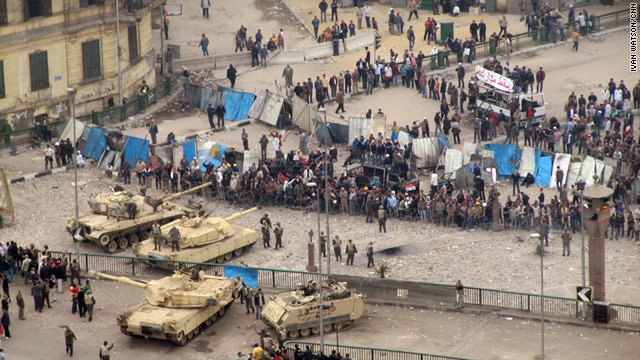
Egyptian army, demonstrators stand off in Tahrir Square

By Ivan Watson, CNN
February 5, 2011 12:14 p.m. EST
Protesters line up against Egyptian military tanks at an entrance to Tahrir Square on Saturday.

Cairo, Egypt (CNN) -- Opposition activists formed a human chain outside one of the entrances to Tahrir Square on Saturday afternoon to prevent two Egyptian military tanks from crossing through barricades into what has effectively become an anti-Mubarak enclave in the heart of the Egyptian capital.
An eyewitness said scuffles broke out after an army general asked demonstrators to take down their makeshift barricades of corrugated steel and debris, which were built up during 48 hours of bloody fighting with regime supporters next to Cairo's landmark Egyptian Museum.
.
"This general went through the barricades, they [the soldiers] knocked down some barricades on the way to the museum, which caused some panic and scuffling," said photographer Ron Haviv. "When he did it all chaos broke loose."
Haviv said that initial tension was defused after Gen. Hassan Al Roweni began negotiating with medics who have established a first aid station for wounded combatants just behind the first line of barriers.
"He is still talking to doctors at the clinic," Haviv said. "He is asking them to remove the clinic."
Later, Roweni made a tour of Tahrir.
Military guards in red berets struggled to hold back the enthusiastic crowd as many Egyptians tried to embrace and kiss the general amid chants of "The military and the people are one hand."
.
Over the past week, Tahrir Square has been transformed from a bustling urban center into a fortified campground inhabited by thousands of well-organized anti-Mubarak demonstrators. It includes sidewalk first aid clinics and stations for charging cell phones, and the protesters respond to threats by blowing whistles and clanging metal rods. The alarm prompts scores of men to race to the entrances to the square, where rocks for stone-throwing are stockpiled in preparation for possible battles.
.
Eyewitnesses said Roweni's visit appeared aimed at trying to persuade demonstrators to reopen the square to ordinary traffic.
The officer took to the stage erected at the north end of the square for several minutes and made an unsuccessful attempt to appeal to the demonstrators.
.
"You can all express your views and opinions freely, but I ask you to put the security of Egypt first," Roweni announced through a loudspeaker system.
"This is directed to the youth of January 25th," he added, referring to the date when protests first erupted, throwing Egypt into what many observers now call a political revolution.
"There are many people who are manipulating you," Roweni said.
The crowd chanted a simple answer: "No, no, no."
The general concluded his short statement by saying, "I don't understand what it is you want."
The crowd roared back a chant that has been repeated for days across the open expanses of Tahrir Square: "Leave, leave, leave. He leaves, we leave."
.
This call for Egyptian President Hosni Mubarak to resign is the demand that unites the grass-roots movement in Tahrir.
After hearing the answer from the crowd, Roweni left the stage and the square without saying another word.
From CNN's Ivan Watson

Friday, February 4, 2011

Egyptians insist for change..[ 2075 ]


'Day of departure' rally in Egypt,,,?


Click to play
Ian Pannell spent the day with the crowds in Tahrir Square

Huge crowds are occupying the main square in the Egyptian capital, Cairo, to reinforce their demand for the resignation of President Hosni Mubarak.
The tens of thousands of protesters attending the "day of departure" rally in Tahrir Square have been waving flags and chanting "Leave! Leave! Leave!" 

Soldiers have been guarding the area to limit disruption by Mubarak supporters.
Mr Mubarak has said he is "fed up" with being in power, but that he is does not want to resign as it will cause chaos.
He told ABC News that the banned Islamist opposition group, the Muslim Brotherhood, would fill a power vacuum left by his absence.

He also denied that his administration was behind the violence of the last two days, and that his son Gamal intended to run for president.

Daily cost of Egypt crisis..[ 2074 ]


Egypt crisis 'costing economy $310m a day'

Rioters in Suez  
Credit Agricole has revised down its estimate for Egypt's economic growth this year


Egypt's uprising is costing the country at least $310m (£192m) a day, according to analysis from Credit Agricole bank.
Economists at the bank have also revised down their economic growth estimate for Egypt this year from 5.3% to 3.7%.
Banks and the stock exchange have been closed for days, and many factories in the major cities have shut.
There have also been more food price rises, one reason tens of thousands of protesters were already on the streets.
Egypt is still in the middle of its peak tourist season, which commonly lasts until May, but airlines and travellers are shunning the destination.
.
The Suez Canal trade link, which earned Egypt revenues of $4.77bn in 2010, remains open. But Denmark's AP Moller-Maersk, the world's largest shipping group, has closed some facilities, including a canal terminal.
The building materials group Lafarge has also closed plants.

NASA Image of the Day, Feb 4th ..[ 2073 ]

The latest NASA "Image of the Day" image.


The sun begins to rise in the east overlooking Launch Pad 39A at NASA's Kennedy Space Center in Florida, with newly arrived space shuttle Discovery. 
 .
Discovery arrived at the launch pad on Feb. 1, 2011 for its next launch opportunity to the International Space Station on the STS-133 mission, currently targeted for liftoff on Feb. 24.

Image credit: NASA/Jack Pfaller
Παρασκευή, 4 Φεβρουάριος 2011 7:00: