The Hellenic Navy (HN) (Greek: Πολεμικό Ναυτικό, Polemikó Naftikó, abbreviated ΠΝ) is the naval force of Greece, part of the Greek Armed Forces. The modern Greek navy has its roots in the naval forces of various Aegean Islands, which fought in the Greek War of Independence. During the periods of monarchy (1833–1924 and 1936–1973) it was known as the Royal Navy (Βασιλικόν Ναυτικόν, Vasilikón Naftikón, abbreviated ΒΝ).The total displacement of all the navy's vessels is approximately 150,000 tons.The motto of the Hellenic Navy is "Μέγα το της Θαλάσσης Κράτος" from Thucydides' account of Pericles' oration on the eve of the Peloponnesian War. This has been roughly translated as "Great is the country that controls the sea". The Hellenic Navy's emblem consists of an anchor in front of a crossed Christian cross and trident, with the cross symbolizing Greek Orthodoxy, and the trident symbolizing Poseidon, the god of the sea in Greek mythology. Pericles' words are written across the top of the emblem. "The navy, as it represents a necessary weapon for Greece, should only be created for war and aim to victory."...............The Hellenic Merchant Marine refers to the Merchant Marine of Greece, engaged in commerce and transportation of goods and services universally. It consists of the merchant vessels owned by Greek civilians, flying either the Greek flag or a flag of convenience. Greece is a maritime nation by tradition, as shipping is arguably the oldest form of occupation of the Greeks and a key element of Greek economic activity since the ancient times. Nowadays, Greece has the largest merchant fleet in the world, which is the second largest contributor to the national economy after tourism and forms the backbone of world shipping. The Greek fleet flies a variety of flags, however some Greek shipowners gradually return to Greece following the changes to the legislative framework governing their operations and the improvement of infrastructure.Blogger Tips and Tricks
This is a bilingual blog in English and / or Greek and you can translate any post to any language by pressing on the appropriate flag....Note that there is provided below a scrolling text with the 30 recent posts...Αυτό είναι ένα δίγλωσσο blog στα Αγγλικά η/και στα Ελληνικά και μπορείτε να μεταφράσετε οποιοδήποτε ποστ σε οποιαδήποτε γλώσσα κάνοντας κλικ στη σχετική σημαία. Σημειωτέον ότι παρακάτω παρέχεται και ένα κινούμενο κείμενο με τα 30 πρόσφατα ποστς....This is a bilingual blog in English and / or Greek and you can translate any post to any language by pressing on the appropriate flag....Note that there is provided below a scrolling text with the 30 recent posts...Αυτό είναι ένα δίγλωσσο blog στα Αγγλικά η/και στα Ελληνικά και μπορείτε να μεταφράσετε οποιοδήποτε ποστ σε οποιαδήποτε γλώσσα κάνοντας κλικ στη σχετική σημαία. Σημειωτέον ότι παρακάτω παρέχεται και ένα κινούμενο κείμενο με τα 30 πρόσφατα ποστς.........

Friday, March 5, 2010

The Greek government debt...[ 706 ]

CURRENCIES: Dollar Falls Vs. Euro On Greece Debt-cut Move

By Deborah Levine

The Wall Street Journal

The U.S. dollar dropped versus the euro on Wednesday and fell versus other major currencies as Greece outlined tax changes and budget cuts to help reduce its deficit.

Moody's Investor Service also gave a thumbs up to the plan, saying it lends credibility to the government's resolve to tackle its finances, and the International Monetary Fund called the fiscal package "very strong."

Relief about Greece's outlook, as well as reasonably good economic data out of the U.S., reduced the appeal of the greenback as a relatively safe investment.

"The latest data then fits nicely into the mold of recovering risk appetite," said Alan Ruskin, head of currency strategy at RBS.

The euro traded at $1.3731, the highest since Feb. 9 and up from $1.3608 in North American trade late Tuesday.

The dollar index (DXY), which measures the greenback against a trade-weighted basket of six major currencies, fell to 79.837, from 80.512 late Tuesday.

The dollar turned lower versus the Japanese currency, slipping 0.5% to buy 88.35 yen.

As for U.S. news, the Institute for Supply Management's index on the services sectors rose to 53 last month, higher than economists had expected.

Earlier in the session, the dollar shrugged of data from payroll-firm ADP that showed private employers cut 20,000 jobs in February, in line with expectations of some economists.

Economists surveyed by MarketWatch are expecting Friday's closely-watched Labor Department data to show that nonfarm payrolls dropped by 90,000 in February, though estimates are wide-ranging as analysts try to account for severe winter storms and temporary hiring by the Census Bureau.

Nonfarm payrolls in the order of down 100,000 would not be considered unreasonable for February," said Michael Woolfolk, senior currency strategist at BNY Mellon.

"However, what is taken away in February will be given back in March, with census hiring continuing to bolster results," he wrote in an email. "The real surprise will not be the triple-digit job loss on Friday, but rather further job losses in March and April."

Still to come is the Federal Reserve's Beige Book, a collection of economic anecdotes to be used by policy makers at the next meeting on March 16.

Greece's plan

The Greek government has said earlier that it would implement tax hikes and spending cuts worth a total of 4.8 billion euros ($6.5 billion), or around 2% of gross domestic product.

Fears of a Greek default and debt troubles in other southern European countries have roiled financial markets, boosted political tensions and even raised questions about the future of the 11-year old European single currency.

The yield premium demanded by investors to hold Greek government debt over German bonds continued to narrow, slipping to below 3 percentage points.

But doubts remain about Greece's ability to implement its planned budget cuts in the face of stiff opposition from the nation's unions, economists said.

"The proof of the pudding is in the eating; there is still a very long way to go before Greece's budget deficit is anyway near the 3% of GDP limit" set for the euro zone, said Jane Foley, research director at Forex.com. "Neither Greece nor the euro is out of the woods yet."

Short squeeze

Analysts also noted record short positions in the euro that have built up in recent weeks, meaning traders are heavily betting the shared currency will fall further.

"Traders should realize that buying euros or pounds to cover shorts is completely different from buying the currencies because of a fundamental change in the outlook for the European economy," said analysts at Global Forex Trading.

Also gaining on the dollar, the British pound (CUR_GBPUSD) bounced higher Wednesday after a February survey of purchasing managers in the U.K.'s dominant services sector indicated a stronger-than-expected acceleration in activity.

The pound, which had been the weakest of the world's major currencies in recent sessions, jumped 1% to buy $1.5111, up from $1.4959 late Tuesday.

  (END) Dow Jones Newswires
03-03-101201ET
Copyright (c) 2010 Dow Jones & Company, Inc.


Thursday, March 4, 2010

Freak waves smashed into a cruise ship [ 705 ]

Cruise Passenger: Rogue Waves Were 'Terrifying'

Thursday, March 04, 2010

BARCELONA, Spain ,March 4 ,2010 — Freak waves that smashed into a Mediterranean cruise ship flooded people's cabins, broke windows in a restaurant and terrified many travelers in an ordeal that claimed two lives, a passenger said Thursday.

Claude Cremex, 73, of Marseille, France said he was in his cabin resting because of the rough seas when the walls of water hit the Cypriot-owned Louis Majesty, which was carrying 1,350 passengers and 580 crewmembers off the coast of northeastern Spain.

The company Louis Cruise Lines said the ship was struck Wednesday by three "abnormally high" waves up to 26 feet high that broke glass windshields in the forward section.

Two people died and six were slightly hurt, according to the Greek coast guard and Spanish officials.

SLIDESHOW: Freak Wave Turns Deadly.

VIDEO: Rogue Wave Caught on Tape

Cremex said he did not see the waves himself but later viewed the damage.

"It was spectacular," he told The Associated Press as the ship sat docked at Barcelona's port with passengers sunning themselves on deck the day after the accident.

"A lot of water came in. Many cabins were flooded," said Cremex, who was traveling with his wife. "Many people were very frightened."

Louis Cruise Lines was not reachable early Thursday to say what the company will do now with the ship and passengers.

The ship's exact original itinerary was not entirely clear, either.

The Spanish news agency Europa Press said it had set sail from the southeastern Spanish port of Cartagena Wednesday, en route to Genoa, Italy. It had planned to stop in Barcelona but skipped it because of bad weather, but ultimately docked there after the waves hit, the agency said.

An official with the Spanish Interior Ministry office in Barcelona said the passengers disembarked Thursday morning so inspectors could examine the ship.

Louis Cruise Lines' Web site says the ship is 680 feet long, and features 10 passenger decks and 732 staterooms along with various bars, pools, restaurants and shops.

Attacks on oil tankers in the Strait of Malacca..[ 704 ]

Terror threat issued for tankers in Strait of Malacca


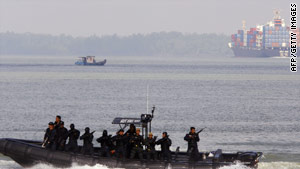
Malaysian authorities carry out an anti-piracy drill in the Strait of Malacca.

(CNN) -March 4, 2010 7:59 a.m. EST- A terrorist group might be planning attacks on oil tankers in the Strait of Malacca, one of the world's busiest shipping lanes, Singapore's navy warned Thursday.

"The terrorists' intent is probably to achieve widespread publicity and showcase that it remains a viable group," said an advisory issued by the Singapore Navy Information Fusion Centre (IFC).

"However, this information does not preclude possible attacks on other large vessels with dangerous cargo," the advisory said.

The IFC recommended that ships strengthen security measures.

It did not name any groups or indicate how the tip was obtained.

Located between Indonesia, Malaysia and Singapore, the Strait of Malacca links the Indian Ocean to the South China Sea and Pacific Ocean and is the shortest sea route between Persian Gulf oil suppliers and Asian markets, according to the U.S. government's Energy Information Administration.

The agency estimates that more than 15 million barrels of oil are transported through the strait every day.

At its narrowest point, the strait is only 1.7 miles wide, which creates a natural bottleneck and makes it vulnerable to terrorist attack.

The IFC warned tanker crews to be on the lookout for smaller vehicles -- including dinghies, sampans and speedboats -- which have been used to launch successful attacks on tankers in the past.

The latest NASA "Image of the Day"..[ 703 ]

NASA Image of the Day
The latest NASA "Image of the Day" image.

Iceberg Collision in Antarctica
An oblong iceberg roughly as big as Rhode Island called B-09B (center right in this image) collided with the edge of the Mertz Glacier in eastern Antarctica this month breaking away a new iceberg (top left) that is nearly as large at B-09B. This image from Feb. 20, 2010, is one of a series of images from NASA's Aqua satellite that showed the progression and aftermath of the collision. The floating ice tongue of the glacier is created as ice flows down from Antarctica and onto the water. Glacier tongues grow longer year by year until they eventually break off, calving a new iceberg. Image Credit: NASA


Πέμπτη, 4 Μάρτιος 2010 7:00:00 πμ

Louvre : Russian icons....[ 702 ]

Louvre sheds western light on Russian icons, past

Click and read Full story: WTOP

Russian icons, with their somber tones and gold-framed visages, perplex many western art viewers.

Detail of a funerary ensemble of icons of princess Sophie presented at the Louvre Museum in Paris, Wednesday March 3, 2010. The exhibition entitled: Sainte Russie, (Holy Russia), takes place from March 5 to May 24. The collection, focusing on icons and including masterpieces by Andrei Rublev, was pieced together from monasteries and museums around Russia.(AP Photo/Remy de la Mauviniere)