The Hellenic Navy (HN) (Greek: Πολεμικό Ναυτικό, Polemikó Naftikó, abbreviated ΠΝ) is the naval force of Greece, part of the Greek Armed Forces. The modern Greek navy has its roots in the naval forces of various Aegean Islands, which fought in the Greek War of Independence. During the periods of monarchy (1833–1924 and 1936–1973) it was known as the Royal Navy (Βασιλικόν Ναυτικόν, Vasilikón Naftikón, abbreviated ΒΝ).The total displacement of all the navy's vessels is approximately 150,000 tons.The motto of the Hellenic Navy is "Μέγα το της Θαλάσσης Κράτος" from Thucydides' account of Pericles' oration on the eve of the Peloponnesian War. This has been roughly translated as "Great is the country that controls the sea". The Hellenic Navy's emblem consists of an anchor in front of a crossed Christian cross and trident, with the cross symbolizing Greek Orthodoxy, and the trident symbolizing Poseidon, the god of the sea in Greek mythology. Pericles' words are written across the top of the emblem. "The navy, as it represents a necessary weapon for Greece, should only be created for war and aim to victory."...............The Hellenic Merchant Marine refers to the Merchant Marine of Greece, engaged in commerce and transportation of goods and services universally. It consists of the merchant vessels owned by Greek civilians, flying either the Greek flag or a flag of convenience. Greece is a maritime nation by tradition, as shipping is arguably the oldest form of occupation of the Greeks and a key element of Greek economic activity since the ancient times. Nowadays, Greece has the largest merchant fleet in the world, which is the second largest contributor to the national economy after tourism and forms the backbone of world shipping. The Greek fleet flies a variety of flags, however some Greek shipowners gradually return to Greece following the changes to the legislative framework governing their operations and the improvement of infrastructure.Blogger Tips and Tricks
This is a bilingual blog in English and / or Greek and you can translate any post to any language by pressing on the appropriate flag....Note that there is provided below a scrolling text with the 30 recent posts...Αυτό είναι ένα δίγλωσσο blog στα Αγγλικά η/και στα Ελληνικά και μπορείτε να μεταφράσετε οποιοδήποτε ποστ σε οποιαδήποτε γλώσσα κάνοντας κλικ στη σχετική σημαία. Σημειωτέον ότι παρακάτω παρέχεται και ένα κινούμενο κείμενο με τα 30 πρόσφατα ποστς....This is a bilingual blog in English and / or Greek and you can translate any post to any language by pressing on the appropriate flag....Note that there is provided below a scrolling text with the 30 recent posts...Αυτό είναι ένα δίγλωσσο blog στα Αγγλικά η/και στα Ελληνικά και μπορείτε να μεταφράσετε οποιοδήποτε ποστ σε οποιαδήποτε γλώσσα κάνοντας κλικ στη σχετική σημαία. Σημειωτέον ότι παρακάτω παρέχεται και ένα κινούμενο κείμενο με τα 30 πρόσφατα ποστς.........

Sunday, February 14, 2010

Russia's Trans-Siberian railway..[ 646 ]

Travel The World's Longest Railway - Online

train

Armchair explorers can now travel the length of Russia's Trans-Siberian railway - at the click of a mouse.Google's Virtual Train combines Google Earth with YouTube video footage to follow the full 5,600 mile journey.

Travellers can cross seven time zones, 12 regions and pass through 87 towns and cities between Moscow and Vladivostok.They can pass the 150 hour journey admiring the views and listening to audio books of Russian classics, such as Leo Tolstoy's War and Peace.

But if sitting through the entire trip is a bit much, users can navigate to specific areas to just catch the highlights.Multimedia stop-offs include a virtual stroll around Yekaterinburg, oil prospecting in Tyumen, reciting Buddhist mantras in Ulan-Ude or hearing the sound of the cannons on Russkiy Island.

Konstantin Kuzmin, marketing director for Google Russia, said: "We want to demonstrate how unusual and fascinating Russia really is and how much it can offer to a curious tourist.

"I know few people who have travelled along the Trans-Siberian railroad but I am sure that a lot of people feel enthusiastic about this trip."That's why we hope that this project will become the starting point not only for the virtual but also for the real trips across Russia."

Google's Virtual Train is at: http://www.google.ru/intl/ru/landing/transsib/en.html -- Courtesy of Ananova.Com

Afghanistan : Stiff resistance by the Taliban...[ 645 ]

Afghan assault finds resistance, explosives

By Atia Abawi, CNN
February 14, 2010 5:32 a.m. EST
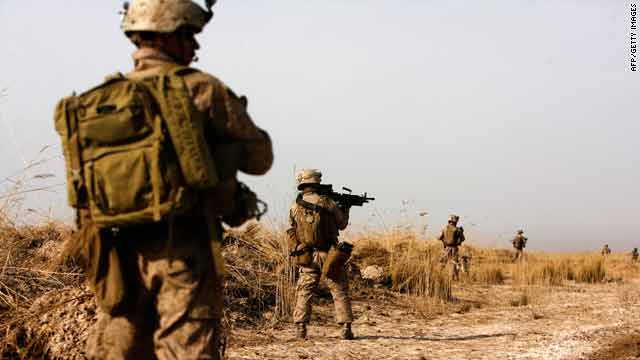
U.S. Marines patrol Sunday in the northeast of Marjah, Afghanistan, controlled for years by militants and drug traffickers.

Marjah, Afghanistan (CNN) -- The Taliban put up a stiff resistance Sunday, as a coalition assault against the militant group entered its second day in southern Afghanistan.

Officials said they did not know how many Taliban fighters remained in the Marjah region of Helmand province but think they may be in the hundreds -- some of whom are holed up in civilian compounds.

Dawoud Ahmadi, the provincial spokesman, said 27 Taliban fighters have been killed. Afghan and international forces also discovered 2,500 kilograms (5,500 lbs) of explosives.

The Taliban spokesman for the Marjah area claimed six Taliban casualties and said militants had killed 192 Afghan and coaltion troops.

In the past, the Taluban has often inflated casualty fighures.

"NATO forces have not captured any areas in Marjah from the Mujahadeen," said Qari Yousif Ahmadi, the Taliban spokesman.

Dubbed Operation Moshtarak, the offensive was launched early Saturday by an international coalition of 15,000 troops including Afghans, Americans, Britons, Canadians, Danes and Estonians.

Hours into the offensive, small-arms fire killed a U.S. Marine, and an explosion killed a British soldier, according to a U.S. military official.

"The Taliban appear confused and disoriented," said Maj. Gen. Gordon Messenger, a British military spokesman. However, he tempered his optimism with the reminder that the operation was not over.

Long a bastion of pro-Taliban sentiment and awash with the opium used to fund the insurgency, the Marjah region has been known as the heroin breadbasket of Afghanistan and a place where the Taliban have set up a shadow government.

U.S. Marines swept into the area from north and south, a U.S. Marine Corps official told CNN. They established a ring of security, preventing anyone from leaving or entering the area, the official said.

In an effort to establish a foothold, troops launched air assaults followed by a ground offensive in rough terrain, a region crisscrossed by canals.

The terrain is so tough that four lightly wounded troops whose injuries normally wouldn't need medical evacuation had to be airlifted for treatment.

NATO forces announced the offensive before it started so that citizens could get out of harm's way.

In the past few days, forces from Afghanistan, Britain and other nations dropped leaflets in and around Marjah warning residents not to allow the Taliban to enter their homes.

And meetings with local leaders, or shuras, have been held, as NATO forces tried to get Afghans on their side, the British military official told CNN.

Afghan President Hamid Karzai on Saturday urged Afghan and international troops to exercise "absolute caution" and ensure civilian safety.

However, there were at least two civilian injuries -- two teens whose house was taken over by the Taliban and used to attack U.S. troops, the Marines said.

More on Operation Moshtarak from Afghanistan Crossroads blog

Key challenges are determining the strength of the remaining insurgency and whether, after the offensive, Afghans will stick with their government.

Officials said they hope Afghan forces and the government will maintain control, win allegiance from the citizens and provide farmers with an alternative to the poppy crops that pervade the region.

Journalist Mati Matiullah and CNN's Nic Robertson, Frederik Pleitgen and Barbara Starr contributed to this report.

Privet comment , [ Unumbered ]

Αποκλεισμός η Κατακλυσμός Mr Panda?

* this message will be deleted in a few days....(7092)


Mr.Panda, Πάντα ...κουτόχορτο ?

BLOG 14-2-2010

Ο γνωστός k. "Panda "(κομιτατζής) που δήθεν ανεβάζει το κύρος του γνωστού Φόρουμ (X), στην ουσια το ..σαμποτάρει με την σωρεία από απρέπειες και ύβρεις που αραδιάζει, (ιδίως στο shout box), παρασύροντας και μια "χούφτα εθισμένα και άγουρα" στην ίδια συμπεριφορά.

Ισχυρίζεται ότι έχει βάλει στην λίστα του των αποκλεισμένων 2 χρήστες ("A" & "N"..ονομαστικά), αλλά ενώ αυτοί τον 'γράφουν κανονικά' αγνοώντας τον, ο ίδιος ασχολείται συνέχεια και καθημερινά με αυτούς σαν..εγκαταλειμμένη γκόμενα.....


Αυτό κ. "Panda"μας δεν είναι "αποκλεισμός".."κατακλυσμός" υποκρισίας είναι...

σταμάτα να μασάς κουτόχορτο...

.хорошо мимо

"Ν"

Saturday, February 13, 2010

Truce.. but "few skirmishes" occurred[ 644 ]

Yemeni cease-fire breached


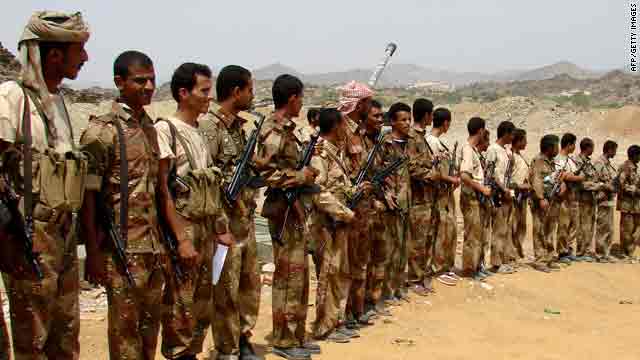
Yemeni troops gather to meet Defence Minister Mohammad Nasir Ahmad during his visit to the frontline in Saada on Friday.

(CNN) February 13, 2010 12:10 a.m. EST--

The same day a cease-fire agreement was to go into effect, a high-ranking Yemeni official accused rebels of trying to assassinate him.

Deputy Interior Minister Gen. Mohammed Bin Abdullah al-Qawsi told Almotamar, the newspaper of the ruling party, Friday that "his car came under intensive fire shots in an attempt to assassinate him." He added that he was in the northwestern city of Saada to inspect security forces and accused Houthi rebels of carrying out the attack, according to the state-run Saba News Agency.

Also in Saada Friday, troops and rebels exchanged fire, killing one and injuring others, Saba reported.

The rebels did not immediately respond to the reports, which followed the announcement of an end to a six-year battle between the government and Shiite Muslim Houthi rebels.

Despite the reports of violence, the truce deal was still intact, said a Yemeni government official who is not authorized to speak to the media.

A "few skirmishes" occurred, including an attack on a security official's motorcade, he said. He would not say whether that official was al-Qawsi. Such violence is common in the early stages of peace deals, he said.

"There are many reasons why this happened, and they were expected," the source said. "One, some of the militia fighters have not been informed yet that the truce was executed. Two, there were revenge killings -- some of the Houthi tribesmen carried out attacks against government forces. These could be considered tribal revenge killings."

Video: Yemen declares cease fire

The government agreed to end all military operations against the Houthis beginning midnight Friday, an apparent end to violence that even tumbled into Saudi Arabia. Houthi rebel leader Abdul Malik al-Houthi earlier signed off on the cease-fire and took to his Web site to order his followers to respect the agreement.

The cease-fire conditions include clearing mines, not interfering with elected local officials, releasing civilians and military personnel, abiding by Yemeni law, returning looted items, and ending attacks within the country's northern neighbor, Saudi Arabia.

The Yemeni government official said rebels were expected to free seven captured Saudi soldiers Saturday.

The revolt by the Houthis in northern Yemen began in 2004. The conflict is believed to be both separatist -- over who will have power in the area -- and sectarian -- whether Shiite Islam will dominate, even though the majority of Yemenis are Sunni. The rebels are supporters of slain Shiite cleric Hussein al-Houthi.

CNN's Mohammed Jamjoom contributed to this report.

Nato-led forces are making good progress [ 643 ]

Major offensive on Afghan Taliban

BBC 15:22 GMT, Saturday, 13 February 2010

map

Nato-led forces say they are making good progress hours after launching the biggest offensive in Afghanistan since the overthrow of the Taliban in 2001.

There were clashes as more than 15,000 US, UK and Afghan troops swept into the Helmand districts of Marjah and Nad Ali in a bid to secure government control.

An Afghan commander said 20 militants had been killed. Two Nato soldiers, one of which was British, have also died.

A Taliban commander reportedly said his men were retreating to spare civilians.

Operation Moshtarak - which means "together" in the local Dari language - is being led by 4,000 US Marines, supported by 4,000 British troops, with Canadians, Danes and Estonians.

'Heavily booby-trapped'

The BBC's Frank Gardner, with Nato forces at Kandahar airbase, says the test of the operation's success will not be on the battlefield.

AT THE SCENE
Ian Pannell
Ian Pannell
BBC News, Nad Ali
It's been a very successful day for British forces. They were able to move into several key villages and establish a foothold.

Broadly speaking, they met little resistance. There was sporadic gunfire. One RPG was fired over the location where we are based.

It's fair to say that the Taliban decided to move out of the district. Many civilians have also left, and the challenge in the coming days and weeks is to persuade them to come back, to establish meaningful security and then allow meaningful governance to take place.

What will make a difference is if there is meaningful security established and if the local people feel confident enough to place their faith in local security forces.

This is an operation that has only just begun and it will take weeks and months before we know how successful it has been.

It all depends on whether the coalition can hold the ground and bring lasting security and good governance to the population of central Helmand.

A spokesman for Nato's Isaf force confirmed to the BBC that two soldiers had been killed in Operation Moshtarak.

British forces said a soldier from the 1st Battalion Grenadier Guards had been killed by an explosion in Nad Ali.

A second Nato soldier was killed by small-arms fire.

Three US soldiers were also killed by an IED, Nato said, although it is not clear whether they were part of Operation Moshtarak.

Mohammad Zazai, commander of Afghan troops in the operation, said: "So far, we have killed 20 armed opposition fighters. Eleven others have been detained." The casualties and captures were in separate incidents.

Troops have been advancing carefully, picking their way through poppy fields, trying not to set off Taliban bombs.

A canal bridge into Marjah was so rigged with explosives that US Marines had to erect temporary crossings to reach the town, reports the Associated Press.

Helmand Governor Gulab Mangal told a news conference the Taliban had "heavily booby-trapped the area".

Marjah resident Abdul Wahaab told AFP by telephone as he and his family left the town: "We were sleeping when all of a sudden we heard this horrible noise - it was helicopters bringing in soldiers.

"As we were crossing the village we saw US and Afghan soldiers on the junctions. There were lots of them."

Afghan President Hamid Karzai, who approved Operation Moshtarak, warned troops to avoid civilian casualties, and called on Taliban fighters to lay down their weapons.

Nato says Marjah is home to the biggest community under insurgent control in the south.

'On the hop'

It was estimated there were between 400 and 1,000 militants based there before Operation Moshtarak was launched.


Marjah has also long been regarded as a linchpin of the lucrative network for smuggling opium - the raw ingredient used to make heroin - harvested from Helmand's poppy fields.

Nato Commander Maj Gen Nick Carter told the BBC that "it would appear that we've caught the insurgents on the hop".

Later at a Ministry of Defence briefing in London, Maj Gen Gordon Messenger said the UK force of more than 1,000 troops in the initial Marjah operation had secured its "key objectives" at the start of Operation Moshtarak.

He said: "There's no complacency - everyone understands this is the easy bit. The hard bit is what comes next in reassuring the public.

"This is all about winning the allegiance of the population. The allegiance is not won in a day, it must be won over time."

The offensive began with waves of helicopters ferrying US Marines into Marjah in the early hours of Saturday.

British troops then flew into Nad Ali district, to the north, followed by tanks and combat units.

Jets and helicopters fired missiles at Taliban positions.

The BBC's Ian Pannell in Nad Ali says the vast majority of villagers seem to have left the area to avoid getting caught in crossfire between the Taliban and Nato troops.

Mullah Mohammed - a Taliban commander in Marjah - told ABC News that his men were pulling back to spare any civilian casualties.

"We found civilians in massive danger so we decided to go backward just to save villagers' lives," he said. His claim cannot be verified.

Nato had distributed leaflets in the Marjah area warning of the planned offensive in a bid to limit civilian casualties.

It is the first major offensive since US President Barack Obama ordered a "surge" of 30,000 extra troops to Afghanistan in December.

More than 1,900 Afghan police will provide support after the initial military operations end, and a large team of Afghan administrators has been assembled.

The operation is part of an effort to secure a 320-km (200-mile) horseshoe-shaped string of towns that runs along the Helmand River, through Kandahar and on to the Pakistani border.

The area holds 85% of the population of Kandahar and Helmand.