The Hellenic Navy (HN) (Greek: Πολεμικό Ναυτικό, Polemikó Naftikó, abbreviated ΠΝ) is the naval force of Greece, part of the Greek Armed Forces. The modern Greek navy has its roots in the naval forces of various Aegean Islands, which fought in the Greek War of Independence. During the periods of monarchy (1833–1924 and 1936–1973) it was known as the Royal Navy (Βασιλικόν Ναυτικόν, Vasilikón Naftikón, abbreviated ΒΝ).The total displacement of all the navy's vessels is approximately 150,000 tons.The motto of the Hellenic Navy is "Μέγα το της Θαλάσσης Κράτος" from Thucydides' account of Pericles' oration on the eve of the Peloponnesian War. This has been roughly translated as "Great is the country that controls the sea". The Hellenic Navy's emblem consists of an anchor in front of a crossed Christian cross and trident, with the cross symbolizing Greek Orthodoxy, and the trident symbolizing Poseidon, the god of the sea in Greek mythology. Pericles' words are written across the top of the emblem. "The navy, as it represents a necessary weapon for Greece, should only be created for war and aim to victory."...............The Hellenic Merchant Marine refers to the Merchant Marine of Greece, engaged in commerce and transportation of goods and services universally. It consists of the merchant vessels owned by Greek civilians, flying either the Greek flag or a flag of convenience. Greece is a maritime nation by tradition, as shipping is arguably the oldest form of occupation of the Greeks and a key element of Greek economic activity since the ancient times. Nowadays, Greece has the largest merchant fleet in the world, which is the second largest contributor to the national economy after tourism and forms the backbone of world shipping. The Greek fleet flies a variety of flags, however some Greek shipowners gradually return to Greece following the changes to the legislative framework governing their operations and the improvement of infrastructure.Blogger Tips and Tricks
This is a bilingual blog in English and / or Greek and you can translate any post to any language by pressing on the appropriate flag....Note that there is provided below a scrolling text with the 30 recent posts...Αυτό είναι ένα δίγλωσσο blog στα Αγγλικά η/και στα Ελληνικά και μπορείτε να μεταφράσετε οποιοδήποτε ποστ σε οποιαδήποτε γλώσσα κάνοντας κλικ στη σχετική σημαία. Σημειωτέον ότι παρακάτω παρέχεται και ένα κινούμενο κείμενο με τα 30 πρόσφατα ποστς....This is a bilingual blog in English and / or Greek and you can translate any post to any language by pressing on the appropriate flag....Note that there is provided below a scrolling text with the 30 recent posts...Αυτό είναι ένα δίγλωσσο blog στα Αγγλικά η/και στα Ελληνικά και μπορείτε να μεταφράσετε οποιοδήποτε ποστ σε οποιαδήποτε γλώσσα κάνοντας κλικ στη σχετική σημαία. Σημειωτέον ότι παρακάτω παρέχεται και ένα κινούμενο κείμενο με τα 30 πρόσφατα ποστς.........

Saturday, February 13, 2010

Truce.. but "few skirmishes" occurred[ 644 ]

Yemeni cease-fire breached
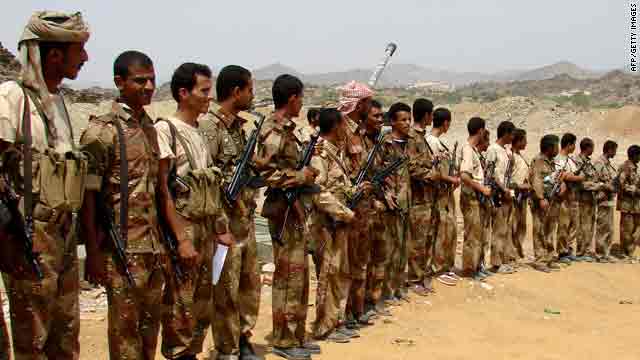

Yemeni troops gather to meet Defence Minister Mohammad Nasir Ahmad during his visit to the frontline in Saada on Friday.

(CNN) February 13, 2010 12:10 a.m. EST--

The same day a cease-fire agreement was to go into effect, a high-ranking Yemeni official accused rebels of trying to assassinate him.

Deputy Interior Minister Gen. Mohammed Bin Abdullah al-Qawsi told Almotamar, the newspaper of the ruling party, Friday that "his car came under intensive fire shots in an attempt to assassinate him." He added that he was in the northwestern city of Saada to inspect security forces and accused Houthi rebels of carrying out the attack, according to the state-run Saba News Agency.

Also in Saada Friday, troops and rebels exchanged fire, killing one and injuring others, Saba reported.

The rebels did not immediately respond to the reports, which followed the announcement of an end to a six-year battle between the government and Shiite Muslim Houthi rebels.

Despite the reports of violence, the truce deal was still intact, said a Yemeni government official who is not authorized to speak to the media.

A "few skirmishes" occurred, including an attack on a security official's motorcade, he said. He would not say whether that official was al-Qawsi. Such violence is common in the early stages of peace deals, he said.

"There are many reasons why this happened, and they were expected," the source said. "One, some of the militia fighters have not been informed yet that the truce was executed. Two, there were revenge killings -- some of the Houthi tribesmen carried out attacks against government forces. These could be considered tribal revenge killings."

Video: Yemen declares cease fire

The government agreed to end all military operations against the Houthis beginning midnight Friday, an apparent end to violence that even tumbled into Saudi Arabia. Houthi rebel leader Abdul Malik al-Houthi earlier signed off on the cease-fire and took to his Web site to order his followers to respect the agreement.

The cease-fire conditions include clearing mines, not interfering with elected local officials, releasing civilians and military personnel, abiding by Yemeni law, returning looted items, and ending attacks within the country's northern neighbor, Saudi Arabia.

The Yemeni government official said rebels were expected to free seven captured Saudi soldiers Saturday.

The revolt by the Houthis in northern Yemen began in 2004. The conflict is believed to be both separatist -- over who will have power in the area -- and sectarian -- whether Shiite Islam will dominate, even though the majority of Yemenis are Sunni. The rebels are supporters of slain Shiite cleric Hussein al-Houthi.

CNN's Mohammed Jamjoom contributed to this report.

No comments: