
Afghan assault finds resistance, explosives
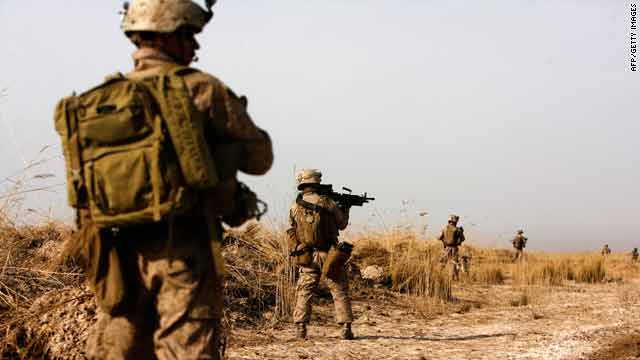
Marjah, Afghanistan (CNN) -- The Taliban put up a stiff resistance Sunday, as a coalition assault against the militant group entered its second day in southern Afghanistan.
Officials said they did not know how many Taliban fighters remained in the Marjah region of Helmand province but think they may be in the hundreds -- some of whom are holed up in civilian compounds.
Dawoud Ahmadi, the provincial spokesman, said 27 Taliban fighters have been killed. Afghan and international forces also discovered 2,500 kilograms (5,500 lbs) of explosives.
The Taliban spokesman for the Marjah area claimed six Taliban casualties and said militants had killed 192 Afghan and coaltion troops.
In the past, the Taluban has often inflated casualty fighures.
"NATO forces have not captured any areas in Marjah from the Mujahadeen," said Qari Yousif Ahmadi, the Taliban spokesman.
Dubbed Operation Moshtarak, the offensive was launched early Saturday by an international coalition of 15,000 troops including Afghans, Americans, Britons, Canadians, Danes and Estonians.
Hours into the offensive, small-arms fire killed a U.S. Marine, and an explosion killed a British soldier, according to a U.S. military official.
"The Taliban appear confused and disoriented," said Maj. Gen. Gordon Messenger, a British military spokesman. However, he tempered his optimism with the reminder that the operation was not over.
Long a bastion of pro-Taliban sentiment and awash with the opium used to fund the insurgency, the Marjah region has been known as the heroin breadbasket of Afghanistan and a place where the Taliban have set up a shadow government.
U.S. Marines swept into the area from north and south, a U.S. Marine Corps official told CNN. They established a ring of security, preventing anyone from leaving or entering the area, the official said.
In an effort to establish a foothold, troops launched air assaults followed by a ground offensive in rough terrain, a region crisscrossed by canals.
The terrain is so tough that four lightly wounded troops whose injuries normally wouldn't need medical evacuation had to be airlifted for treatment.
NATO forces announced the offensive before it started so that citizens could get out of harm's way.
In the past few days, forces from Afghanistan, Britain and other nations dropped leaflets in and around Marjah warning residents not to allow the Taliban to enter their homes.
And meetings with local leaders, or shuras, have been held, as NATO forces tried to get Afghans on their side, the British military official told CNN.
Afghan President Hamid Karzai on Saturday urged Afghan and international troops to exercise "absolute caution" and ensure civilian safety.
However, there were at least two civilian injuries -- two teens whose house was taken over by the Taliban and used to attack U.S. troops, the Marines said.
More on Operation Moshtarak from Afghanistan Crossroads blog
Key challenges are determining the strength of the remaining insurgency and whether, after the offensive, Afghans will stick with their government.
Officials said they hope Afghan forces and the government will maintain control, win allegiance from the citizens and provide farmers with an alternative to the poppy crops that pervade the region.
Journalist Mati Matiullah and CNN's Nic Robertson, Frederik Pleitgen and Barbara Starr contributed to this report.


No comments:
Post a Comment