The Hellenic Navy (HN) (Greek: Πολεμικό Ναυτικό, Polemikó Naftikó, abbreviated ΠΝ) is the naval force of Greece, part of the Greek Armed Forces. The modern Greek navy has its roots in the naval forces of various Aegean Islands, which fought in the Greek War of Independence. During the periods of monarchy (1833–1924 and 1936–1973) it was known as the Royal Navy (Βασιλικόν Ναυτικόν, Vasilikón Naftikón, abbreviated ΒΝ).The total displacement of all the navy's vessels is approximately 150,000 tons.The motto of the Hellenic Navy is "Μέγα το της Θαλάσσης Κράτος" from Thucydides' account of Pericles' oration on the eve of the Peloponnesian War. This has been roughly translated as "Great is the country that controls the sea". The Hellenic Navy's emblem consists of an anchor in front of a crossed Christian cross and trident, with the cross symbolizing Greek Orthodoxy, and the trident symbolizing Poseidon, the god of the sea in Greek mythology. Pericles' words are written across the top of the emblem. "The navy, as it represents a necessary weapon for Greece, should only be created for war and aim to victory."...............The Hellenic Merchant Marine refers to the Merchant Marine of Greece, engaged in commerce and transportation of goods and services universally. It consists of the merchant vessels owned by Greek civilians, flying either the Greek flag or a flag of convenience. Greece is a maritime nation by tradition, as shipping is arguably the oldest form of occupation of the Greeks and a key element of Greek economic activity since the ancient times. Nowadays, Greece has the largest merchant fleet in the world, which is the second largest contributor to the national economy after tourism and forms the backbone of world shipping. The Greek fleet flies a variety of flags, however some Greek shipowners gradually return to Greece following the changes to the legislative framework governing their operations and the improvement of infrastructure.Blogger Tips and Tricks
This is a bilingual blog in English and / or Greek and you can translate any post to any language by pressing on the appropriate flag....Note that there is provided below a scrolling text with the 30 recent posts...Αυτό είναι ένα δίγλωσσο blog στα Αγγλικά η/και στα Ελληνικά και μπορείτε να μεταφράσετε οποιοδήποτε ποστ σε οποιαδήποτε γλώσσα κάνοντας κλικ στη σχετική σημαία. Σημειωτέον ότι παρακάτω παρέχεται και ένα κινούμενο κείμενο με τα 30 πρόσφατα ποστς....This is a bilingual blog in English and / or Greek and you can translate any post to any language by pressing on the appropriate flag....Note that there is provided below a scrolling text with the 30 recent posts...Αυτό είναι ένα δίγλωσσο blog στα Αγγλικά η/και στα Ελληνικά και μπορείτε να μεταφράσετε οποιοδήποτε ποστ σε οποιαδήποτε γλώσσα κάνοντας κλικ στη σχετική σημαία. Σημειωτέον ότι παρακάτω παρέχεται και ένα κινούμενο κείμενο με τα 30 πρόσφατα ποστς.........

Wednesday, April 24, 2013

Space humanoid robot ...[ 3099 ]

Astronaut vs. Robonaut

Syria Confusion for the two Orthodox bishops kidnapped..[ 3098 ]

Kidnapped Syrian bishops' whereabouts remain unclear

Boulos Yaziji (left) and Yohanna Ibrahim  
The bishops are the most senior Christian clerics kidnapped since the conflict began
.
Confusion surrounds the whereabouts of two Orthodox bishops kidnapped in Syria on Monday, but who were said to have been freed on Tuesday.
There were reports that the two men, Yohanna Ibrahim and Boulos Yaziji, were back in the city of Aleppo. 
.
But other sources with links to the bishops have told the BBC this is not so and their families are still worried about their whereabouts.
They had been returning from the Turkish border when they were seized.
It was not immediately clear who had kidnapped them.
.
Bishop Ibrahim is the head of the Syriac Orthodox Church in Aleppo, while Bishop Yaziji leads the city's Greek Orthodox Church.
They are the most senior Christian clerics caught up directly in the war.
Abductions on the rise
Kidnappings have increased dramatically in Syria in the past year but the abduction of such high-ranking Christian figures is unusual, the BBC's James Reynolds reports from the city of Istanbul, in neighbouring Turkey.
BBC map
Christians made up about 10% of the mainly Sunni Muslim country's population before the uprising against President Bashar al-Assad began just over two years ago.
.
President Assad's government has hoped to retain their loyalty, based on a shared fear of what might happen if Sunni Muslims take over the country, our correspondent says.
But some Christians have chosen to join the opposition - including George Sabra, the newly appointed leader of the opposition coalition, he adds.
.
State TV earlier announced that an "armed terrorist group" had kidnapped the two bishops as they carried out "humanitarian work in [the] Aleppo countryside".
Their driver is thought to have been killed in Monday's kidnapping attack.
Abdulahad Steifo, a Syriac member of the opposition Syrian National Coalition, said the men had been kidnapped on the road to Aleppo from the rebel-held Bab al-Hawa crossing, which is close to the Turkish town of Reyhanli..
.
Asked who was behind their abduction, he said: "All probabilities are open."
In an interview with BBC Arabic's Saeed Shehada a week ago, Bishop Ibrahim said he was optimistic about the future of Christians in Syria:
"There is no persecution of Christians and there is no single plan to kill Christians. Everyone respects Christians. Bullets are random and not targeting the Christians because they are Christians," he said.
.
According to the UN, at least 70,000 people have been killed in the civil war and more than one million are now living as refugees in neighbouring countries.

Tuesday, April 23, 2013

Kidnapped Orthodox bishops have been released,..[ 3097 ]

Kidnappers free Syrian bishops: church group


Archbishop Paul Yazigi and Syriac Orthodox archbishop Yohanna Ibrahim,    (Reuters, AFP) 
Updated 6:42 pm: An association of Middle Eastern Christians on Tuesday said that two Orthodox bishops reportedly kidnapped by rebels in northern Syria have been released, in a statement citing Syrian sources.
'
The French "Oeuvre d'Orient" group said that Greek Orthodox archbishop Paul Yazigi and Syriac Orthodox archbishop Yohanna Ibrahim, who were seized on Monday, were already at Saint Elias cathedral in Aleppo.
.
Western-backed Syrian rebels in the province of Aleppo had earlier on Tuesday denied that they had kidnapped two prominent Syrian archbishops.
State news agency SANA reported the kidnapping on Monday night, saying an "armed terrorist group" kidnapped Greek Orthodox archbishop Paul Yazigi and Syriac Orthodox archbishop Yohanna Ibrahim in the village of Kafr Dael in Aleppo province.
.
Church sources earlier on Tuesday said it did not know who was behind the kidnapping, but that a witness to the abduction who was travelling with the men said the kidnappers had foreign accents and light faces, and might be Chechens.
Syria's religious affairs ministry said "there is evidence that those who kidnapped the bishops were Chechen mercenaries working under the leadership of al-Nusra Front."
.
Nusra, a jihadist group fighting to oust the Syrian government, has pledged allegiance to al-Qaeda chief Ayman al-Zawahiri.
The kidnapped archbishops are the most senior church figures seemingly caught up in the fight between government forces and rebels trying to end four decades of Assad family rule.

Razek Siriani, a representative of the Syriac Orthodox Archdiocese of Aleppo, said that Yazigi and Ibrahim had been seized on their way to the Turkish border after a humanitarian mission to help release two priests kidnapped months earlier.
.
He said that details of the kidnapping were unclear – the Syrian government said on Monday that the bishops had been travelling to, not from, Aleppo – but that the driver had been shot dead and a fourth member of the group managed to escape.
.
(Reuters, AFP)

Two Aleppo archbishops kidnapped on Monday evening [ 3096 ]

Govt calls for release of Syrian Orthodox archbishops


'
Concern after the kidnapping of Greek Orthodox and Syriac Orthodox archbishops of Aleppo, Paul Yazigi and Gregorios Yohanna Ibrahim, on the road to Aleppo from the rebel-held Bab al Hawa crossing with Turkey
The Greek Orthodox archbishop of Aleppo, Paul Yazigi 
The Greek Orthodox archbishop of Aleppo, Paul Yazigi  
'
The Greek government has called for the release of two Syrian bishops kidnapped on Monday by armed rebels in the northern province of Aleppo.

The Greek Orthodox and Syrian Orthodox archbishops of Aleppo, Paul Yazigi and Gregorios Yohanna Ibrahim, were seized by "a terrorist group" in the village of Kfar Dael as they were "carrying out humanitarian work", Syria's official new agency Sana said. 
'
A Syriac member of the opposition Syrian National Coalition, Abdulahad Steifo, said the men had been kidnapped on the road to Aleppo from the rebel-held Bab al Hawa crossing with Turkey.
'
In Athens, the foreign ministry has set up a crisis management team to work for the clerics' release.
Foreign Minister Dimitris Avramopoulos, in Brussels for a Nato meeting, expressed the support of the Greek government to the patriarch of Antioch, John X, who heads the Greek Orthodox church in Syria.
He also requested the help of the European External Action Service, which coordinates EU foreign policy, to secure the bishops' release.
 
"We're going to talk about this [the kidnapping] – and not only about this dramatic development. The international community should work together in order to put an end to the drama of the Syrian people," Avramopoulos said.
He also called the new caretaker leader of the Syrian National Coalition, veteran dissident George Sabra, about the abduction.

Born in Lattakya in Syria, Archbishop Paul holds a doctoral degree from the Aristotle University of Thessaloniki. 
'
Christians make up less than 10 percent of the Syria's 23 million people and, like other religious minorities, many have been wary of the mainly Sunni Muslim uprising against Assad, whose Alawite sect is an offshoot of Shi'ite Islam. 
'
Writing in January, Yazigi said was important that the uprisings known as the "Arab Spring" should not jeopardise centuries of religious diversity in the Middle East. 
'
"What is the spring without the diversity and richness of colours in comparison with the haze...of winter? Diversity is richness while monochromatic uniformity is a ticking bomb that kills its owner," he said

View Larger Map

Spanish police arrested two suspected terrorists...[ 3095 ]

Spain arrests 2 men suspected of al Qaeda group links

By Al Goodman, CNN
April 23, 2013 -- Updated 1421 GMT (2221 HKT)
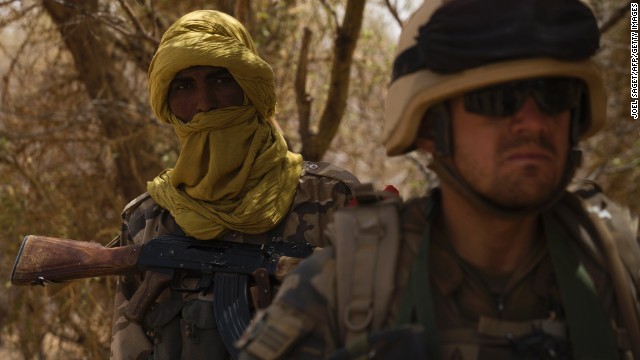
A member of the Malian special forces and a French soldier on April 10, 2013, north of Gao, Mali.


Madrid (CNN) -- Spanish police arrested two suspected terrorists with apparent links to an al Qaeda-affiliated group Tuesday but said they had no indication of an imminent attack.
The Interior Ministry identified the suspects as Nou Mediouni, 23, from Algeria, who was arrested in the north-central city of Zaragoza, and Hassan El Jaaouani, 52, from Morocco, who was detained in the southeastern city of Murcia.
'
Spanish police worked with their counterparts in France and Morocco to carry out the latest arrests, an Interior Ministry statement said.
The two suspects have a "profile" that is similar to the two suspects in the Boston Marathon attacks, the statement said. Interior Minister Jorge Fernandez Diaz told reporters that police consider them "lone wolves," like the Boston suspects.
-
 
Al Qaeda in Mali behind Algeria attack
 
Al Qaeda threatens more attacks
 
Why Mali matters: al Qaeda on the rise
However, the similarity is based only on how the two suspects in Spain were "radicalized," by going to online forums and chat rooms, and also in the suspects' alleged interest in pulling from the Internet information on bomb-making, said an Interior Ministry spokesman, who by custom is not identified.
. . 
The pair, who are from different countries, are not brothers and, unlike the two suspects in the Boston Marathon attacks, have no roots in the Caucasus region, he said.
But Fernandez said one of the suspects recently praised the Boston attacks. A second Interior Ministry spokesman said that was the younger suspect, Mediouni.
Both of the suspects in Spain are unemployed, the second Interior Ministry spokesman said. Mediouni, arrested in Zaragoza, studied computer sciences but had not worked professionally in that field, the ministry statement said.
The two are suspected members of a radical cell close to the terrorist organization al Qaeda in the Islamic Maghreb, the Interior Ministry said.
.
The two men have been under surveillance as part of an operation lasting more than a year run in cooperation with France and Morocco, the Spanish Interior Ministry said.
The Madrid train bombings in March 2004, which killed 191 people and wounded more than 1,800, led to a sharp increase in Spain's fight against Islamic terrorism. The courts convicted 14 Islamic militants for their role in the bombings, along with four Spaniards convicted for trafficking in explosives used in the attacks.
Since then, authorities have told CNN that Spain has assigned hundreds of additional police officers to investigate Islamic terrorism and added dozens of Arabic translators, so authorities will be able to understand communications and threats. Around 400 suspected Islamic militants have been arrested in Spain since March 2004, although many have been released by judges for lack of evidence.
'
Mali extremist contacts alleged
Mediouni was identified and recruited by Mali-based members of al Qaeda in the Islamic Maghreb through his interest in radical Islamist Internet sites, the Interior Ministry statement alleges.
He was given specific instructions for a trip to a jihadist camp in northern Mali led by the group, the Interior Ministry claims, but was unable to meet with AQIM leaders because of the heightened security presence in the area.
Since January, France and nearby African nations have been supporting Malian forces in their efforts to push back Islamist extremists who carved out a large haven in northern Mali last year.
El Jaaouani is also alleged to have established contact with AQIM leaders in Mali and to be responsible for recruiting radicals in Spain. One of the people he contacted was directly involved with the kidnapping and murder of two French citizens in Niger in January 2011, the Spanish Interior Ministry said.
The two suspects' homes were being searched by police, the statement added. They are due to be arraigned Thursday at the National Court in Madrid, which handles terrorism cases, a court spokeswoman said.
The arrests in Spain come days before the Madrid Marathon on Sunday.
About 26,000 runners are expected to take part in a marathon, half-marathon and 10-kilometer race, to be run at the same time. Security has been increased in light of the attacks in Boston, authorities said.
'
-
CNN's Claudia Rebaza and Laura Smith-Spark contributed to this report.