The Hellenic Navy (HN) (Greek: Πολεμικό Ναυτικό, Polemikó Naftikó, abbreviated ΠΝ) is the naval force of Greece, part of the Greek Armed Forces. The modern Greek navy has its roots in the naval forces of various Aegean Islands, which fought in the Greek War of Independence. During the periods of monarchy (1833–1924 and 1936–1973) it was known as the Royal Navy (Βασιλικόν Ναυτικόν, Vasilikón Naftikón, abbreviated ΒΝ).The total displacement of all the navy's vessels is approximately 150,000 tons.The motto of the Hellenic Navy is "Μέγα το της Θαλάσσης Κράτος" from Thucydides' account of Pericles' oration on the eve of the Peloponnesian War. This has been roughly translated as "Great is the country that controls the sea". The Hellenic Navy's emblem consists of an anchor in front of a crossed Christian cross and trident, with the cross symbolizing Greek Orthodoxy, and the trident symbolizing Poseidon, the god of the sea in Greek mythology. Pericles' words are written across the top of the emblem. "The navy, as it represents a necessary weapon for Greece, should only be created for war and aim to victory."...............The Hellenic Merchant Marine refers to the Merchant Marine of Greece, engaged in commerce and transportation of goods and services universally. It consists of the merchant vessels owned by Greek civilians, flying either the Greek flag or a flag of convenience. Greece is a maritime nation by tradition, as shipping is arguably the oldest form of occupation of the Greeks and a key element of Greek economic activity since the ancient times. Nowadays, Greece has the largest merchant fleet in the world, which is the second largest contributor to the national economy after tourism and forms the backbone of world shipping. The Greek fleet flies a variety of flags, however some Greek shipowners gradually return to Greece following the changes to the legislative framework governing their operations and the improvement of infrastructure.Blogger Tips and Tricks
This is a bilingual blog in English and / or Greek and you can translate any post to any language by pressing on the appropriate flag....Note that there is provided below a scrolling text with the 30 recent posts...Αυτό είναι ένα δίγλωσσο blog στα Αγγλικά η/και στα Ελληνικά και μπορείτε να μεταφράσετε οποιοδήποτε ποστ σε οποιαδήποτε γλώσσα κάνοντας κλικ στη σχετική σημαία. Σημειωτέον ότι παρακάτω παρέχεται και ένα κινούμενο κείμενο με τα 30 πρόσφατα ποστς....This is a bilingual blog in English and / or Greek and you can translate any post to any language by pressing on the appropriate flag....Note that there is provided below a scrolling text with the 30 recent posts...Αυτό είναι ένα δίγλωσσο blog στα Αγγλικά η/και στα Ελληνικά και μπορείτε να μεταφράσετε οποιοδήποτε ποστ σε οποιαδήποτε γλώσσα κάνοντας κλικ στη σχετική σημαία. Σημειωτέον ότι παρακάτω παρέχεται και ένα κινούμενο κείμενο με τα 30 πρόσφατα ποστς.........

Monday, March 11, 2013

Venezuela : Maduro / Capriles...[ 3064 ]

Venezuela opposition leader Capriles to stand in election

Opposition leader Henrique Capriles. 8 March 2013 
 Mr Capriles heads the umbrella opposition group Table for Democratic Unity
BBC / 
-
Venezuelan opposition leader Henrique Capriles has confirmed that he will stand in presidential elections on 14 April.
In a televised address, Mr Capriles accused the governing PSUV party of manipulating the recent death of Hugo Chavez.
Mr Chavez died on 5 March after a two-year battle against cancer.
Mr Capriles will stand against Acting President Nicolas Maduro, whom Mr Chavez named as his favoured successor.
The acting president went on state television minutes after the opposition leader's appearance, accusing him of being a "fascist".
Correspondents say the stage is now set for a bitter presidential campaign.
Nicolas Maduro and Henrique Capriles (file images)
Both Mr Maduro and his opposition rival must register their candidacies by Monday.
Mr Chavez - who led Venezuela for 14 years - won last October's election against Mr Capriles, polling 54% of the vote to Mr Capriles's 44%.
Mr Chavez named his 50-year-old vice-president and foreign minister as his preferred successor following the recurrence of cancer.
Mr Maduro's friendship with Hugo Chavez dates back to when the former president served time in prison for an attempted coup in 1992.
The former bus driver campaigned for Mr Chavez to be released - which happened two years later.
He has vowed to carry on where the late leader left off but acknowledged that Mr Chavez would be difficult to follow.
He told a crowd on Saturday: "I am not Chavez - speaking in terms of the intelligence, charisma, historical force, leadership capacity and spiritual grandeur of our comandante [commander]."
Hugo Chavez's body is still lying in state at a military academy in the capital Caracas. Millions of Venezuelans have filed past to pay their respects.
Mr Maduro says the former leader's body will be embalmed "like Lenin and Mao Zedong".
----

Analysis

It was the first night of a short electoral campaign.
Henrique Capriles went first. His address, televised by opposition TV station Globovision, used strong words against Nicolas Maduro. He said the interim president had been lying to the country about the health of Mr Chavez and that he was using the late president's body as a prop for his electoral campaign. "All of this has been coldly calculated," he said.
He addressed Mr Maduro by name, in an aggressive fashion. "Nicolas, I am not going to give you a free ride," he said. And then he added that Mr Maduro was not Mr Chavez.
Minutes later, Mr Maduro went on national state television, wearing a red T-shirt and with a picture of Mr Chavez prominent in the background.
He accused Mr Capriles of inciting hatred. "We are all one family," he said. "Our father is Hugo Chavez."
Less than a week after the announcement of Mr Chavez's death, it is clear that much of the campaign will once again be about him.
The opposition boycotted Mr Maduro's swearing-in on Friday, claiming that - under the constitution - the speaker of the National Assembly, Diosdado Cabello, should be the one to take over as acting president.
Mr Capriles - candidate for the umbrella opposition group Table for Democratic Unity (MUD) - called the move fraudulent.
On Sunday, he again accused the socialist PSUV of violating the constitution.
"My fight is not to be president, my fight is for Venezuela to move forward," he said.
"You [the PSUV] are the ones who became sick by power. You fear losing it."
He added: "I am going to fight. Nicolas, I am not going to give you a free pass. You will have to beat me with votes."
Mr Capriles, 40, is a lawyer by training and governor of the state of Miranda. He describes his policies as "centrist" and "humanist".
'Biggest mistake' In his televised address on Sunday, Nicolas Maduro accused Henrique Capriles of inciting hatred, and said he was trying to provoke violence by insulting the late president's image.
"You have made the biggest mistake of your life," he said.
He announced that he would ask the national assembly to change the constitution on Tuesday to allow Mr Chavez's body to lie beside that of 19th Century South American revolutionary leader Simon Bolivar.
  -

Contrails...[ 3063 ]

Contrails Carry Clues to More Eco-Friendly Flights


Puffy white exhaust contrails stream from the engines of NASA's DC-8 flying laboratory in this image taken from an HU-25 Falcon flying about 30 feet behind. NASA researchers have begun a series of flights using the agency's DC-8 to study the effects of alternate biofuel on engine performance, emissions and aircraft-generated contrails at altitude.

The DC-8 is using conventional JP-8 jet fuel, or a 50-50 blend of JP-8 and an alternative fuel of hydroprocessed esters and fatty acids that comes from camelina plants. More than a dozen instruments mounted on the Falcon jet are characterizing the soot and gases streaming from the DC-8, monitoring the way exhaust plumes change in composition as they mix with air, and investigating the role emissions play in contrail formation.

Image Credit: NASA/Eddie Winstead

Tuesday, March 5, 2013

SpaceX-2 Mission,,, [ 3062 ]

SpaceX-2 Mission Launch

Friday, March 1, 2013

China divided on TV 'execution parade..[ 3061 ]

China divided on TV 'execution parade': judicial resolve or crude voyeurism

Two-hour broadcast showed four foreign prisoners being led to their deaths after being charged with murder of Chinese sailors
Naw Kham
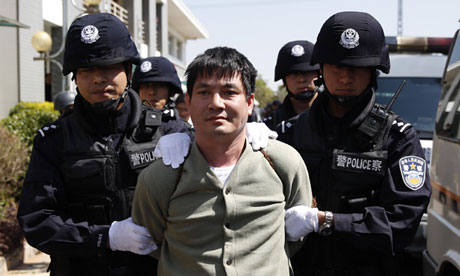
Convicted murderer Naw Kham being led to his execution in China. Photograph: Zuma / Rex Features
'
Naw Kham's wry smile belied his macabre circumstances. "I haven't been able to sleep for two days. I have been thinking too much. I miss my mum. I don't want my children to be like me," the 44-year-old Burmese drug lord, chained to a chair, told a Chinese television interviewer.
'
On Friday – two days after the interview – the Burmese freshwater pirate was executed for allegedly murdering a crew of Chinese sailors on the Mekong river in October, 2011. His last moments were aired on state television.
In the two-hour live broadcast, black-clad police officers hauled Naw Kham from a detention centre in southern China, bound him with ropes and chains, and bundled him on to a bus bound for the execution site. Three of his alleged henchmen followed in similar fashion. They were each killed – off camera – by lethal injection.
The broadcast elicited a polarised response in China. Some saw it as a reassuring show of judicial resolve; others compared the two-hour television special to a Mao-era "execution parade" – an unjustifiable transformation of somebody's last moments into a crude propagandistic lesson.
Experts said the broadcast, which juxtaposed Naw Kham's final march with bold displays of Chinese judicial force – armed Chinese patrol boats on the Mekong, rows of Swat police– was intended to convey an unambiguous message.
"I think [the broadcast] is compatible with what the government wants– to show the Chinese people that the government is serious about protecting them within the country and outside," said Shi Yinhong, a professor of international relations at Renmin University in Beijing.
According to official accounts, the Chinese sailors were transporting fuel oil, apples and garlic along the busy Mekong shipping route in two cargo ships, the Hua Ping and the Yu Xing 8, when they were ambushed near the Golden Triangle, a notoriously lawless area bordering Thailand, Burma and Laos.
'
When Thai authorities reached the murder scene, they found 12 dead sailors – one on the boat, and 11 by a nearby port – some of whom had apparently been blindfolded, gagged with duct tape and shot in the head at close range. One had her neck broken. Another was missing entirely. Nearly one million methamphetamine pills were found on board.
Chinese web users reacted to the news with horror. Chinese authorities sent gunboats down the Mekong, causing some to question China's long-standing foreign policy of non-interference in other countries' domestic affairs. Shipping on the river briefly came to a halt.
'
Naw Kahm soon emerged as a prime suspect. China's official media portrayed the manhunt to find him – a cross-border effort involving a 200-person investigative team – as similar to the US search for Osama bin Laden. The state-run Global Times reported last month that China's drug enforcement authorities considered using an unprecedented drone strike to bomb him out of his mountain hideaway in north-eastern Burma. He was captured in Laos last spring and promptly extradited.
State media identified Naw Kham's three henchmen as Hsang Kham from Thailand, Zha Xika from Laos and Yi Lai of "unknown origin". The four prisoners were sentenced to death last autumn for intentional homicide, drug trafficking, kidnapping and hijacking.
A high provincial court rejected their appeals, yet a Reuters investigation in early 2012 cast doubt on the allegations and raised the possibility that a nine-man anti-narcotics unit within the Thai military was responsible for the massacre.
'
On China's most popular microblogging site, Sina Weibo, response to the execution were firmly divided. Some users praised the government's hard line on crimes against Chinese citizens abroad; others decried the live broadcast as unnecessarily cruel and voyeuristic.
Lawyer Tao Jiamei called it an infringement of China's own criminal procedure law, which dictates that executions "should be announced, but should not be publicly exposed".
Nicholas Bequelin, a Hong Kong-based senior researcher for Human Rights Watch, said public executions were fairly common in China until the early to mid-1990s. They were formally banned in 1979. "Sometimes, in the early days, people were executed right away in stadiums," he said. "Then the practice actually shifted to taking these people away, generally on a truck, to be executed elsewhere."
'
Human rights groups estimate that China executes between 5,000 and 8,000 people per year. The exact number is considered a state secret.

Thursday, February 28, 2013

Bangladesh sentences leader to death for war crimes...[ 3060 ]

Bangladesh sentences Jamaat-e-Islami leader to death for war crimes

Islamic party enforces general strike on day Delwar Hossain Sayedee is found guilty of crimes relating to independence war

  • guardian.co.uk,
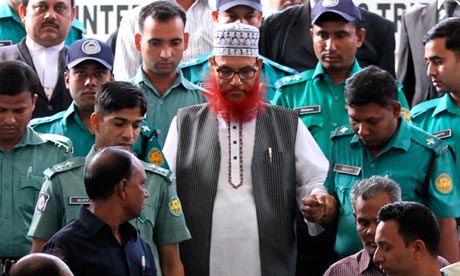
Delwar Hossain Sayedee
The Jamaat-e-Islami leader Delwar Hossain Sayedee, centre, denies the allegations, saying the charges are politically motivated. Photograph: AFP/Getty Images'
'
A special war crimes tribunal in Bangladesh has sentenced the leader of an Islamic political party to death for crimes stemming from the nation's 1971 fight for independence, a politically charged decision that sparked violent protests.
The Jamaat-e-Islami leader Delwar Hossain Sayedee was found guilty of eight counts out of 20 involving mass killings, rape and atrocities during the nine-month war against Pakistan, the prosecutor Syed Haider Ali said. The verdict was announced by the presiding tribunal judge ATM Fazle Kabir in a packed courtroom.
 '
"Justice has been done to those who lost their loved ones at the hands of Sayedee," Ali said.
Lawyers for the defendant boycotted the tribunal during the verdict and rejected it as politically motivated. Sayedee's lawyer Abdur Razzak said they would appeal.
Jamaat-e-Islami was enforcing a nationwide general strike on Thursday to denounce the trial and to demand Sayedee be freed.
'
Supporters of Sayedee clashed with police in Sirajganj district while protesting against the verdict, leaving two people dead, the private television channel Ekattor TV reported. Police were not immediately available to comment on the reported deaths.
Sayedee is the third defendant to be convicted of crimes against humanity since Sheikh Hasina's government initiated the tribunal in 2010.
In the first verdict in January, the tribunal sentenced the former Jamaat leader Abul Kalam Azad to death on similar charges.
Another Jamaat leader, Abdul Quader Mollah, was sentenced to life in prison in February for atrocities during the war.
Another seven top leaders of Jamaat are on trial for their alleged role in the atrocities during the war.
'
Jamaat-e-Islami, the largest Islamic party in Muslim-majority Bangladesh, had campaigned against the 1971 independence war, but it denies committing any atrocities.
Jamaat, a key ally of the country's largest opposition party, the Bangladesh Nationalist party, led by the former premier Khaleda Zia, was a partner in her government from 2001 to 2006.
Zia's party has questioned the conduct of the tribunal, saying the trial was aimed at destroying the opposition.
'
International human rights organisations also questioned the fairness of the trial, referring to the disappearance of a witness for Sayedee.
Bangladesh says the 1971 war left 3 million people dead, 200,000 women raped and forced millions to take shelter in neighbouring India.