The Hellenic Navy (HN) (Greek: Πολεμικό Ναυτικό, Polemikó Naftikó, abbreviated ΠΝ) is the naval force of Greece, part of the Greek Armed Forces. The modern Greek navy has its roots in the naval forces of various Aegean Islands, which fought in the Greek War of Independence. During the periods of monarchy (1833–1924 and 1936–1973) it was known as the Royal Navy (Βασιλικόν Ναυτικόν, Vasilikón Naftikón, abbreviated ΒΝ).The total displacement of all the navy's vessels is approximately 150,000 tons.The motto of the Hellenic Navy is "Μέγα το της Θαλάσσης Κράτος" from Thucydides' account of Pericles' oration on the eve of the Peloponnesian War. This has been roughly translated as "Great is the country that controls the sea". The Hellenic Navy's emblem consists of an anchor in front of a crossed Christian cross and trident, with the cross symbolizing Greek Orthodoxy, and the trident symbolizing Poseidon, the god of the sea in Greek mythology. Pericles' words are written across the top of the emblem. "The navy, as it represents a necessary weapon for Greece, should only be created for war and aim to victory."...............The Hellenic Merchant Marine refers to the Merchant Marine of Greece, engaged in commerce and transportation of goods and services universally. It consists of the merchant vessels owned by Greek civilians, flying either the Greek flag or a flag of convenience. Greece is a maritime nation by tradition, as shipping is arguably the oldest form of occupation of the Greeks and a key element of Greek economic activity since the ancient times. Nowadays, Greece has the largest merchant fleet in the world, which is the second largest contributor to the national economy after tourism and forms the backbone of world shipping. The Greek fleet flies a variety of flags, however some Greek shipowners gradually return to Greece following the changes to the legislative framework governing their operations and the improvement of infrastructure.Blogger Tips and Tricks
This is a bilingual blog in English and / or Greek and you can translate any post to any language by pressing on the appropriate flag....Note that there is provided below a scrolling text with the 30 recent posts...Αυτό είναι ένα δίγλωσσο blog στα Αγγλικά η/και στα Ελληνικά και μπορείτε να μεταφράσετε οποιοδήποτε ποστ σε οποιαδήποτε γλώσσα κάνοντας κλικ στη σχετική σημαία. Σημειωτέον ότι παρακάτω παρέχεται και ένα κινούμενο κείμενο με τα 30 πρόσφατα ποστς....This is a bilingual blog in English and / or Greek and you can translate any post to any language by pressing on the appropriate flag....Note that there is provided below a scrolling text with the 30 recent posts...Αυτό είναι ένα δίγλωσσο blog στα Αγγλικά η/και στα Ελληνικά και μπορείτε να μεταφράσετε οποιοδήποτε ποστ σε οποιαδήποτε γλώσσα κάνοντας κλικ στη σχετική σημαία. Σημειωτέον ότι παρακάτω παρέχεται και ένα κινούμενο κείμενο με τα 30 πρόσφατα ποστς.........

Friday, June 29, 2012

Deal on eurozone banks...[ 2878 ]

Merkel defends compromise deal on eurozone banks


Angela Merkel: "The details affecting liability... will have to be discussed... those negotiations are going to be anything but easy"
-

BBC,29 June 2012 Last updated at 14:08 GMT
 
Germany's Chancellor Angela Merkel says she is satisfied with a deal to help finance debt-laden eurozone countries.
"I think we found a good compromise," she said after all-night talks which saw her come under heavy pressure from Italy and Spain.
-
A new supervisory body will enable the European Central Bank (ECB) to "keep a very close eye on the banks", she said.
Spain is awaiting a 100bn-euro (£80bn; $125bn) recapitalisation of its troubled banks by the eurozone.
Mrs Merkel said the deal on lending would provide sufficient safeguards for the taxpayers' money used by the EU bailout funds.

“Start Quote

The eurozone's bailout fund (backed by taxpayers' money) will be taking a stake in failed banks - risk has been increased”
The EU's existing bailout fund - the European Financial Stability Facility - will provide aid under the current rules until the new permanent fund, the European Stability Mechanism (ESM), is ready to take over. The ESM is due to be launched next month.
The funds will not only be able to lend directly to banks. They will also be used to buy bonds of countries like Italy and Spain whose borrowing costs have soared - with the intention that those countries will not have to apply for a formal Greek-style bailout.
Eurozone leaders agreed to begin implementing the decisions by 9 July. However, it could take until the end of the year before the new money becomes available.
Germany, the biggest economic power in the eurozone, is reluctant to continue bailing out debt-laden countries. Its position is supported by the Netherlands, Austria and Finland.
Breaking 'vicious circle'
Announcing the deal, EU Council President Herman Van Rompuy said it would break the "vicious circle" between banks and national governments.
The euro surged against other currencies while European stock markets also rose sharply.
During Friday afternoon trading, the main German and French market were up 3.5%, while in London the FTSE 100 rose 1.8%.
US markets also rose significantly on opening. The Dow Jones industrial average was up 1.5% in early trading.
The BBC's Andrew Walker, in Brussels, says the new loans will not be given "seniority" over private sector loans.
This means that if Spain were to default, those official lenders would not get preferential treatment. The move should make Spanish government debt a little more attractive to private investors, our correspondent says.
Growth stimulus

Europe's press reacts

  • Le Monde (France): "At dawn, a compromise was ripped out with forceps"
  • Die Welt (Germany): "While the Italians were harrying Germany on the pitch, they were also pushing Merkel into a tight spot in Brussels. Together with the Spanish, they put the German chancellor under massive pressure"
  • Der Spiegel (Germany): "As in football, so at the euro summit: Italy has won out on key points in a long night of negotiations in Brussels, Chancellor Merkel gave way"
  • Il Sole 24 Ore (Italy): "Many details remain to be negotiated and could turn out to be difficult, but in substance the eurozone states yesterday put on the table the first piece of a banking union"
Late on Thursday, Spain and Italy withheld support for a growth package worth 120bn euros, demanding immediate EU measures to lower their borrowing costs.
The growth package, including a funding boost for the European Investment Bank, was later agreed.
-
The leaders also approved a roadmap for building a more integrated eurozone - what should eventually become a fiscal union. It includes controversial plans for "eurobonds" - mutualisation of eurozone debt.
-
Mrs Merkel has resisted the idea of pooling eurozone debt. On Friday she said "details about liability will have to be discussed by the finance ministers and those negotiations will be anything but easy".
The deal came about after new French President Francois Hollande appeared to throw his weight behind Italy and Spain.

Germany-Italy 1-2...[ 2877 ]

Mario Balotelli, Italy's postman, celebrates first-class delivery

The striker's crunched explosion of a second goal against Germany showed why Cesare Prandelli kept the faith
Mario Balotelli Italy
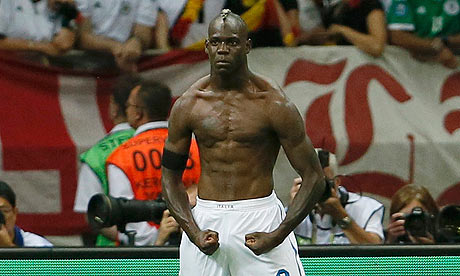
Mario Balotelli celebrates his second goal for Italy during the Euro 2012 semi-final against Germany. Photograph: Tony Gentile/Reuters
-
So "Il Postino" has delivered. Manuel Neuer had sunk to his haunches, his left arm still aloft as if signalling the surrender, as Mario Balotelli ripped off his shirt, flung it to the turf and flexed his muscles. Claudio Marchisio's embrace rocked through the forward but by the time the rest of the delirious Azzurri descended upon him, the adrenaline-fuelled snarl was melting into a broad smile. One myth has at least been dispelled: the striker is more than happy to celebrate a goal, and particularly one this special.
-
The crunched explosion of a finish from Balotelli's right boot, dispatched so ferociously beyond a startled Neuer nine minutes from the interval, felt pivotal. A sign that a player who can infuriate as much as he dazzles can flourish at this level. It was a goal to sum up the 21-year-old, his gathering of Riccardo Montolivo's punt hinting initially at clumsiness before a cuter touch set up the finish. Against another opponent the goalkeeper might have been confident of his angles, and the retreating Philipp Lahm capable of recovering to intercept, but the brute in Balotelli would not allow it. Italy had been defending a corner five seconds earlier. Now they were on the verge of a ninth major final.
-
The nickname that is likely now to catch on requires a fuller explanation. On the eve of this contest, Twitter had been awash with a quote attributed to Balotelli who had apparently been asked why he refused to celebrate his goals. The riposte snapped back: "When I score, I don't celebrate because I'm only doing my job. When a postman delivers letters, does he celebrate?"
-
Yet there are exceptions, and a European Championship semi-final against Germany demanded emotion. The Manchester City striker had attempted a more matter-of-fact strut as he departed at the interval – his was an air of "so what's all the fuss about" as the cameras focused in – but the substitute Alessandro Diamanti, with a hug and a mouthed "wow" by the tunnel, betrayed what the watching world was thinking. To have witnessed a goalkeeper of Neuer's class so helpless said it all.
-
Poland clearly suits Balotelli. He has scored all of his international goals here, from the winner in a friendly in Wroclaw back in November 2011, to his team's second against Ireland in Poznan this month. He now has four in 13 games. This contest had initially passed him by, the forward too isolated while Germany poured through. As the midway point of the half approached and Italy started to make inroads of their own, Andrea Pirlo sprayed a glorious pass for Giorgio Chiellini to collect, with the full-back finding Antonio Cassano.
-
 The Milan striker's turn away from Jérôme Boateng and Mats Hummels, one of the most lauded defenders at these finals, left the Germans splayed.
The cross was delicious, bypassing the panicked Holger Badstuber, for Balotelli to thump a free header back and beyond the disorientated Neuer. His reaction had been more ecstatic then, flapping his shirt as he charged after Cassano – Hummels' tormentor-in-chief through the 58 minutes he managed – and embracing his strike partner. That pairing, enigmatic yet potentially destructive, might yet prove key to claiming this tournament. On the occasions they click, they seem irrepressible. Spain may look impregnable, but they will be wary.
-
Yet the reality is no one, least of all Cesare Prandelli, can predict the impact Balotelli will have at the Olympic Stadium. The manager had mouthed a warning to his matchwinner to keep his cool having been booked for removing his shirt, a reminder that his game is always played on the brink. Even on the biggest occasions he is a player capable of the sublime to the utterly ridiculous, with memories still fresh of his indiscipline at the Emirates in April when City appeared to have surrendered the title. Even at these finals, He had only summoned his best previous display after starting sulkily on the bench against Ireland, and had missed too many chances against England for comfort. If Italy were guilty of profligacy that night, the striker was the main culprit.
-
Yet to witness his trampling of Badstuber, Hummels et al was to wonder why there had been cries for his omission. In the aftermath of the penalty success against Roy Hodgson's side, Prandelli had fielded questions over his faith in the former Internazionale forward. His relationship with Italy's media, as demonstrated by the wildly inappropriate cartoon that appeared in Gazzetta dello Sport this week, is fractious at best. Even his team-mates have found him difficult at times, Daniele De Rossi admitting on the eve of this game that he had "shouted at him at half-time" of the England game in Kiev to rouse him from his lethargy.
-
"But how do you try to work out what goes on in the head of such a young man?" asked Prandelli. "In terms of his behaviour, mentality and psychology, he has changed radically with us." He will be more loved back home after this display, and with a final flourish maybe still to come. His evening ended with a kiss for his adoptive mother, Silvia, in the crowd. This felt like a coming of age with the Azzurri. Germany suffered his arrival.

Saturday, June 23, 2012

Germani - Greece 4-2......[ 2876 ]

Germany Flatten Greece 4-2 to Make Euro Semis

Topic: Euro 2012

Germany's players celebrate at the end of the Euro 2012 match with Greece on June 22, 2012
GDANSK, June 23 (RIA Novosti)
Germany set up a Euro 2012 semifinal with England or Italy after a 4-2 flattening of 2004 champions Greece on Friday.
German captain Philipp Lahm turned his team's domination into a lead on 39 minutes with a swerving shot from distance.
-
Greece pulled it back to 1-1 against the run of play in the 55th minute, when Georgios Samaras finished a rare counterattack by hammering the ball into net.
Midfielder Sami Khedira halted the Greek celebrations just six minutes later, volleying Jerome Boateng's cross under the bar.
-
Miroslav Klose, replacing the German top scorer Mario Gomez in the starting eleven, headed a third on 68 minutes, nodding into an empty net from a Mesut Ozil free kick.
German midfielder Marco Reus sealed it on 74 minutes by powering in under the crossbar after Michalis Sifakis had saved Klose's shot.
Dimitris Salpigidis scored a consolation penalty for Greece a minute from time after Boateng handled in the penalty area.
-
Germany play England or Italy - who face off on Sunday - in Thursday's semifinal in Warsaw.
Germany were the only of the competition's 16 teams to emerge from the group stage with three wins, beating Portugal 1-0, the Netherlands 2-1 and Denmark 2-1.
Nevertheless, Joachim Low fielded a bold lineup with four changes to the side that started the Denmark game, relegating the two scorers in that match - Lukas Podolski and Lars Bender - to the bench.
-
The Greeks, who escaped from Group A with a shock 1-0 win over Russia, put up a slightly bigger fight than most had expected, with Grigoris Makos doing a reasonable job of filling the void left by the suspended Giorgos Karagounis, but they inevitably folded as the German triangle of Khedira, Bastian Schweinsteiger and Ozil proved irresistible.
-
Greece saw the ball in their net as early as four minutes, but Andre Schurrle, Bayer Leverkusen's 21-year-old starlet, was adjudged to have been offside.
A long-range shot from Borussia Dortmund's Reus whizzed past the post after Khedira released him.
Germany then blew a series of opportunities, all created by Reus.
-
First Sifakis denied Ozil, then Klose was inches away from making contact with a ball from the left, and finally the 23-year-old himself pulled a powerful shot just wide.
Greece responded only after the half-hour mark, when a shot from range by Sotiris Ninis was saved by the German keeper Manuel Neuer.
Schurrle could have doubled the lead before the break with another long-range strike, which turned soared just past the post.
-
Seven minutes after the break Neuer was forced into action again, capturing the ball firmly as Samaras was about to rush one on one in the penalty area.
The Germans went on to make their superiority count as soon as Low replaced Schurrle with Bayern Munich regular Thomas Muller.
Relaxed, they started to convert their chances and the game was over by the 74th minute.
-
Germany: Manuel Neuer, Philipp Lahm, Mats Hummels, Holger Badstuber, Jerome Boateng, Bastian Schweinsteiger, Sami Khedira, Marco Reus (Mario Gotze ,79), Miroslav Klose (Mario Gomez , 79), Andre Schurrle (Thomas Muller, 67), Mesut Ozil.
-
Greece: Michalis Sifakis, Vasilis Torosidis, Georgios Tzavelas (Georgios Fotakis, 46), Kyriakos Papadopoulos, Sokratis Papastathopoulos, Kostas Katsouranis, Giannis Maniatis, Grigoris Makos (Nikos Liberopoulos, 71), Dimitris Salpigidis, Georgios Samaras, Sotiris Ninis (Theofanis Gekas, 46)

Tuesday, June 19, 2012

Greek coalition deal...[ 2875 ]

Greek conservatives poised to clinch coalition deal


Leader of conservative New Democracy party Antonis Samaras waves to supporters after his statement on the election results in Athens June 17, 2012. Samaras claimed victory in Sunday's national election, saying Greeks had voted to stay in the euro single currency. REUTERS-John Kolesidis

ATHENS | Tue Jun 19, 2012 5:02am EDT
(Reuters) - Greece's conservatives expect to be able to form a coalition government with the Socialists on Tuesday, allowing the two parties that dominated politics for decades to share power despite a major anti-establishment election vote.
Conservative New Democracy leader Antonis Samaras has promised to negotiate less punishing terms for Greece's international bailout, after only narrowly beating a radical left-wing party that campaigned to scrap the austerity deal entirely.
A senior New Democracy official expected agreement soon on a new cabinet with the PASOK Socialists and possibly another smaller centre-left party following Sunday's election, the second in as many months.
-
Speaking late on Monday, he said a deal would be reached on Tuesday that would involve more than a symbolic involvement by PASOK in the government.
"They will participate actively," said the official, who declined to be identified.
New Democracy and PASOK alternated in power from the fall of military rule in 1974 until last year, when Greece's economic crisis forced the arch rivals to share power in a pro-bailout national unity government.
-
"Political leaders should be aware of the fact that this government is Greece's last chance to remain in the eurozone," the centre-left daily Ta Nea said in an editorial.
"The Greek people are ready to reward the parties that manage to ease austerity and punish those that raise voices of dissent," it said.
-
The comment underscored the widespread expectation in Greece that a new government will be able to negotiate an easing in the tough conditions of the European Union and International Monetary Fund bailout despite resistance from Germany.
Many Greeks hold both parties responsible for the nation's near bankruptcy, which forced it to take bailouts from the European Union and IMF in 2010 and again this year.
-
New Democracy narrowly won the election, averting the immediate risk of a Greek euro zone exit but raising doubts on whether the new government can impose austerity cuts on a nation deeply divided over the price for bailout funds.
After claiming victory over the radical leftist SYRIZA party to jubilant crowds, Samaras began on Monday the more sobering task of talking to rivals to cobble together a coalition.
The greatly weakened PASOK, which finished third in Sunday's vote, has yet to commit to supporting Samaras, but its leader Evangelos Venizelos said talks must be wrapped up by Tuesday - signaling a deal would be agreed by then.
The smaller, moderate Democratic Left party, which opposed the bailout backed by the conservatives and the Socialists, has also suggested it will offer conditional support to a government led by Samaras.
Venizelos was due to meet the head of Democratic Left, Fotis Kouvelis in the morning to gauge support for a three-way alliance with their traditional conservative rivals.
With Greece just weeks away from running out of cash and a new government needed to negotiate the next installment of funds from lenders, Greek political leaders appeared determined to avert the deadlock that followed an inconclusive vote on May 6.
"I am optimistic that this time they will agree to form a government," a Greek banker who declined to be named told Reuters. "They have realized that there is no margin of error or further delays. A third election would be a disaster."
-
With New Democracy taking a 50-seat bonus under Greek electoral law for coming first, a New Democracy-PASOK alliance would have 162 seats, a majority in the 300-seat parliament. Adding the Democratic Left would give it 179 seats.

NATION IN CRISIS
A difficult road lies ahead for Samaras, a U.S.-educated economist who went to college with former Socialist Prime Minister George Papandreou.
He inherits a nation in deep social and economic crisis, with an economy in its fifth year of a recession that has left one in five workers out of a job. A rising number of businesses are closing down, the number of homeless on the streets is growing and anger at austerity cuts is at boiling point.
Samaras promised Greeks and prospective partners that he would water down the painful terms of the EU/IMF bailout.
-
"We will simultaneously have to make some necessary amendments to the bailout agreement in order to relieve the people of crippling unemployment and huge hardships," he said.
Samaras campaigned on promises to cut taxes as well as raising unemployment benefits and pensions.
-
The New Democracy official said the new government would aim to accelerate and broaden a privatization program to top up state but also ask its creditors to spread 11.7 billion euros ($14.7 billion) of further austerity cuts over four years instead of two.
But any attempt to veer off the prescribed austerity path would not sit well with European partners already irritated by what they see as the slow pace of Greek reform. Germany, Europe's paymaster, has ruled out more than minor delays to some targets in the 130-billion-euro rescue package.
-
Chancellor Angela Merkel said at a meeting of G20 leaders in Mexico that any loosening of Greece's agreed reform promises would be unacceptable and reiterated that Athens had to stick to its commitments.
-
With an emboldened SYRIZA bloc led by former communist student leader Tsipras at the head of a powerful opposition, the new government could face protests soon after taking office. SYRIZA almost doubled its share of the vote since the previous election on May 6.
($1 = 0.7949 euros)
(Writing by Deepa Babington; Editing by Will Waterman)

Monday, June 18, 2012

Greece seeks bailout coalition...[ 2874 ]


Greece's New Democracy seeks bailout coalition


Leader of conservative New Democracy party Antonis Samaras is cheered by supporters after his statement on the election results in Athens June 17, 2012. REUTERS/John Kolesidis

ATHENS | Mon Jun 18, 2012 5:51am EDT
 
(Reuters) - Greece's centre-right New Democracy party will try to form a coalition on Monday to back the country's international bailout after a narrow election victory that eased fears of a sudden exit from the euro.
-

European stocks and the euro briefly opened higher after Sunday's vote, and the Athens streets were quiet after New Democracy leader Antonis Samaras pledged to move swiftly to form a government. He was due to meet Greek President Karolos Papoulias at 12.30 p.m. (0930 GMT).
-
The once-mighty Socialist PASOK party, now reduced to third place, indicated it would support former coalition partner Samaras but had not yet decided whether to join the government or just offer parliamentary backing.
-
In deep recession, crushed under its huge public debt and facing rising social tensions, Greece faces a daunting struggle to restore a near-bankrupt economy, and a new government could face a new wave of protests after taking office.
-
"The crisis has been postponed, not necessarily averted," said Theodore Couloumbis, political analyst and vice-president of Athens-based think-tank 
-
ELIAMEP.
"For this government to last it has to show results. You can't continue with 50 percent youth unemployment and a fifth straight year of recession," he said.
The radical left SYRIZA bloc, which had promised to tear up the bailout deal signed in March with the European Union and International Monetary Fund, scored strongly in the election, and party leader Alexis Tsipras promised to continue its opposition to the painful austerity measures demanded of Greece.
"I don't think anything good will come out of these elections," said Dinos Arabatzis, a 56 year-old taxi driver who voted for New Democracy.
"Whoever is in power now will get burned. Samaras will get burned, and Tsipras will come out much stronger if we go to elections again - that's what worries me," he said.
MILITANT OPPOSITION
With nearly 100 percent of ballots counted, New Democracy had won 29.7 percent of the vote, ahead of SYRIZA on 27 percent, and PASOK on 12.3 percent.
A 50-seat bonus automatically given to the party that comes first would give a theoretical New Democracy-PASOK alliance 162 seats in the 300-seat parliament, enough for a majority broadly committed to the 130-billion-euro ($164 billion) bailout.
"The result showed people want the euro, but society remains divided. SYRIZA will be a militant opposition, possibly complicating the new government's efforts," a senior New Democracy official said on condition of anonymity.
"The new government must deliver a positive development soon - an easing of the bailout terms or a positive sign in the economy - or people will lose trust in a week."
In the markets, trust had an even shorter shelf life. Though the FTSEurofirst 300 index rose 1.1 percent at the open, the index had shed all those gains before two hours were up, as the underlying problems in the euro zone brought investors back to earth. The euro's rise also evaporated.
SUPPORT
PASOK officials told Reuters that a meeting on Monday would decide how they would support Samaras - whether by participating fully in government, or by voting with the coalition in parliament. The smaller, anti-bailout Democratic Left party was also due to decide on Monday whether it would back the conservatives.
-
The White House said it hoped the election outcome would lead to the swift formation of a new government that would make "timely progress" on economic challenges.
"We believe that it is in all our interests for Greece to remain in the euro area while respecting its commitment to reform," said President Barack Obama's press secretary Jay Carney.
-
The new government may get some help from euro zone peers relieved that SYRIZA had not won, setting Greece on course for a euro exit with incalculable consequences for the rest of the 17-member bloc.
However, they have offered no prospect of any major overhaul of the bailout agreement, which requires Greece to find 11.7 billion euros in spending cuts in June to qualify for the next loan installment.
-
German Foreign Minister Guido Westerwelle said the substance of the bailout agreement was "not negotiable", but he said creditors might be willing to offer some flexibility on timing for some of the targets, given the time lost in campaigning after the inconclusive election on May 6.
-
"We're ready to talk about the timeframe as we can't ignore the lost weeks, and we don't want people to suffer because of that," he told German radio on Monday.
However, even if it were granted some leeway, a coalition that won only 40 percent of the vote would struggle to push through reforms in the face of deep public resentment of repeated rounds of tax hikes and pay and pension cuts.
-
Despite his loss Tsipras, 37, appeared buoyed by the election and rejected calls to join an all-party unity government, saying his party was now the main opposition force and promising to fight the bailout package.
-
His attitude has raised fears of a return to the anti-austerity protests that have left parts of central Athens pock-marked with angry graffiti.
Underlining the signs of potential instability, the ultra-nationalist Golden Dawn party took 18 seats, repeating its success of May 6 and confirming its status as a force in Greek politics, carried by an angry mood of public protest.
(Additional reporting by Dina Kyriakidou, Writing by James Mackenzie; Editing by Will Waterman)