The Hellenic Navy (HN) (Greek: Πολεμικό Ναυτικό, Polemikó Naftikó, abbreviated ΠΝ) is the naval force of Greece, part of the Greek Armed Forces. The modern Greek navy has its roots in the naval forces of various Aegean Islands, which fought in the Greek War of Independence. During the periods of monarchy (1833–1924 and 1936–1973) it was known as the Royal Navy (Βασιλικόν Ναυτικόν, Vasilikón Naftikón, abbreviated ΒΝ).The total displacement of all the navy's vessels is approximately 150,000 tons.The motto of the Hellenic Navy is "Μέγα το της Θαλάσσης Κράτος" from Thucydides' account of Pericles' oration on the eve of the Peloponnesian War. This has been roughly translated as "Great is the country that controls the sea". The Hellenic Navy's emblem consists of an anchor in front of a crossed Christian cross and trident, with the cross symbolizing Greek Orthodoxy, and the trident symbolizing Poseidon, the god of the sea in Greek mythology. Pericles' words are written across the top of the emblem. "The navy, as it represents a necessary weapon for Greece, should only be created for war and aim to victory."...............The Hellenic Merchant Marine refers to the Merchant Marine of Greece, engaged in commerce and transportation of goods and services universally. It consists of the merchant vessels owned by Greek civilians, flying either the Greek flag or a flag of convenience. Greece is a maritime nation by tradition, as shipping is arguably the oldest form of occupation of the Greeks and a key element of Greek economic activity since the ancient times. Nowadays, Greece has the largest merchant fleet in the world, which is the second largest contributor to the national economy after tourism and forms the backbone of world shipping. The Greek fleet flies a variety of flags, however some Greek shipowners gradually return to Greece following the changes to the legislative framework governing their operations and the improvement of infrastructure.Blogger Tips and Tricks
This is a bilingual blog in English and / or Greek and you can translate any post to any language by pressing on the appropriate flag....Note that there is provided below a scrolling text with the 30 recent posts...Αυτό είναι ένα δίγλωσσο blog στα Αγγλικά η/και στα Ελληνικά και μπορείτε να μεταφράσετε οποιοδήποτε ποστ σε οποιαδήποτε γλώσσα κάνοντας κλικ στη σχετική σημαία. Σημειωτέον ότι παρακάτω παρέχεται και ένα κινούμενο κείμενο με τα 30 πρόσφατα ποστς....This is a bilingual blog in English and / or Greek and you can translate any post to any language by pressing on the appropriate flag....Note that there is provided below a scrolling text with the 30 recent posts...Αυτό είναι ένα δίγλωσσο blog στα Αγγλικά η/και στα Ελληνικά και μπορείτε να μεταφράσετε οποιοδήποτε ποστ σε οποιαδήποτε γλώσσα κάνοντας κλικ στη σχετική σημαία. Σημειωτέον ότι παρακάτω παρέχεται και ένα κινούμενο κείμενο με τα 30 πρόσφατα ποστς.........

Tuesday, March 13, 2012

Russians to Build in Paris,,,[ 2789 ]

Russian Developer to Build 2 Skyscrapers in Paris

The Eiffel Tower
MOSCOW, March 13 (RIA Novosti)

Russia's Hermitage Construction & Management Group will build two skyscrapers in Paris with a 323 meter height each for over two billion euros, the Kommersant business newspaper reported on Tuesday, quoting the company's owner Emin Iskenderov.
The two buildings, which will be constructed in city's major business district La Defense by 2017, will be lower the Eiffel Tower by only seven meters.
-
The overall square area will amount to 280,000 square meters, including apartments at 160,000 square meters, offices at 30,000 square meters, a trade center at 40,000 square meters and a hotel at 35,000 square meters. The company will also build 130 rooms for students in the towers as social obligations.
-
Iskenderov also told the paper that Hermitage had already invested about 200 million euros in the project and planned to attract banking loans worth a total of 700 million euros, as well as one billion euros expected from apartment sales.
-

Monday, March 12, 2012

Israel's 'Iron Dome' system ...[ 2788 ]

Israel's 'Iron Dome' system isn't enough protection

By David Frum, CNN Contributor
March 12, 2012 -- Updated 1924 GMT (0324 HKT)
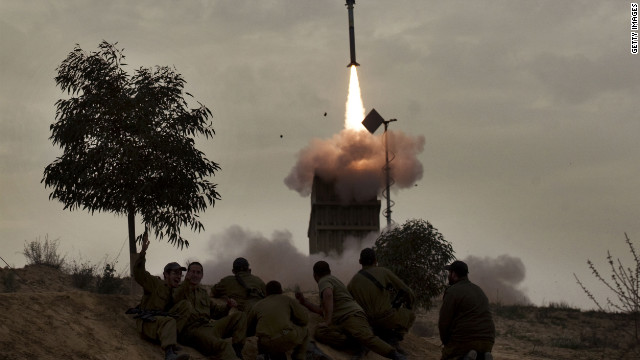
Israeli soldiers watch a missile launch from the Iron Dome defense system in the southern Israeli city of Beer Sheva on Monday.

Editor's note: David Frum, a CNN contributor, is a contributing editor at Newsweek and The Daily Beast. He was a special assistant to President George W. Bush from 2001 to 2002 and is the author of six books, including "Comeback: Conservatism That Can Win Again." 

(CNN) -- As Iran rushes ahead with its nuclear program, some foreign policy thinkers urge Israel to accept that it must live with "incomplete" security.

-
Israel has met the barrage with a new defense system, named Iron Dome.
David Frum
David Frum
Iron Dome senses rocket launches. Its computers assess which rockets are headed toward populated areas, then it fires missiles to intercept the incoming rockets. 
 -
According to the Israel Defense Forces, Iron Dome has achieved a success rate of more than 90% when fired. Since Friday, Palestinian militants have fired more than 170 rockets at Israeli cities, but as yet, no Israeli civilians have been killed.
 -
Since 2001, Israel has responded to attacks by deploying ever-more effective technological systems: first the security fence to halt the entry of suicide bombers; now Iron Dome to stop short-range rockets; and in time, the Arrow anti-ballistic missile system against longer-range missiles.
-
These innovations have defeated and deterred violence and saved many lives.
But these innovations are also subject to inherent weaknesses.
The rockets launched from Gaza are armed only with explosives and shrapnel. When Iron Dome misses -- and it does sometimes miss -- the Gaza rockets kill and maim only within a very limited radius.
-
The fence also fails sometimes. Last year for example, a British citizen was killed and 50 people wounded by a suicide bombing near the Jerusalem convention center. Yet as with the Gaza rockets, the lethality of suicide bombings is inherently limited. Israel does not need to reach 100% success to defeat the terrorism threat.
Suppose, however, that the rockets carried nuclear payloads, or that the suicide bombers had access to radioactive materials. Then a 90% success rate would not nearly suffice.
-
Iran's nuclear program threatens to upend the strategic calculus of the past decade, to overwhelm all Israeli countermeasures to protect Israel's population.
-
A nuclearized Iran does not imply "incomplete" security for Israel. It would expose Israel to absolute insecurity.
As rockets fly toward southern Israel, the rest of Israel carries on. The economy produces and thrives. 
-
A relative of mine, visiting Jerusalem, comments that if she were not reading about the rockets in the newspapers, she would not know they were being fired.
Yet even the threat of a mass-casualty event would paralyze the Israeli economy. 
 -
People would avoid downtowns, visitors would stay home, children would be sent abroad, investment flows would cease. Iran would not have to shoot at Israel. It would just have to talk loosely about shooting at Israel to do vast harm.
-
Iron Dome represents a triumph of Israeli science, generously supported by U.S. aid under both Presidents Bush and Obama. But we remain far away from a high-tech shield against the Iranian threat. 
-
This week's congratulations to Israel must be tempered by awareness: The biggest danger -- Iran's potential ability to build a weapon that could kill hundreds of thousands in a single strike -- looms as menacing as ever.

Death penalty on table..[ 2787 ]

Death penalty on table for Victorian Edward Myatt


Edward Norman Myatt
Edward Norman Myatt, 54, was arrested last month. Picture: Lukman S. Bintoro The Daily Telegraph
POLICE in Bali have confirmed an alleged Australian drug smuggler will face three charges including trafficking, which attracts a possible death sentence. 
-
Edward Myatt, 54, was arrested two weeks ago at Ngurah Rai airport after he was allegedly caught trying to smuggle 1.1kg of hashish and more than four grams of methamphetamines into Bali in his stomach.
-
Police have now finished their preliminary investigations, confirming yesterday the Victorian would face three charges, the most serious of which could put him in front of a firing squad.
It is expected Myatt will be charged under three separate articles of Indonesia's anti-drugs laws, including possession, importing and distributing narcotics.
-
Bali police spokesman Hariadi said on Monday that Myatt had told investigators he bought the drugs, which have an estimated street value of $70,000, in Delhi from a man known as "Dr Steve" for about $1250.
He then separated the drugs into smaller quantities and wrapped them in plastic at his hotel before continuing onto Bali.
-
It is unclear when Myatt allegedly bought the drugs but police said he had been in Delhi since February 2 after travelling to India on a Virgin Atlantic flight from London's Heathrow Airport.
He was arrested in Bali on February 27 after arriving on a flight from Delhi via Bangkok.
The Ballarat-born man has denied being part of a larger drug-smuggling network, telling police last week he had been working alone.
-
But investigators remain unconvinced and are continuing to explore the possibility that Myatt was part of an organised operation, and may even have smuggled drugs into Bali in the past.
"There's such an indication that such a syndicate exists," Hariadi said on Monday.
"We're still developing the case and gathering statements related to the evidence."
While Myatt was born in Ballarat, it is understood he has lived in the UK for a number of years.
-
He has provided Bali police with addresses in Balwyn, Melbourne, and Yorkshire in England.
Myatt holds an Australian and British passport and has been receiving consular assistance from both countries.
If convicted, he faces a minimum of five years in jail.
-
But similar cases in the recent past have produced far more severe outcomes.
Sydney man Michael Sacatides was sentenced last year to 18 years in prison for attempting to smuggle of 1.7kg of methamphetamines, commonly known as ice, into Bali.
He is being held at Bali's Kerobokan jail, where a total of 12 Australians are housed, including the Gold Coast's Schapelle Corby and the Bali Nine.

Satellite Sea Launch..[ 2786 ]

Sea Launch Signs Two Satellite Launch Contracts

Sea Launch
MOSCOW, March 12 (RIA Novosti)
The Sea Launch consortium said on Monday it has signed contracts on the launch of a European and a U.S. telecoms satellites.
The company is expected to launch the Eutelsat 70B communications satellite in the fourth quarter of 2012, and the Intelsat 27 satellite in the beginning of 2013.
-
Both launches will be carried out from Sea Launch's floating platform Odyssey at its equatorial launch site in the international waters of the Pacific Ocean.
-
The Sea Launch system offers the most direct and cost-effective route to geostationary orbit for commercial communications satellites, providing diversity of supply, affordability and flexibility for the industry's satellite operators.
It uses reliable Ukrainian-built Zenit-3SL carrier rockets with Russian DM boosters to deliver satellites into orbit.
-
Sea Launch AG was formed in 1995 as a consortium of four companies from Norway, Russia, Ukraine and the United States, and managed by U.S. Boeing. 
 -
It resumed operations last year after a 30-month hiatus that saw passage through U.S. Chapter 11 bankruptcy, change of ownership from Boeing to Energia and a move from California to Switzerland.
The company has conducted over 30 launches so far. Two of them resulted in failure and one was abortive.
-

Gaza-Israel violence...[ 2785 ]

Gaza-Israel violence enters 4th day

By the CNN Wire Staff
March 12, 2012 -- Updated 1414 GMT (2214 HKT)
 
Israel, Gaza exchange rocket fire


Gaza City (CNN) -- Five people were killed Monday in Gaza, the latest deaths in days of airstrikes that marked the worst escalation of violence in the coastal territory in months, Palestinian officials said.
Israel has said its airstrikes have targeted militant rocket launching sites across the Palestinian territory in response to more than 100 rocket attacks from Gaza into Israel since Friday.
-
At least 23 people have been killed in strikes since Friday, while at least 75 people have been wounded.
Three civilians and two militants were killed in what Palestinian medical officials said were Israeli airstrikes Monday.
A civilian was killed and three others were injured Monday afternoon in the northern Gaza neighborhood of Beit Lahia, Palestinian officials said. The Israeli military had no immediate information on that incident.
-
Israeli and Palestinian officials offered conflicting accounts of another blast Monday that killed a 15-year-old boy in Gaza.
Palestinian medical and security sources said an Israeli airstrike killed the teen, but the Israeli military said it did not attack the area where the death was reported.
-
"We did not attack during those hours of the morning in the northern Gaza strip," Lt. Col. Avital Leibovich told CNN, saying that Israeli military activity during the time was focused on southern Gaza.
-
"One of the possibilities is that one of the terrorist organizations in Gaza fired a rocket that landed inside Gaza," Leibovich said, noting that some two dozen rockets fired by Palestinians militants in the last four days have landed inside Gaza.
Two militants also were killed in overnight airstrikes in southern Gaza, Palestinian officials said, and 40 people were injured.
-
The fighting is the worst outbreak of violence in Gaza this year and comes as Israel and the world's attention has been largely focused on Iran and Syria.
A spokesman for the militant group Islamic Jihad warned Israeli citizens Monday to stay in their bunkers, vowing the group would fire more rockets into southern Israel.
-
Speaking at a press conference Monday in Gaza City, Abu Ahmed boasted his group had fired dozens of longer-range Grad rockets into Israel and a larger number of smaller short-range rockets.
Ahmed said Islamic Jihad would not enter a cease-fire agreement with Israel until it paid the price for its aggression.
Since Friday, eight Israelis have been wounded and 500,000 have been forced into shelters, Israeli military and emergency services said. More than 200,000 children are being kept home from school as a safety precaution, according Israeli police spokesman Micky Rosenfeld.
At least 15 rockets and mortars were fired Monday, Rosenfeld said. There were no reports of injuries.
 -
Defense Minister Ehud Barak defended Israel's response to rocket attacks.
"We remain determined to protect and defend our citizens," Barak said Monday. "If the attacks continue, we will continue to respond. It takes patience and resilience to overcome these challenges, but we are determined and we will be ready to defend our civilians at any moment."
-
A spokeswoman for the Israel Defense Forces said Monday's strikes targeted a weapons storage facility and rocket launching sites in Gaza.
Israeli Prime Minister Benjamin Netanyahu suggested Sunday that the new cycle of attacks and counterattacks resulted from a successful Israeli strike on "an arch-terrorist who organized many attacks against the state of Israel."
-
"Naturally, this led to another round with the Popular Resistance Committees, Islamic Jihad and other groups," Netanyahu said, naming Palestinian militant groups.
Israel's military "is striking at them in strength," Netanyahu said. "We have exacted from them a very high price; naturally, we will act as necessary."
-
Palestinian factions met Sunday to discuss the possibility of a truce, according to a spokesman for the Salah Edeen Brigades, one of the militant factions. Hamas leadership in Gaza and Egyptian officials were working to try to bring about a truce, said the spokesman, who goes by the name Abu Muhamad.
-
However, Islamic Jihad rejected the possibility of a truce until certain conditions are met, including an end to the airstrikes and "targeted assassinations," according to the militant group's official radio station.
Israeli Foreign Minister Avigdor Liberman said Israel makes its "best effort to target terrorists and not the civilian population," but added: "We will not accept the constant disruption of life in the south of Israel, and I advise all heads of terror to think well about their actions."
-
He blamed Hamas, the Palestinian Islamist movement that runs Gaza, and Palestinian Authority President Mahmoud Abbas for the violence.
"Abbas must decide if he wants to conduct serious negotiations for peace or align himself with Hamas and Islamic Jihad and become a part of the map of world terror," Liberman said.
-
He was referring to ongoing talks between Abbas' Fatah faction and Hamas, aimed at forming a new Palestinian unity government. The two factions have been bitter rivals since Hamas seized control of Gaza in 2007.
Both sides sent letters Sunday to the U.N. Security Council, calling for an end to the violence.
-
CNN's Talal Abu Rahma, Guy Azriel, Kevin Flower, Kareem Khadder and Josh Levs contributed to this report.