The Hellenic Navy (HN) (Greek: Πολεμικό Ναυτικό, Polemikó Naftikó, abbreviated ΠΝ) is the naval force of Greece, part of the Greek Armed Forces. The modern Greek navy has its roots in the naval forces of various Aegean Islands, which fought in the Greek War of Independence. During the periods of monarchy (1833–1924 and 1936–1973) it was known as the Royal Navy (Βασιλικόν Ναυτικόν, Vasilikón Naftikón, abbreviated ΒΝ).The total displacement of all the navy's vessels is approximately 150,000 tons.The motto of the Hellenic Navy is "Μέγα το της Θαλάσσης Κράτος" from Thucydides' account of Pericles' oration on the eve of the Peloponnesian War. This has been roughly translated as "Great is the country that controls the sea". The Hellenic Navy's emblem consists of an anchor in front of a crossed Christian cross and trident, with the cross symbolizing Greek Orthodoxy, and the trident symbolizing Poseidon, the god of the sea in Greek mythology. Pericles' words are written across the top of the emblem. "The navy, as it represents a necessary weapon for Greece, should only be created for war and aim to victory."...............The Hellenic Merchant Marine refers to the Merchant Marine of Greece, engaged in commerce and transportation of goods and services universally. It consists of the merchant vessels owned by Greek civilians, flying either the Greek flag or a flag of convenience. Greece is a maritime nation by tradition, as shipping is arguably the oldest form of occupation of the Greeks and a key element of Greek economic activity since the ancient times. Nowadays, Greece has the largest merchant fleet in the world, which is the second largest contributor to the national economy after tourism and forms the backbone of world shipping. The Greek fleet flies a variety of flags, however some Greek shipowners gradually return to Greece following the changes to the legislative framework governing their operations and the improvement of infrastructure.Blogger Tips and Tricks
This is a bilingual blog in English and / or Greek and you can translate any post to any language by pressing on the appropriate flag....Note that there is provided below a scrolling text with the 30 recent posts...Αυτό είναι ένα δίγλωσσο blog στα Αγγλικά η/και στα Ελληνικά και μπορείτε να μεταφράσετε οποιοδήποτε ποστ σε οποιαδήποτε γλώσσα κάνοντας κλικ στη σχετική σημαία. Σημειωτέον ότι παρακάτω παρέχεται και ένα κινούμενο κείμενο με τα 30 πρόσφατα ποστς....This is a bilingual blog in English and / or Greek and you can translate any post to any language by pressing on the appropriate flag....Note that there is provided below a scrolling text with the 30 recent posts...Αυτό είναι ένα δίγλωσσο blog στα Αγγλικά η/και στα Ελληνικά και μπορείτε να μεταφράσετε οποιοδήποτε ποστ σε οποιαδήποτε γλώσσα κάνοντας κλικ στη σχετική σημαία. Σημειωτέον ότι παρακάτω παρέχεται και ένα κινούμενο κείμενο με τα 30 πρόσφατα ποστς.........

Saturday, March 10, 2012

Video made Japan tsunami 'more real'...[ 2779 ]

Video made Japan tsunami 'more real'

By Kyle Almond, CNN
March 9, 2012 -- Updated 1748 GMT (0148 HKT)
 
2011: Japan tsunami brings destruction / Video


(CNN) -- One year ago, the world watched as a massive tsunami engulfed entire communities in northern Japan.
Live television footage showed waves as high as 30 feet rushing into coastal cities, tossing around boats, cars and rooftops just an hour after one of the largest earthquakes ever recorded.
"I thought Japan would disappear," one elderly survivor said in the immediate aftermath. "I thought Japan would disappear under water."
Earthquakes are not uncommon for Japan, which rests on one of the world's most active fault lines. But the one that triggered the tsunami on March 11, 2011, had a magnitude of 9.0, making it the fourth-largest earthquake in the world since 1900.
"My wife and I stood outside and basically held on to the outside of our house," resident Matt Alt said on the day of the quake. "We couldn't even stand up. We have never ever felt anything on the magnitude of what we experienced today."
-
The videos from last year's disaster are still astonishing today. One shows a man trapped in rushing waters, desperately clinging to a telephone wire. Another shows people running away from the tsunami, barely escaping before a wall of water barrels into their homes.
Many other people, however, were not so lucky. As of Friday, the official death toll was 15,854. An additional 3,167 people are still missing.
The total damage from the disaster has been estimated at about 25 million yen, or $300 billion.
-
"The house you're seeing here wasn't here before," one man said, showing his neighborhood's damage a week after the tsunami. "It was swept here by the wave. The houses that were here were completely washed away."
With the popularity of mobile phones in Japan, last year's tsunami was one of the most recorded natural disasters in history. Amateur videos surfaced quickly, making it easier than ever for people around the world to empathize with the victims, said Tokyo-based technology consultant Steve Nagata.
-
"Because you had all of this very real footage, it made the incident much more real in people's minds," Nagata recently told CNN's Kyung Lah. "They no longer have to imagine what a tsunami is. They saw it live. ... To be able to do this in near real time and to do it to audiences across the globe is unprecedented."
Many people lost their homes in the tsunami but were fortunate to find shelter at nearby evacuation centers.
-
In Ishinomaki, Japan, evacuees used old boxes to set up "cardboard cities" while they waited for temporary housing to be built.
One of those evacuees, Yoshichi Suzuki, had a positive outlook as he stayed with his grandchildren at the shelter.
Two months after the tsunami, Suzuki was nursing several plants that he had salvaged from his damaged home.
"They were washed away by the tsunami but still survived," he told Lah. "And they're blooming with flowers now.
"Just like the plants, we must go on and live."
-
To see more amazing video footage from Japan's earthquake and tsunami, check out the complete coverage rail at right or click here.

Japan mourns tsunami dead...[ 2778 ]

Japan mourns tsunami dead; grapples with unfinished business


Girls pray after arranging candles at a candlelight event in Iwaki, Fukushima prefecture March 10, 2012. REUTERS-Kim Kyung-Hoon
Participants place candles to form the shape of '3.11' at a candlelight event in Iwaki, Fukushima prefecture March 10, 2012. REUTERS-Kim Kyung-Hoon
Paper lanterns, lit to mourn March 11, 2011 earthquake and tsunami victims, are released into the sea in Yamada town, Iwate Prefecture March 10, 2012, a day before the disaster's one-year anniversary. REUTERS-Kyodo

OFUNATO, Japan | Sat Mar 10, 2012 11:05am EST
(Reuters) - With a minute of silence, tolling bells and prayers, Japan will on Sunday mark the first anniversary of an earthquake and tsunami that killed thousands and set off a nuclear crisis that shattered public trust in atomic power and the nation's leaders.
A year after the magnitude 9.0 earthquake unleashed a wall of water that hit Japan's northeastern coast, killing nearly 16,000 and leaving nearly 3,300 unaccounted for, the country is still grappling with the human, economic and political costs.
-
Along the coast, police and coastguard officers, urged on by families of the missing, still search rivers and shores for remains even though the chances of finding any would appear remote. Without bodies, thousands of people are in a state of emotional and legal limbo.
-
Koyu Morishita, 54, lost his 84-year-old father, Tokusaburo, as well as his home and family-run fish factory in the port of Ofunato. Tokusaburo's body has not been found.
"I do cry a little bit every once in a while, but my true tears will come later, when I have time," Morishita said while visiting a memorial for his father at a hilltop temple above Ofunato, accompanied by his dog, Muku.
-
Like the rest of the country, Ofunato will observe a moment of silence at 2:46 p.m. (0546 GMT) when the quake struck and then again, 33 minutes later when a 23-metre (75-foot) wall of water hit the town, killing 340 of its 41,100 residents and leaving 84 missing.
A "bell of hope" will toll and mourners will sail out to sea to release lanterns.
The Japanese people earned the world's admiration for their composure, discipline and resilience in the face of the disaster while its companies impressed with the speed with which they bounced back, mending torn supply chains.
-
As a result, the economy looks set to return to pre-disaster levels in coming months with the help of about $230 billlion in rebuilding funds agreed in rare cooperation between the government and the opposition.
"In recent history, Japan seized rapid economic expansion from the ashes and desolation of World War Two, and we built the most energy-efficient economy in the world in the aftermath of the oil shock," Prime Minister Yoshihiko Noda said in an article published in the Washington Post.
"On the anniversary of the Great East Japan Earthquake, we remember that today we face a challenge of similar proportions."

"100 PEOPLE, 100 OPINIONS"
Yet people are increasingly sceptical about whether the political establishment is up to the task.
Politicians and bureaucrats drew fire for the chaotic response to the crisis at the tsunami-wrecked Fukushima nuclear plant and their failure to seize the moment and tackle a myriad of ills that have dogged Japan for two decades.
"If there are 100 people, there will be 100 opinions," said Morishita. "We are hoping that someone can lead us and show us hope and dreams. But that doesn't exist."
After a brief truce, politicians resumed business as usual: parliamentary squabbles that gave Japan its sixth leader in five years and now threaten to block important tax and welfare reforms and stall progress in dealing with other business.
-
"There is no leadership," said Hiroaki Oikawa, 56, another Ofunato resident who lost his two fish factories and his home.
Nine people from three generations of his family now live under one roof in temporary housing. Oikawa resumed operations at one of his factories last September and he is leading efforts to rebuild a shopping arcade.
"There are no politicians to whom we can leave things."
-
Anti-nuclear demonstrations planned across the country for the anniversary also serve as a reminder that many want bolder action than the government's preferred scenario of a gradual reduction in reliance on nuclear power.
Not a single community has agreed to restart reactors taken off line since the disaster, meaning all of Japan's 54 reactors may be shut by the middle of the year.
-
Slow progress in drawing up plans for the tsunami and radiation tainted region is deepening the misery of survivors, about 326,000 of whom are still homeless, including 80,000 evacuated from the vicinity of the Fukushima plant.
-
While the government declared the plant's reactors had reached "cold shutdown" in December, its dismantling and the clean-up of an area the size of Luxembourg will take decades at an incalculable cost using technologies yet to be developed.
-
Taxpayers, facing proposed sales tax increases to help fund the country's debt, will need to cough up tens of billions of dollars to prop up Fukushima plant operator Tokyo Electric Power -- widely attacked for ignoring the possibility of a disaster and for what critics say has been arrogance since.
-
($1 = 81.40 yen)
(Writing by Tomasz Janowski; Editing by Linda Sieg and Robert Birsel)

The Fukushima accident ...[2777]

What Fukushima accident did to the ocean

By Ken Buesseler, Special to CNN
March 10, 2012 -- Updated 1435 GMT (2235 HKT)
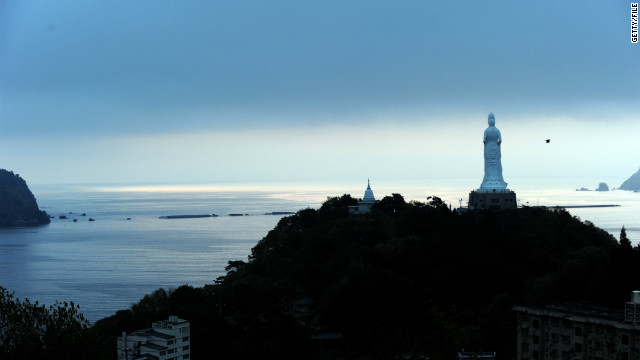
A huge Buddha statue looks over the bay in 2011 in the tsunami-devastated city of Kamaishi, Japan.


Editor's note: Ken Buesseler is a Senior Scientist at the Woods Hole Oceanographic Institution who has studied marine radioactivity since Chernobyl in 1986 and led an international research cruise off Japan in June 2011. 
-
(CNN) -- One year ago, a series of events began with an earthquake off the cost of Japan that culminated in the largest accidental release of radioactivity into the ocean in history.
-
We have to be careful and say "accidental" because in the late 1950s and early 1960s, 50 to 100 times more radioactivity was released worldwide as fallout from the intentional testing of nuclear weapons.
 -
 The word "ocean" is also important, since Chernobyl in 1986 was hundreds of miles inland, so it had a smaller impact on the concentrations of radionuclides in the sea than was measured directly off Japan in 2011.
One year later, we have to ask, what do we know about Fukushima's impact on the ocean and levels of radioactive contaminants in water and fish?
Ken Buesseler
Ken Buesseler
-
In many ways we were fortunate that impacts were largely confined to the ocean. Certainly, the Japanese people continue to feel devastating effects of so large a release within their country, and many people may never be able to return to their homes. But in general the winds during the height of the accident at the Fukushima Daiichi nuclear power plant were blowing offshore. 
-
As a result, more than three-quarters of the radioactivity fell on the ocean. This is important, as any that lands on soil remains in place, resulting in the potential for greater human exposure and increased chances of contamination to food supplies and property.
In the Pacific, however, the strong Kuroshio Current (similar to the Atlantic Gulf Stream) helped move any contamination quickly away from shore and diluted it by mixing it into deeper water.
-
This allowed us to report that by June 2011, even when we sampled within sight of the nuclear power plants, levels of cesium-137 and cesium-134 in the ocean, two primary products of nuclear fission, were elevated, but still below those considered of concern for exposure to humans. 
-
They were also well below biological thresholds of concern to the small fish and plankton we sampled, even if these were consumed by humans.
-
Several other groups have now confirmed our findings about levels of radioactivity up to 400 miles offshore.
Other measurements show trends that are more worrisome. Levels of radioactivity found in fish are not decreasing and there appear to be hot spots on the seafloor that are not well mapped. There is also little agreement on exactly how much radioactivity was released or even whether the fires and explosions at the power plant resulted in more radioactive fallout to the ocean than did direct releases of radioactivity caused by dumping water on the reactors to keep them cool.
-
Japan is taking what some think of as a precautionary measure by lowering the limits of radioactive contaminants in drinking water and food supplies, including seafood, on April 1.
-
The new level for fish will be one-tenth of the acceptable level in the United States. Will Japan's new limits build consumer confidence or raise fears and questions about why more fish are considered unsafe for consumption? And why were fish caught last year considered safe, but now are not?
-
Despite the announcement in December that operators of the power plant had achieved cold shut down, we know they are still using tons of water to cool the reactors and that not all the water has been collected or treated. As a result, the ground around the site is like a dirty sponge, saturated with contaminated water that is leaking into the ocean.
Marine sediments are also collecting radioactive contaminants, exposing bottom-dwelling fish, shellfish and other organisms on the sea floor to higher levels of contaminants than those in the waters above.
-
 Little is known, however, about the level of contamination in the groundwater and on the seafloor and whether these will be a source of contaminants long after levels in the ocean have become diluted to the point that only the most sensitive instruments can detect them.
We do know that we can detect cesium at very dilute levels, well below those considered harmful. 
 -
Using these sensitive techniques we can track the Fukushima contaminants as ocean currents carry the peak releases across the Pacific where they are expected to reach the U.S. West Coast in 2013-2014 at levels that are much lower than we measured off Japan in 2011 and thus not of concern to human health.
-
Two weeks ago, we held the largest international gathering of marine scientists studying radioactive substances in the ocean originating from Fukushima. Although we shared freely what each of us has learned in the last year, what we need today is also what we needed on March 11, 2011 — greater international coordination of long-term studies of the fate and consequences of the radiation. 
 -
We've done the initial assessments. Now we need to begin answering the tougher questions, building public confidence in scientific studies by having multiple, independent groups at work, and ensuring we have the resources to build comprehensive, long-term studies.
-
As a scientist and a marine radiochemist, I am trained to provide answers about radioactivity in the ocean—how much is out there, where it is, and what its fate is likely to be in the future. Today, we haven't gone very far beyond the first question, which was key on March 11, 2011, but hardly seems sufficient one year later.

Friday, March 9, 2012

Black bear cubs on 'Newsroom'...[ 2776 ]

Black bear cubs on 'America's Newsroom'

 March 9, 2012
'America the Wild' host Casey Anderson previews new season of adventures
VIDEO

-

B.Obama congratulated V. Putin ...[ 2775 ]

Finally, Obama Calls Putin

Topic: Vladimir Putin Elected Russian President

Barack Obama
WASHINGTON, March 9 (RIA Novosti)

U.S. President Barack Obama congratulated Russian Prime Minister Vladimir Putin on his presidential election victory in a telephone call on Friday, a Putin aide told RIA Novosti.
-
It is the first time the two men have spoken since Putin won the presidential election in a landslide on Sunday.
Obama told Putin he is ready to "work closely" with the Russian president-elect, Yury Ushakov, a foreign affairs aide to Putin said.
-
"The telephone conversation was informal and wholly substantive in nature and lasted about 20 minutes," Ushakov said.
The two also expressed willingness to hold a summit meeting in the near future and agreed to maintain contact with each other until they do meet.
-
Putin and Obama agreed that criticism of each other made in the heat of election campaigns should not be allowed to become obstacles in bilateral relations.
Putin stressed the importance of Russian-U.S. relations for global security and Obama expressed the hope "that the positive trends in bilateral relations seen in the last few years will continue," the aide said.
Putin also wished Obama luck in his White House re-election campaign.
-
Media correspondents accompanying Obama in Virginia earlier reported that Obama was putting through a call to Putin, citing Principal Deputy White House Press Secretary Josh Earnest.
-
“The president called president-elect Vladimir Putin this morning. Josh did not say whether it was a call to congratulate him (following Putin's victory in Sunday’s presidential election). 
-
The White House will report on the substance of the call later,” according to a statement made available to RIA Novosti.
-
The media has been rife with speculation as to why Obama waited so long to make a call to Putin, whose election victory occurred five days ago. Yesterday White House Press Secretary Jay Carney said: “I would not read anything into it beyond the busy schedules of the two.”