The Hellenic Navy (HN) (Greek: Πολεμικό Ναυτικό, Polemikó Naftikó, abbreviated ΠΝ) is the naval force of Greece, part of the Greek Armed Forces. The modern Greek navy has its roots in the naval forces of various Aegean Islands, which fought in the Greek War of Independence. During the periods of monarchy (1833–1924 and 1936–1973) it was known as the Royal Navy (Βασιλικόν Ναυτικόν, Vasilikón Naftikón, abbreviated ΒΝ).The total displacement of all the navy's vessels is approximately 150,000 tons.The motto of the Hellenic Navy is "Μέγα το της Θαλάσσης Κράτος" from Thucydides' account of Pericles' oration on the eve of the Peloponnesian War. This has been roughly translated as "Great is the country that controls the sea". The Hellenic Navy's emblem consists of an anchor in front of a crossed Christian cross and trident, with the cross symbolizing Greek Orthodoxy, and the trident symbolizing Poseidon, the god of the sea in Greek mythology. Pericles' words are written across the top of the emblem. "The navy, as it represents a necessary weapon for Greece, should only be created for war and aim to victory."...............The Hellenic Merchant Marine refers to the Merchant Marine of Greece, engaged in commerce and transportation of goods and services universally. It consists of the merchant vessels owned by Greek civilians, flying either the Greek flag or a flag of convenience. Greece is a maritime nation by tradition, as shipping is arguably the oldest form of occupation of the Greeks and a key element of Greek economic activity since the ancient times. Nowadays, Greece has the largest merchant fleet in the world, which is the second largest contributor to the national economy after tourism and forms the backbone of world shipping. The Greek fleet flies a variety of flags, however some Greek shipowners gradually return to Greece following the changes to the legislative framework governing their operations and the improvement of infrastructure.Blogger Tips and Tricks
This is a bilingual blog in English and / or Greek and you can translate any post to any language by pressing on the appropriate flag....Note that there is provided below a scrolling text with the 30 recent posts...Αυτό είναι ένα δίγλωσσο blog στα Αγγλικά η/και στα Ελληνικά και μπορείτε να μεταφράσετε οποιοδήποτε ποστ σε οποιαδήποτε γλώσσα κάνοντας κλικ στη σχετική σημαία. Σημειωτέον ότι παρακάτω παρέχεται και ένα κινούμενο κείμενο με τα 30 πρόσφατα ποστς....This is a bilingual blog in English and / or Greek and you can translate any post to any language by pressing on the appropriate flag....Note that there is provided below a scrolling text with the 30 recent posts...Αυτό είναι ένα δίγλωσσο blog στα Αγγλικά η/και στα Ελληνικά και μπορείτε να μεταφράσετε οποιοδήποτε ποστ σε οποιαδήποτε γλώσσα κάνοντας κλικ στη σχετική σημαία. Σημειωτέον ότι παρακάτω παρέχεται και ένα κινούμενο κείμενο με τα 30 πρόσφατα ποστς.........

Friday, January 13, 2012

Iran's ' oil at deep discount ...[ 2630 ]

Iran's 'distressed' oil to keep flowing - at deep discount

@CNNMoney January 12, 2012: 4:49 PM ET
-
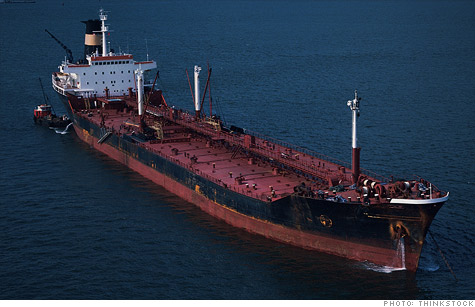
As Japan, South Korea and European counties wean themselves from Iranian crude, the country could be forced to sell its oil for 10% to 15% less.
-
NEW YORK (CNNMoney) -- Despite tightening sanctions on Iran's oil industry, experts say the country's crude should still flow -- but perhaps at a deep discount.
In fact, the bargaining has already begun, two analysts said.
China, the largest buyer of Iranian oil, has sharply reduced its imports from Iran over the past two months. 
-
But it hasn't been in sympathy with U.S. efforts to pressure Iran on its nuclear efforts. Rather, China believes it can negotiate a lower price.
"This isn't about Beijing trying to be a good actor," said Trevor Houser, a partner at the international economics research firm Rhodium Group. "The Chinese are trying to get a better price on what is now a distressed asset."
-
Iran finds its oil in a state of distress thanks to tightening sanctions imposed by the United States, Britain and anticipated moves from the European Union.
As Iran loses customers, remaining clients like China can ask for a discount oil price.
Houser suspects Iran will ultimately have to sell its oil for a 10% to 15% discount, putting a significant dent in the government's budget.
-
"That's much greater than anything we've seen to date in terms of impact from sanctions," he said.

Oil price spike from Iran sanctions seems unlikely

The U.S. sanctions basically say any bank that processes Iranian oil transactions will be barred from doing business in the United States. The sanctions are in effect but enforcement hasn't begun.
They are the toughest sanctions the United States has imposed on Iran's oil industry, which supplies the Iranian government with about half of its revenue.
Iran exports about 2.3 million barrels of oil per day, mostly to Asia. The world consumes about 89 million barrels a day.
-
The sanctions are designed to put financial pressure on Iran so it gives up its nuclear program, which Iran says is for peaceful purposes but many suspect is intended to produce a bomb.
Experts are mixed on whether the sanctions will actually work.
-
On Thursday Japan, the second-largest buyer of Iranian oil, said it will gradually shift away from buying Iranian crude. There were conflicting reports that India, Iran's third-largest customer, will do the same. European nations and South Korea are expected to wean themselves from Iranian oil over the next year.
-
In many ways this is a win-win situation for President Obama and European leaders. They want to hit Iran where it hurts -- in its wallet -- but don't want to cause an oil price spike that will have a similar effect on drivers in their home countries. Having Iran still supply the world with crude -- but at a lower price -- hits that goal.
-
"At the end of the day, the Obama administration doesn't want to fully implement" the sanctions, said Greg Priddy, an oil analyst at Eurasia Group, a political risk consultancy. "They want something that hurts them, not us."
Priddy agreed that Iran's oil will need to be sold at a discount.
But other analysts doubt these new sanctions will really hurt Iran.
-
Oil is an easily traded commodity. Iran can find buyers for its crude on the black market, through middle men, or from countries willing to flout the sanctions.
The sanctions could cause the price of oil to go up, so even if Iran does reduce the amount of crude it sells, it won't suffer financially.
-
"I don't think this is a serious blow," said Manouchehr Takin, an energy analyst at the Center for Global Energy Studies in London and a former executive in the consortium that ran Iran's oil fields under the Shah. "They might even gain revenue if the price goes up."  To top of page

Thursday, January 12, 2012

The arrest of Abbot Efraim of "Athos" ...[ 2629 ]

Greek church protests pre-trial detention of Abbot Efraim

Abbot Efraim
ATHENS, January 12 (RIA Novosti)
The autocephalous Orthodox Church of Greece has called for the release of Abbot Efraim, the head of the Vatopedi Monastery in Mount Athos, who is currently under arrest on real estate fraud charges, the church’s Holy Synod said on Thursday. 
-
“Our church respects rulings by justice and would not like to interfere in its responsibility sphere… Nevertheless, together with many believers, the church expresses sympathy of all its members to the embattled abbot, and… hopes the possibility of his release from custody will be reconsidered,” it said.
-

The Cypriot-born 56-year-old Abbot Efraim is accused of involvement in a criminal scheme under which the Greek government swapped cheap farmland for costly Athens real estate in favor of the Vatopedi Monastery. He says he is not guilty.
-

The head of the Church of Greece, Ieronymos II, Archbishop of Athens and All Greece, plans to visit Efraim in jail.
-

On December 29, the head of the Russian Orthodox Church, Patriarch Kirill of Moscow and All Russia, urged Greek President Karolos Papoulias to release Efraim, who was arrested on December 24.
-

In November, Efraim led a Vatopedi Monastery delegation that brought one of the main Christian relics, a belt of the Virgin Mary, to Russia for the first time in history.

The arrest of Efraim has sparked a diplomatic row between Moscow and Athens.
-

The Church of Greece is one of the fourteen autocephalous churches in the Orthodox Christian community. Mount Athos is within the jurisdiction of another autocephalous church in Greece, the Ecumenical Patriarchate of Constantinople.
-

The Ecumenical Patriarchate denounced the Russian Orthodox Church’s interference in the case.

A number of Greek legal experts have questioned whether the police actions on self-governed Mount Athos were legal. Athos is part of Greek territory. Its monks are Greek citizens, but a special warrant from the prosecutor’s office is required to arrest a person on Athos.

Bomb attack on Iran nuclear scientist...[ 2628 ]

US condemns bomb attack on Iran nuclear scientist

Wreck of blown up car in Tehran. 11 Jan 2012  
A magnetic bomb was attached to the car by two motorcyclists, Iran says


The US has condemned the killing of an Iranian nuclear scientist in a car bomb attack in north Tehran.
National Security Council spokesman Tommy Vietor said the US "had absolutely nothing to do" with the attack.
Mostafa Ahmadi-Roshan, who worked at the Natanz uranium enrichment facility, died along with the driver of the car.
Several Iranian nuclear scientists have been assassinated in recent years, with Iran blaming Israel and the US.
Both deny any involvement.
Washington and its allies suspect Tehran of secretly developing a nuclear weapon but Iran insists its nuclear programme is peaceful.
"The United States had absolutely nothing to do with this. We strongly condemn all acts of violence, including acts of violence like this," said Mr Vietor.
Iran's Atomic Energy Organization described the killings as "a heinous act".
Iranian Vice-President Mohammad Reza Rahimi said on state TV that the bomb attack would not stop "progress" in the country's nuclear programme.
Mr Ahmadi-Roshan, 32, was a university lecturer who supervised a department at the Natanz plant, the semi-official news agency Fars reported.
Iranian officials said two men on a motorcycle attached a magnetic bomb to his car during the morning rush hour and detonated it outside a university campus.
Mr Ahmadi-Roshan died immediately while his driver died later of his wounds, Fars reported. A third occupant of the Peugeot 405 was injured and taken to hospital.
The blast left debris hanging in nearby trees.
Iran says the attack was similar to the killings of three other scientists over the past two years.
A senior Israeli official described the attack as "revenge" but said he was unaware who had carried it out.
-
"I don't know who took revenge on the Iranian scientist but I am definitely not shedding a tear," military spokesman Brig Gen Yoav Mordechai wrote on his official Facebook page.
The attack comes amid rising tensions between Iran and the West.
The UN's nuclear watchdog recently confirmed that Tehran had begun enriching uranium up to 20% at its underground northern Fordo plant near Qom.
The US said it was "a further escalation" of Iran's violation of UN resolutions regarding its nuclear plans.
In a further attempt to pile pressure on Iran, Western UN envoys on Wednesday condemned Iran's enrichment of uranium at the Fordo plant as a "clear breach" of UN resolutions.
France's deputy envoy Martin Briens said Britain, France, Germany and the US raised concerns at the Security Council because the new plant has no "credible civilian use".
-
Nuclear scientist Mostafa Ahmadi-Roshan  
Mostafa Ahmadi-Roshan worked at the Natanz uranium enrichment facility
However, the BBC's Barbara Plett at the UN says an agreement on further sanctions is unlikely.
The UN Security Council has passed six resolutions and four rounds of sanctions against Iran although Russia and China are expected to block any further measures.
Russian Deputy Foreign Minister Sergei Ryabkov earlier told the Itar-Tass news agency that Moscow was firmly against any new sanctions on Iran, adding that they wouldn't help nuclear non-proliferation.
-
Western nations are also imposing sanctions on Iran over its nuclear programme. In response, Tehran has threatened to block the transport of oil through the Strait of Hormuz.
US Secretary of State Hillary Clinton on Wednesday described that threat as "provocative and dangerous".
-
CLICKABLE
Massoud Ali Mohammadi Majid Shahriari Fereydoon Abbasi Davani Mostafa Ahmadi Roshan Interactive map of Tehran

Wednesday, January 11, 2012

US launched its first drone attack in Pakistan ...[ 2627 ]

U.S. launches first drone strike since deadly November attack

By the CNN Wire Staff
January 11, 2012 -- Updated 0957 GMT (1757 HKT)
Drone missions were halted last year after a set of controversial American strikes left two dozen Pakistani soldiers dead.


(CNN) -- The United States has launched its first drone attack in Pakistan after more than a month-long lull, killing at least four suspected militants, CNN has confirmed.

The drone fired two missiles on Tuesday at a suspected militant compound near the provincial capital of Miranshah in the North Waziristan region, located in the country's volatile tribal belt that borders Afghanistan.
-

It represents an apparent end to the pause in U.S. drone strikes in Pakistan, halted last year after a set of controversial American strikes left two dozen Pakistani soldiers dead at two mountainous border posts and further strained relations between the two nations.

Pakistan's military has repeatedly insisted that airstrikes that killed 24 of its soldiers on November 26 near the Afghan border were deliberate. Its government soon thereafter ordered the American military to vacate an air base used to launch drone strikes.

A U.S. investigation into the attacks blamed poor communication and "inadequate coordination" between both nations that prompted the deadly incident.


Brig. Gen. Stephen A. Clark said last month that a coalition team heading toward an Afghan village near the Pakistani border came under attack from "very direct and heavy" machine gun fire, as well as to incoming mortars.
-

The ground commander responded with a "show of force," with an F-15 jet and an AC-130 gunship making their presence known and dropped flares illuminating the area, Clark said. When the firing and mortars didn't stop, airstrikes were called in.

But Pakistani officials have argued that well-established operating procedures and an intricate system for operational information sharing were deliberately ignored, which led to the deaths.
-

The disagreement is thought to have further eroded the already fragile relations between the United States and Pakistan.
-
CNN's Barbara Starr and Pam Benson in Washington and Saboor Khattak in Pakistan contributed to this report.
-

The Bulgaria parliament anf the Armenian genocide...[ 2626 ]

Bulgaria parliament rejects Armenian genocide declaration

Bulgaria parliament rejects Armenian genocide declaration
21:41 11/01/2012
MOSCOW, January 11 (RIA Novosti)
The Bulgarian parliament on Wednesday turned down a declaration recognizing the Ottoman Empire's genocide against Armenians, the Sofia News Agency reported.

The declaration refers to the deaths of more than 1 million Armenians living in the Ottoman Empire between 1915 and 1917.
-

It was the fifth time the declaration, initiated on behalf of the far-right Ataka (Attack) party, failed to pass.

Ataka leader Volen Siderov said it was natural for "a patriotic party like his" to recognize the Armenian genocide.

"To hide certain events from your history because they are bad for you as a country is demagogy, in my opinion," he said.
-

Lyutvi Mestan, a senior MP from the ethnic Turkish Movement for Rights and Freedoms party, opposed Ataka's proposal, saying parliament was not an institution to establish historical truths.
-

Some 1 million Turks live in Bulgaria, constituting the country's largest ethnic minority. Armenians, though considerably fewer in number, are also among Bulgaria's significant minorities.