The Hellenic Navy (HN) (Greek: Πολεμικό Ναυτικό, Polemikó Naftikó, abbreviated ΠΝ) is the naval force of Greece, part of the Greek Armed Forces. The modern Greek navy has its roots in the naval forces of various Aegean Islands, which fought in the Greek War of Independence. During the periods of monarchy (1833–1924 and 1936–1973) it was known as the Royal Navy (Βασιλικόν Ναυτικόν, Vasilikón Naftikón, abbreviated ΒΝ).The total displacement of all the navy's vessels is approximately 150,000 tons.The motto of the Hellenic Navy is "Μέγα το της Θαλάσσης Κράτος" from Thucydides' account of Pericles' oration on the eve of the Peloponnesian War. This has been roughly translated as "Great is the country that controls the sea". The Hellenic Navy's emblem consists of an anchor in front of a crossed Christian cross and trident, with the cross symbolizing Greek Orthodoxy, and the trident symbolizing Poseidon, the god of the sea in Greek mythology. Pericles' words are written across the top of the emblem. "The navy, as it represents a necessary weapon for Greece, should only be created for war and aim to victory."...............The Hellenic Merchant Marine refers to the Merchant Marine of Greece, engaged in commerce and transportation of goods and services universally. It consists of the merchant vessels owned by Greek civilians, flying either the Greek flag or a flag of convenience. Greece is a maritime nation by tradition, as shipping is arguably the oldest form of occupation of the Greeks and a key element of Greek economic activity since the ancient times. Nowadays, Greece has the largest merchant fleet in the world, which is the second largest contributor to the national economy after tourism and forms the backbone of world shipping. The Greek fleet flies a variety of flags, however some Greek shipowners gradually return to Greece following the changes to the legislative framework governing their operations and the improvement of infrastructure.Blogger Tips and Tricks
This is a bilingual blog in English and / or Greek and you can translate any post to any language by pressing on the appropriate flag....Note that there is provided below a scrolling text with the 30 recent posts...Αυτό είναι ένα δίγλωσσο blog στα Αγγλικά η/και στα Ελληνικά και μπορείτε να μεταφράσετε οποιοδήποτε ποστ σε οποιαδήποτε γλώσσα κάνοντας κλικ στη σχετική σημαία. Σημειωτέον ότι παρακάτω παρέχεται και ένα κινούμενο κείμενο με τα 30 πρόσφατα ποστς....This is a bilingual blog in English and / or Greek and you can translate any post to any language by pressing on the appropriate flag....Note that there is provided below a scrolling text with the 30 recent posts...Αυτό είναι ένα δίγλωσσο blog στα Αγγλικά η/και στα Ελληνικά και μπορείτε να μεταφράσετε οποιοδήποτε ποστ σε οποιαδήποτε γλώσσα κάνοντας κλικ στη σχετική σημαία. Σημειωτέον ότι παρακάτω παρέχεται και ένα κινούμενο κείμενο με τα 30 πρόσφατα ποστς.........

Saturday, September 24, 2011

Putin to return as president...[ 2444 ]

Putin to return as Russia's president


MOSCOW | Sat Sep 24, 2011 10:33am EDT
(Reuters) - Vladimir Putin declared on Saturday he planned to reclaim the Russian presidency at March elections that could open the way for the former KGB spy to rule until 2024.
The announcement, greeted by cheers at a congress of Prime Minister Putin's ruling United Russia party, ended months of speculation over whether he or President Dmitry Medvedev would run. The two have ruled in a power 'tandem' since Putin was forced by the constitution to yield the presidency four years ago after serving a maximum two consecutive terms.
"It is a great honor for me," Putin said to a long standing ovation from thousands of party members in a Moscow sports stadium after Medvedev proposed his mentor return as president. "Thank you, I hope for your support."
Putin, 58, described in leaked U.S. diplomatic cables as the "Alpha dog" in the tandem, then left the stage and embraced Medvedev. He also proposed his younger and more liberal protege replace him as prime minister after the March election to lead a young reformist government.
Over 11 years, Putin has cultivated the image of a vigorous leader, filmed riding bare chested, scuba diving and showing his judo skills. His policies, crushing a Chechen separatist rebellion, taming super-rich businessmen and bringing wayward regions to heel have similarly won him popularity.
But critics say his return to the Kremlin, virtually unopposed, could herald an era of economic and political stagnation in the world's largest country.
MEDVEDEV TO HEAD PARTY LIST
In carefully choreographed scenes, Putin had earlier on Saturday proposed Medvedev, 46, to lead United Russia's list of candidates for a parliamentary election on December 4.
This will prepare Medvedev for a role in government. The move is also intended to help reverse a decline in support for United Russia and boost its hopes of maintaining its two-thirds majority in the State Duma lower house.
"I want to say directly: (Medvedev and I) reached an agreement between ourselves long ago, several years ago already, on what to do in the future, on who should do what," Putin said.
"But both I and Dmitry Anatolyevich Medvedev believe that this is far from the most important thing -- who will do what, who will sit in what place. What is far more important is something else: how we will all work, what results we achieve, and how the citizens of our country will relate to this."
Opinion polls show other potential candidates, such as nationalist Vladimir Zhirinovsky or Communist Gennady Zyuganov, have much less support and Putin will easily be elected.
The main liberal opposition leaders such as former Prime Minister Mikhail Kasyanov have only limited appeal nationwide and Kasyanov's party has been barred from taking part in the parliamentary election.
The next president will be elected for six years and the constitution still limits the head of state to a maximum of two straight terms -- meaning Putin could be in power for 12 years.
Investors had been urging him to announce his plans because the political uncertainty has deterred many from putting money into the $1.5 trillion economy of the world's largest energy producer.
As president from 2000 to 2008, Putin oversaw an economic boom where household incomes improved on the back of a rise in global oil prices and his tough talking and macho image helped restore Russia's self confidence on the world stage.
But Putin, who was once a KGB officer in East Germany, is widely seen as more conservative than Medvedev and critics accuse him of riding roughshod over human rights and restoring the power of the security forces.
ERA OF STAGNATION?
Some economists say his return to the Kremlin makes it less likely that Russia will carry out much-needed changes such as pension reforms and reducing Russia's dependency on natural resources. Oil and gas revenues make up half the budget.
But Chris Weafer, a strategist at Troika Dialogue investment bank, said the need for change made it impossible for Putin not to carry out reforms.
"There will not be a return to the government style and agenda priorities of the previous Putin administration. That simply is not an option," he said.
Some experts fear a return to the economic stagnation of the 1970s and 1980s under Soviet leader Leonid Brezhnev if reforms are not carried out. Critics such as former Soviet leader Mikhail Gorbachev have warned of the risk of unrest.
"For today the country must face a very gloomy outlook -- this is stagnation and decay for another 12 years, this is the Brezhnev era revisited," said Andrei Piontkovsky, a political analyst at the Russian Academy of Sciences.
Russia, a nuclear power and permanent member of the United Nations Security Council, also faces difficulties in ties with the United States, despite calls for a "reset' in relations, and uncertainty following the upheaval in the Arab world.
Putin's return to the presidency puts at risk the good reputation he established among many Russians for restoring a degree of stability after President Boris Yeltsin's chaotic presidency in the 1990s following the Soviet Union's collapse.
But senior political sources had said Putin was worried by a perception that Medvedev did not have enough support among political and business leaders to ensure stability if he tried to push ahead with political reforms as head of state.
Other political sources suggested Putin simply did not trust Medvedev enough to allow him another six years as president -- the term has been extended from four years -- and has been disappointed with his performance.
"I fully agree (with Putin's decision to run). He is a very good and a wise man," said Denis, a Muscovite in his mid-20s.
But some Russians complain there is still a lack of democracy and media freedom in Russia and that they have little say in who runs the country of 142 million people.
"Our opinion does not count, as (the outcome) of both the current and the previous elections was pre-determined," said Anna, a Muscovite in her 20s.

(Additional reporting by Gleb Bryanksi, Steve Gutterman and Alexei Anishchuk, Douglas Busvine and Thomas Grove; editing by Ralph Boulton)

Friday, September 23, 2011

Falling satellite...[ 2443 ]

U.S. is in falling satellite's potential strike zone, NASA says


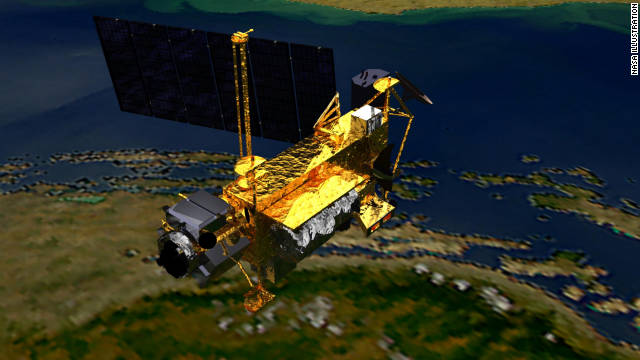
NASA's Upper Atmosphere Research Satellite is expected to re-enter the atmosphere Friday or Saturday.
 
By John Zarella, CNN
September 23, 2011 -- Updated 1628 GMT (0028 HKT)
 

Miami (CNN) -- A satellite on the verge of falling back to Earth appears to have begun slowing down but will not re-enter the atmosphere until late Friday or early Saturday U.S. time, according to NASA.
The United States is once again an unlikely but potential target for the 26 pieces of the Upper Atmosphere Research Satellite, expected to survive the descent. Those pieces, made of stainless steel, titanium and beryllium that won't burn, will range from about 10 pounds to hundreds of pounds, according to NASA.
-
NASA said Friday morning that it would be hours before it would be able to zero in on the time and place of the re-entry.
Mark Matney of NASA's Orbital Debris team in Houston said there's no way to know exactly where the pieces will come down.
"Keep in mind, they won't be traveling at those high orbital velocities. As they hit the air, they tend to slow down. ... They're still traveling fast, a few tens to hundreds of miles per hour, but no longer those tremendous orbital velocities," he explained.
-
Because the satellite travels thousands of miles in a matter of minutes as it orbits -- even just before it begins re-entry -- it will be impossible to pinpoint the exact location the pieces will come down. On top of that, Matney said, the satellite is not stable.
"Part of the problem is, the spacecraft is tumbling in unpredictable ways, and it is very difficult to very precisely pinpoint where it's coming down even right before the re-entry."
FAA: Pilots watch for falling satellite
Where will satellite debris strike?
Because water covers 70% of the Earth's surface, NASA has said that most if not all of the surviving debris will land in water. Even if pieces strike dry land, there's very little risk any of it will hit people.
However, in an abundance of caution, the Federal Aviation Administration on Thursday released an advisory warning pilots about the falling satellite, calling it a potential hazard.
-
"It is critical that all pilots/flight crew members report any observed falling space debris to the appropriate (air traffic control) facility and include position, altitude, time and direction of debris observed," the FAA statement said.
The FAA said warnings of this sort typically are sent out to pilots concerning specific hazards they may encounter during flights such as air shows, rocket launches, kites and inoperable radio navigational aids.
NASA says space debris the size of the satellite's components re-enters the atmosphere about once year. Harvard University astrophysicist Jonathan McDowell noted that the satellite is far from being the biggest space junk to come back.
-
"This is nothing like the old Skylab scare of the '70s, when you had a 70-ton space station crashing out of the sky. So, I agree with the folks in Houston. It's nothing to be worried about," McDowell said.
Pieces of Skylab came down in western Australia in 1979.
The only wild card McDowell sees is if somehow a chunk hits a populated area.
"If the thing happens to come down in a city, that would be bad. The chances of it causing extensive damage or injuring someone are much higher."
-
NASA said that once the debris hits the atmosphere 50 miles up, it will take only a matter of minutes before the surviving pieces hit the Earth.

Wednesday, September 21, 2011

The Moons of Saturn....[ 2442 ]

A Quintet of Saturn's Moons

Nevada air race crash...[ 2441 ]

11th person dies as result of Nevada air race crash

By the CNN Wire Staff
September 21, 2011 -- Updated 0209 GMT (1009 HKT)
-
New Reno air crash video shows impact


(CNN) -- An 11th person has died because of injuries sustained in the crash Friday at an air race at Reno, Nevada, an official with the Washoe County Medical Examiner's Office said Tuesday.
No details about this latest victim were released.

The official, Michelle Anderson, said there would be a news conference revealing more information late Tuesday.
-
Authorities have so far identified seven people who died from the crash

Read more :


Tuesday, September 20, 2011

U.S.-Iran 'Hotline' ?...[ 2440 ]

No U.S.-Iran 'Hotline' Anytime Soon, Official Says

PHOTO: The aircraft carrier USS Constellation patrols January 16, 2003 in the Persian Gulf.
Harkening back to the days of the Soviet Union, some U.S. officials are reportedly considering establishing an emergency "hotline" between the U.S. and Iran, but one senior defense official told ABC News those kinds of discussions are, at this point, premature.
-
The Wall Street Journal reported today several U.S. officials were weighing the establishment of a direct line between the U.S. and Iranian militaries after a series of "near-miss" encounters between the two in the Persian Gulf that could have potentially led to a broader conflict.
"There may or may not be advocates for establishing a naval hotline at some point," the senior U.S. defense official told ABC News, "but discussion of it is very premature. There are no proposals for opening up such a channel currently in front of either the Secretary of Defense or the President."
-
The Journal reported U.S. officials are particularly worried about run-ins with high-performance speed boats sometimes equipped with missiles and possibly operated by Iran's elite military force, the Islamic Revolutionary Guard Corps.
-
"We continue to be concerned about Iran's destabilizing activities and ambitions, and we remain firmly committed to protecting our personnel, our interests, and our partners in the region," Department of Defense spokesperson George Little told reporters. "We have consistently conveyed to Iran that it must halt its destabilizing behavior and avoid any provocations in the Gulf, Iraq, or elsewhere."