
Friday, September 9, 2011


Wednesday, September 7, 2011
Isolated residents in Japan..[ 2418 ]
Isolated residents in mountainous areas need protection from natural disasters

-
(Mainichi Japan) September 6, 2011
-
Powerful Typhoon No. 12, which caused tremendous damage to extensive areas of Japan, particularly the Kii Peninsula, has highlighted the need for measures to protect residents of sparsely populated mountainous areas, especially elderly people, from natural disasters.
The typhoon left a large number of people dead. Rescue workers are still searching for many missing people, while some neighborhoods remain isolated from other areas, with roads to their regions cut off in many areas and communications paralyzed. The national government, which has set up a disaster task force, should work closely with local governments concerned to search for and rescue missing people and restore disaster-hit areas.
-
The typhoon, which ran through the Shikoku and Chugoku districts in western Japan, blew out into the Sea of Japan in the predawn hours of Sept. 4. Since it was moving slowly, it brought heavy rain over a long period. In many areas, rainfall reached record levels.
The Kii Peninsula often has heavy rain, and is prone to typhoons. Still, local residents do not appear to have predicted such enormous damage this time in light of their past experiences. A natural disaster could hit any area of Japan, where there are many steep mountains and numerous rivers, at any time. The central and local governments should quickly implement disaster countermeasures that suit the situation of each region.

-
When a natural disaster occurs, the mayors of the affected municipalities are authorized to issue evacuation recommendations or orders under the Disaster Measures Basic Law if they deem the situation is dangerous. If the mayors cannot issue such recommendations or orders, the governors that have jurisdiction over the affected municipalities can perform the duty on their behalf.
-
Many people were hit by disasters triggered by the latest typhoon while staying in their homes. There are also many cases where residents were hit by disasters before evacuation recommendations or orders were issued. This shows that the authorities should also have better implemented measures to minimize damage caused by natural disasters even if it could not completely prevent them.
Local governments were late in issuing evacuation recommendations or orders apparently because the typhoon had initially caused no major damage and officials had failed to predict possible landslides and other disasters. Now that the typhoon has caused such tremendous damage, it is necessary for government officials as well as experts to scrutinize whether judgment by local authorities on issuing such orders was appropriate, learn lessons from the disaster and reflect on these issues as part of future measures to prevent disasters and to minimize damage caused by natural disasters.
-
The typhoon caused such enormous damage because it hit many sparsely populated mountainous areas where rescue workers struggled to help elderly residents to evacuate, illustrating difficulties in conducting rescue operations in such areas.
-

-
Approximately 70 percent of the Japanese archipelago is mountainous areas where the populations are declining and aging. However, it is difficult to secure enough land to build large-scale levees in such areas. Therefore, circle-shaped levees should be built around neighborhoods, the land for houses should be raised and other alternative measures should be taken to protect houses in such areas from floods and other natural disasters. Local governments that have sparsely populated areas need to learn lessons from the latest typhoon and implement anti-disaster measures that suit their respective situations, such as the compilation of disaster-prevention maps.
-
Telephone lines were paralyzed in Wakayama, Nara and Mie prefectures for a long time. The failure to communicate necessary information on the disaster as a result may have contributed to the damage. In response, local bodies should establish a communications network or improve existing ones, such as through the introduction of satellite-based mobile phones, to secure communication methods in case of emergencies. They should also consider how to secure disaster-resistance roads and bases for rescue and relief operations in case of emergencies.
-
 Click here for the original Japanese story
(Mainichi Japan) September 6, 2011
Texas wildfire...[ 2418 ]
Texas wildfire, The 101 Ranch 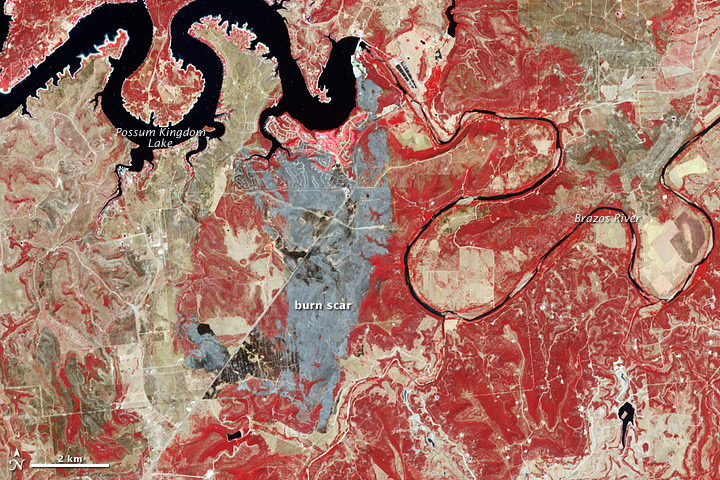 The burn scar is gray, vegetation is red, and bare or sparsely vegetated ground is tan. Water is navy blue.
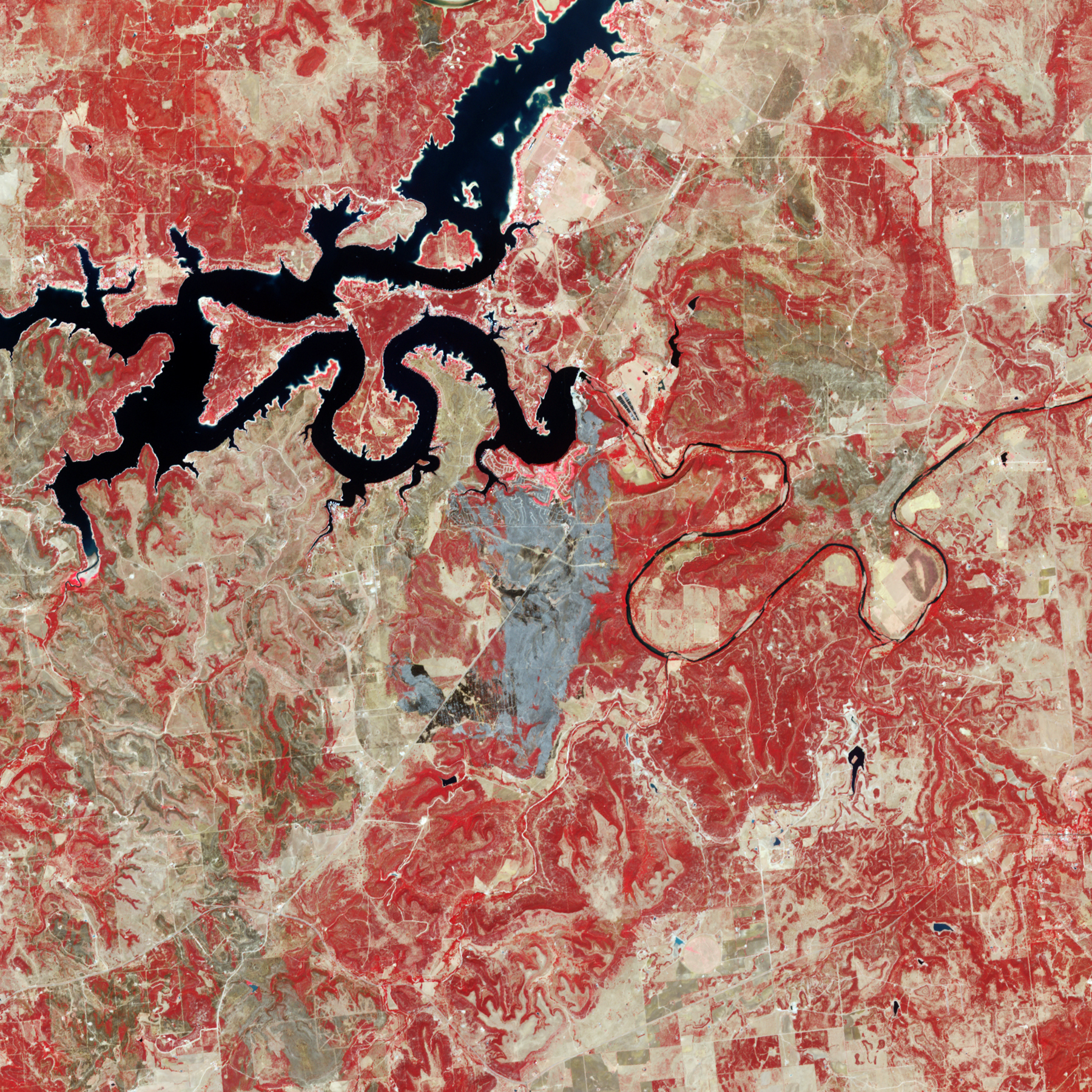 The burn scar is gray, vegetation is red, and bare or sparsely vegetated ground is tan. Water is navy blue.
acquired September 3, 2011 download large image (4 MB, JPEG)
acquired September 3, 2011 download GeoTIFF file (8 MB, TIFF)
-
The 101 Ranch Fire began on August 30, 2011, south of Possum Kingdom Lake in Palo Pinto County, Texas. By September 6, the fire had scorched 6,555 acres (2,653 hectares), according to the Incident Information System.
Just south of the easternmost curve of Possum Kingdom Lake is a network of residential streets, some of which lie within the burn scar. The Texas Forest Service reported that 39 homes and nine RVs had been destroyed. Although dozens of homes had been lost, firefighters saved nearly 200 others.
-
As of September 6, the 101 Ranch Fire was 85 percent contained. News sources said that winds had died down, and some firefighters had been released to battle other blazes in the state. The same day, the Texas Forest Service reported that it had responded to 22 new fires in the past 24 hours, and 181 fires over the past week.
-
The surge of wildfire in the region burned a total of 118,413 acres (47,920 hectares), and more than 700 homes had likely been lost in just 48 hours.
The fires came in the midst of high temperatures and low humidity. Large parts of Texas have suffered from severe drought in the summer of 2011.
The Advanced Spaceborne Thermal Emission and Reflection Radiometer (ASTER) on NASA’s Terra satellite captured this false-color image of the Ranch 101 burn scar on September 3, 2011.
-
The burn scar is gray, vegetation is red, and bare or sparsely vegetated ground is tan. Water is navy blue.
-Just south of the easternmost curve of Possum Kingdom Lake is a network of residential streets, some of which lie within the burn scar. The Texas Forest Service reported that 39 homes and nine RVs had been destroyed. Although dozens of homes had been lost, firefighters saved nearly 200 others.
-
As of September 6, the 101 Ranch Fire was 85 percent contained. News sources said that winds had died down, and some firefighters had been released to battle other blazes in the state. The same day, the Texas Forest Service reported that it had responded to 22 new fires in the past 24 hours, and 181 fires over the past week.
-
The surge of wildfire in the region burned a total of 118,413 acres (47,920 hectares), and more than 700 homes had likely been lost in just 48 hours.
The fires came in the midst of high temperatures and low humidity. Large parts of Texas have suffered from severe drought in the summer of 2011.
NASA Earth Observatory image created by Jesse Allen and Robert Simmon, using data provided courtesy of NASA/GSFC/METI/ERSDAC/JAROS, and U.S./Japan ASTER Science Team. Caption by Michon Scott.
- Instrument:
- Terra - ASTER
GARGIL spacecraft. Preparations for lunch ..[2418]
NASA Image , Preparing GRAIL spacecraft for Launch

Preparing GRAIL for Launch
At Cape Canaveral Air Force Station's Space Launch Complex 17B in Florida, these spacecraft technicians may be the last persons to glimpse NASA's twin Gravity Recovery and Interior Laboratory, or GRAIL, spacecraft as the sections of the Delta payload fairing close around them.
-
The fairing will protect the spacecraft from the impact of aerodynamic pressure and heating during ascent and will be jettisoned once they are outside the Earth's atmosphere.
-
Launch aboard a United Launch Alliance Delta II rocket from Pad 17B is scheduled for Sept. 8. The spacecraft will fly in tandem orbits around the moon for several months to measure its gravity field. GRAIL's primary science objectives include determining the structure of the lunar interior, from crust to core, and understanding of the thermal evolution of the moon. Image Credit: NASA/Jim Grossmann
Tuesday, September 6, 2011
Libyan convoys have passed through Niger this week,...[ 2417 ]
U.S.: Gadhafi not believed to be in Niger convoy
September 6, 2011 2:16 p.m. EDT
The U.S. State Department said it viewed the two sets of vehicles as parts of a single convoy -- and that Gadhafi is not believed to be on it.
"Apparently a convoy has entered and it does include some senior members of the Gadhafi regime, but we do not believe that Gadhafi himself was among them," department spokeswoman Victoria Nuland said.
One convoy was on its way Tuesday to the capital, Niamey, a military captain in Niger said.
Another convoy reached Niamey a day earlier, an official with Niger's Interior Ministry said. That convoy included six high-ranking Libyan officials close to Gadhafi, including Gen. Mansour Daw, the source said. Daw is said to be the head of the Revolutionary Guard and is responsible for the security of Gadhafi and his family.
-
Read more
Subscribe to:
Posts (Atom)