The Hellenic Navy (HN) (Greek: Πολεμικό Ναυτικό, Polemikó Naftikó, abbreviated ΠΝ) is the naval force of Greece, part of the Greek Armed Forces. The modern Greek navy has its roots in the naval forces of various Aegean Islands, which fought in the Greek War of Independence. During the periods of monarchy (1833–1924 and 1936–1973) it was known as the Royal Navy (Βασιλικόν Ναυτικόν, Vasilikón Naftikón, abbreviated ΒΝ).The total displacement of all the navy's vessels is approximately 150,000 tons.The motto of the Hellenic Navy is "Μέγα το της Θαλάσσης Κράτος" from Thucydides' account of Pericles' oration on the eve of the Peloponnesian War. This has been roughly translated as "Great is the country that controls the sea". The Hellenic Navy's emblem consists of an anchor in front of a crossed Christian cross and trident, with the cross symbolizing Greek Orthodoxy, and the trident symbolizing Poseidon, the god of the sea in Greek mythology. Pericles' words are written across the top of the emblem. "The navy, as it represents a necessary weapon for Greece, should only be created for war and aim to victory."...............The Hellenic Merchant Marine refers to the Merchant Marine of Greece, engaged in commerce and transportation of goods and services universally. It consists of the merchant vessels owned by Greek civilians, flying either the Greek flag or a flag of convenience. Greece is a maritime nation by tradition, as shipping is arguably the oldest form of occupation of the Greeks and a key element of Greek economic activity since the ancient times. Nowadays, Greece has the largest merchant fleet in the world, which is the second largest contributor to the national economy after tourism and forms the backbone of world shipping. The Greek fleet flies a variety of flags, however some Greek shipowners gradually return to Greece following the changes to the legislative framework governing their operations and the improvement of infrastructure.Blogger Tips and Tricks
This is a bilingual blog in English and / or Greek and you can translate any post to any language by pressing on the appropriate flag....Note that there is provided below a scrolling text with the 30 recent posts...Αυτό είναι ένα δίγλωσσο blog στα Αγγλικά η/και στα Ελληνικά και μπορείτε να μεταφράσετε οποιοδήποτε ποστ σε οποιαδήποτε γλώσσα κάνοντας κλικ στη σχετική σημαία. Σημειωτέον ότι παρακάτω παρέχεται και ένα κινούμενο κείμενο με τα 30 πρόσφατα ποστς....This is a bilingual blog in English and / or Greek and you can translate any post to any language by pressing on the appropriate flag....Note that there is provided below a scrolling text with the 30 recent posts...Αυτό είναι ένα δίγλωσσο blog στα Αγγλικά η/και στα Ελληνικά και μπορείτε να μεταφράσετε οποιοδήποτε ποστ σε οποιαδήποτε γλώσσα κάνοντας κλικ στη σχετική σημαία. Σημειωτέον ότι παρακάτω παρέχεται και ένα κινούμενο κείμενο με τα 30 πρόσφατα ποστς.........

Saturday, April 23, 2011

NASA Image of the Day,,[ 2251 ]

NASA : Image of the Day

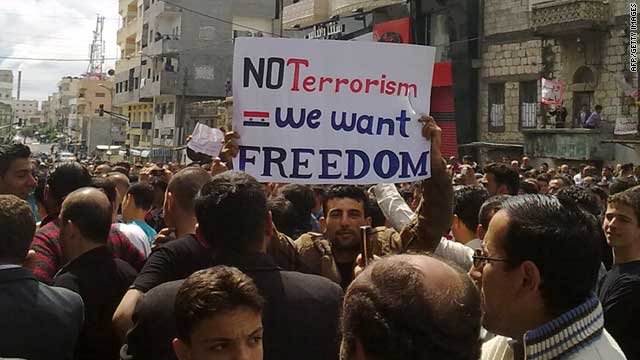
Violence erupts across Syria..[ 2250 ]

More than 40 dead in protests as violence erupts across Syria

By the CNN Wire Staff
April 22, 2011 -- Updated 2116 GMT (0516 HKT)
Syrian anti-government protesters taking part in a demonstration in Banias in northeastern Syria on Friday.

(CNN) -- Violence swept across Syria on Friday, with at least 43 people reported killed in another bloody day of confrontation between government forces and demonstrators calling for political change.
-

Reliable numbers were difficult to come by. Amnesty International, citing local human rights activists, reported that at least 75 people were killed in Friday's protests. The Syrian government does not permit CNN to report from inside the country.
-

The killings occurred in several flashpoint regions as thousands of Syrian protesters defiantly marched after Muslims' weekly prayers in a display of mass discontent toward the government.

Read more 

Thursday, April 21, 2011

NASA Image of the Day, Apr 21st..[ 2249 ]

        The latest NASA "Image of the Day" image.        
-
Like rivers of liquid water, glaciers flow downhill, with tributaries joining to form larger rivers. But where water rushes, ice crawls. As a result, glaciers gather dust and dirt, and bear long-lasting evidence of past movements. 
Alaska's Susitna Glacier revealed some of its long, grinding journey when the Advanced Spaceborne Thermal Emission and Reflection Radiometer (ASTER) on NASA’s Terra satellite passed overhead on Aug. 27, 2009. 
This satellite image combines infrared, red and green wavelengths to form a false-color image. Vegetation is red and the glacier's surface is marbled with dirt-free blue ice and dirt-coated brown ice. Infusions of relatively clean ice push in from tributaries in the north. 
The glacier surface appears especially complex near the center of the image, where a tributary has pushed the ice in the main glacier slightly southward. Susitna flows over a seismically active area. In fact, a 7.9-magnitude quake struck the region in November 2002, along a previously unknown fault. 
Geologists surmised that earthquakes had created the steep cliffs and slopes in the glacier surface, but in fact most of the jumble is the result of surges in tributary glaciers. 
Glacier surges--typically short-lived events where a glacier moves many times its normal rate--can occur when melt water accumulates at the base and lubricates the flow. 
This water may be supplied by meltwater lakes that accumulate on top of the glacier; some are visible in the lower left corner of this image. The underlying bedrock can also contribute to glacier surges, with soft, easily deformed rock leading to more frequent surges. 
Image Credit: NASA/GSFC/METI/ERSDAC/JAROS, and U.S./Japan ASTER Science

Πέμπτη, 21 Απριλίου 2011 7:00:00 πμ

Japan to speed up housing for evacuees..[ 2248 ]


Pressure on to speed up construction of temporary housing for evacuees


(Mainichi Japan) April 20, 2011
A room of a temporary housing facility in Rikuzentakata, Iwate Prefecture, is pictured on April 3. (Mainichi )
Over one month has already passed since the devastating March 11 earthquake and tsunami, yet people continue to live in shelters. Problems constructing temporary housing and slow progress in moving evacuees to public housing outside their hometowns are to blame for this situation.
-
Prolonged life in shelters, where privacy and sanitation problems are rampant, threatens the wellbeing of evacuated residents who are trying to stay healthy and maintain a decent standard of living. 
 -
The government should demonstrate its resolve to prevent people from having to spend a long time in shelters, and exhaust every possible means to spur the construction of temporary housing.
-
Some 140,000 people hit by the tsunami and nuclear crisis continue to live in shelters. With nothing more than cardboard barriers to separate families living in gymnasiums, it is impossible to retain privacy, putting strain on evacuees. Furthermore, there are many elderly people at shelters and deterioration in their living environments has aggravated their illnesses, in some cases resulting in death from pneumonia -- an issue of increasing concern.
-
The government says it plans to construct 70,000 temporary homes, adding the cost to the fiscal budget. But more than one month after the disaster, there has been little progress, with work on fewer than 9,000 homes started. One reason is that it has been difficult to find appropriate sites on high ground that evaded the March 11 disaster. Also hampering efforts is the scarcity of materials.
In this April 12, 2011 file photo, a man walks a path between spaces divided by corrugated boxes for each family at the evacuation center at the Big Palette Fukushima sports arena in Koriyama, Japan, a month after an earthquake and tsunami struck Japan's northeastern coast. (AP Photo/Hiro Komae, File)
-
House of Representatives member Tadayoshi Nagashima, who was mayor of Yamakoshi during the 2004 Niigata-Chuetsu Earthquake and oversaw evacuations in the village, has warned that life in shelters should not continue for more than two months. 
 -
The current pace of temporary housing construction, with just 4,500 homes due to be completed by the first week of next month, is too slow. Government officials must be more aware that this is a battle against time.
The government must cooperate with local bodies and do all it can to secure land, including that in neighboring areas. Using public funds to lease private land is one option. To secure materials, it must also boost production and speed up imports.
-
After all this, if it is still impossible to construct temporary housing in time, then public housing and accommodation provided by other public bodies should be put to use as soon as possible. Officials must check once more to confirm that shelters are getting the information they need.
-
One reason people may have remained in shelters in spite of the poor living environment is that they fear their ties with their hometowns will be cut if they move somewhere else. 
-
It has been pointed out that people would be more willing to move to other dwellings if targets were set for them to later move into temporary housing in their hometowns -- even if that meant waiting six months. 
 -
Local bodies should swiftly announce detailed schedules for the construction of temporary homes.
In principle, evacuees are supposed to obtain their own supplies after moving into temporary housing, and their time in temporary housing is limited to two years -- facts that have left them uncertain about their futures.
-
Workers construct temporary housing for people whose homes were destroyed by the March 11 earthquake and tsunami in the grounds of a school acting as a shelter in Rikuzentakata, Iwate Prefecture, Japan, Sunday, March 20, 2011. (AP Photo/Matt Dunham)
-
It is certain that it will take a long time to recover from the tsunami. The government should quickly review such principles.
Click here for the original Japanese story


Two photographers killed in Libya,,[ 2247 ]

Two photographers killed in Libya

Apr 21, 2011 6:46 AM | By Sapa-AFP

Tim Hetherington, an Oscar-nominated British film director and war photographer, and award-winning US photographer Chris Hondros were killed and two other Western journalists wounded on Wednesday in the besieged Libyan city of Misrata.


Photojournalist Tim Hetherington (R) and Getty Images photojournalist Chris Hondros  were killed after coming under fire in the besieged Libyan town of Misrata.


quote Journalists across the globe risk their lives each day to keep us informed, demand accountability from world leaders, and give a voice to those who would not otherwise be heard quote


Vanity Fair, for which Hetherington was working, confirmed the death of the 41-year-old who covered numerous conflicts and won the 2007 World Press Photo Award for his coverage of US soldiers in Afghanistan.

Hondros, also 41, suffered grave head injuries in the same mortar attack, said medics in the western port city of Misrata, and died hours later from his wounds, Getty Images confirmed to AFP.

Getty "is deeply saddened to confirm the death of staff photographer Chris Hondros who has died of injuries while covering events in Libya on April 20th," the agency said in a statement.

Two other colleagues, Guy Martin, a freelance photographer working for Panos, and photographer Michael Brown, working for Corbis, were also wounded in the attack, the agencies confirmed.

Hetherington and Hondros were the second and third journalist killed in Libya in its two-month-old conflict.

President Barack Obama's chief spokesman, Jay Carney, said the US leader was "saddened" to learn Hetherington had been killed, in a statement released before the news of Hondros' death.

"Journalists across the globe risk their lives each day to keep us informed, demand accountability from world leaders, and give a voice to those who would not otherwise be heard," Carney said.

Hondros "never shied away from the front line having covered the world's major conflicts throughout his distinguished career and his work in Libya was no exception," Getty said in its statement.

"We are working to support his family and his fiancée as they receive this difficult news, and are preparing to bring Chris back to his family and friends in the United States. He will be sorely missed."

The Liverpool-born Hetherington produced and co-directed the acclaimed documentary Restrepo, which won a Oscar nomination.

"He really wanted to get the pictures but at the same time I had the impression he was a very responsible person," Tiziana Prezzo, an Italian journalist who was in Misrata two days earlier, told AFP.

"He was one of the last people I met in Misrata. Now that he's not alive any more... it's shocking," she said.

Pulitzer Prize-nominated photographer Hondros had covered many of the world's conflict zones over the last decade, working in Kosovo, Angola, Sierra Leone, Afghanistan, Kashmir, the West Bank, Iraq, and Liberia, among other places.

In 2006, he won the prestigious Robert Capa Gold Medal photography award for his "exceptional courage and enterprise" in Iraq.

The four journalists were hit by mortar fire on Tripoli Street, the main thoroughfare and focus of fighting in Misrata, which has been under siege for almost two months by Libyan leader Muammar Gaddafi's forces.

Hetherington's family said in a statement released to Vanity Fair that it was "with great sadness we learned that our son and brother" Hetherington was killed, saying "he will be forever missed".

On Tuesday, he sent his last post to his Twitter account, where he tweeted: "In besieged Libyan city of Misrata. Indiscriminate shelling by Qaddafi forces. No sign of NATO."

A reporter for the Fayetteville Observer, Hondros' hometown newspaper in North Carolina -- where he joined as an intern, and later staff photographer before moving to New York to pursue his career -- was at the family home when the call came from Getty, delivering the news of his death.

"When it came to photography, he gave it everything," Paul Woolverton reported for the Observer. "You can tell with some people, who are really go-getters, that they are going to go far."

Journalists increasingly have come under fire in the ongoing conflict in Libya.

In the courtroom of Benghazi, seat of the opposition, photographs of missing journalists plaster the walls alongside a portrait of Ali Hassan al-Jaber, an Al-Jazeera cameraman killed on March 12 in an ambush near Benghazi.

Jaber was the first foreign journalist killed in Libya since the beginning of the uprising against Gaddafi on February 15. Numerous journalists have been detained and often mistreated by the Libyan regime.

A spokesman for the rebel Transitional National Council (TNC) said that eight foreign journalists and six Libyan colleagues are currently being held by Gaddafi's forces.

TNC spokesman Abdel Hafiz Ghoqa said journalists were free to work unhindered in rebel-held areas of eastern Libya.

"Even under the difficult conditions imposed to us by the regime, everyone is free to say what they think and move where they wish, journalists and citizens alike," he said.

A growing number of media companies are hiring security consultants for advice on their movements around the fluctuating front line between Gaddafi's loyalists and rebel forces.