The Hellenic Navy (HN) (Greek: Πολεμικό Ναυτικό, Polemikó Naftikó, abbreviated ΠΝ) is the naval force of Greece, part of the Greek Armed Forces. The modern Greek navy has its roots in the naval forces of various Aegean Islands, which fought in the Greek War of Independence. During the periods of monarchy (1833–1924 and 1936–1973) it was known as the Royal Navy (Βασιλικόν Ναυτικόν, Vasilikón Naftikón, abbreviated ΒΝ).The total displacement of all the navy's vessels is approximately 150,000 tons.The motto of the Hellenic Navy is "Μέγα το της Θαλάσσης Κράτος" from Thucydides' account of Pericles' oration on the eve of the Peloponnesian War. This has been roughly translated as "Great is the country that controls the sea". The Hellenic Navy's emblem consists of an anchor in front of a crossed Christian cross and trident, with the cross symbolizing Greek Orthodoxy, and the trident symbolizing Poseidon, the god of the sea in Greek mythology. Pericles' words are written across the top of the emblem. "The navy, as it represents a necessary weapon for Greece, should only be created for war and aim to victory."...............The Hellenic Merchant Marine refers to the Merchant Marine of Greece, engaged in commerce and transportation of goods and services universally. It consists of the merchant vessels owned by Greek civilians, flying either the Greek flag or a flag of convenience. Greece is a maritime nation by tradition, as shipping is arguably the oldest form of occupation of the Greeks and a key element of Greek economic activity since the ancient times. Nowadays, Greece has the largest merchant fleet in the world, which is the second largest contributor to the national economy after tourism and forms the backbone of world shipping. The Greek fleet flies a variety of flags, however some Greek shipowners gradually return to Greece following the changes to the legislative framework governing their operations and the improvement of infrastructure.Blogger Tips and Tricks
This is a bilingual blog in English and / or Greek and you can translate any post to any language by pressing on the appropriate flag....Note that there is provided below a scrolling text with the 30 recent posts...Αυτό είναι ένα δίγλωσσο blog στα Αγγλικά η/και στα Ελληνικά και μπορείτε να μεταφράσετε οποιοδήποτε ποστ σε οποιαδήποτε γλώσσα κάνοντας κλικ στη σχετική σημαία. Σημειωτέον ότι παρακάτω παρέχεται και ένα κινούμενο κείμενο με τα 30 πρόσφατα ποστς....This is a bilingual blog in English and / or Greek and you can translate any post to any language by pressing on the appropriate flag....Note that there is provided below a scrolling text with the 30 recent posts...Αυτό είναι ένα δίγλωσσο blog στα Αγγλικά η/και στα Ελληνικά και μπορείτε να μεταφράσετε οποιοδήποτε ποστ σε οποιαδήποτε γλώσσα κάνοντας κλικ στη σχετική σημαία. Σημειωτέον ότι παρακάτω παρέχεται και ένα κινούμενο κείμενο με τα 30 πρόσφατα ποστς.........

Tuesday, March 23, 2010

'Symbolic' Death Row for Decades...[ 786 ]

In California, Killers Sit on 'Symbolic' Death Row for Decades, Costing Billions

By Ed Barnes /Updated March 22, 2010 - FOXNews.com,

The state of California is losing billions of dollars keeping hundreds of prisoners on death row -- but the ultimate punishment is mostly symbolic in the state, where inmates ply the appeals process for decade after decade and are more likely to die of old age than by execution.

On June 28, 1984, a young man broke into the home of 79-year-old Jennie Vincow in Los Angeles. Over the course of a few hours he ransacked the elderly woman's apartment, raped her and repeatedly stabbed her. He then slashed her throat so badly that she was nearly decapitated. Her son found her body the next day.

It was the beginning of a spree of murder, rape and burglary that gripped Southern California for 14 months — until Richard Ramirez, a 24-year-old drifter from El Paso, Texas, was arrested in Los Angeles. By then, the man who had come to be known as "the Night Stalker" had killed no fewer than 13 people and brutally raped and disfigured several more, including:

• Vincent and Maxine Zazza. Vincent, 64, was found in his home with a bullet hole in his temple. His wife, Maxine, 44, was found naked in her bed, her eyes gouged out and with stab wounds on her face, neck, breasts, abdomen and groin.
• Elyas Abowath, 35, who was shot in the head while he slept. Ramirez allowed Abowath's wife, 29, to live — after he raped and sodomized her.
• Lela and Max Kneiding, both 66, found shot to death and mutilated with a machete.

Ramirez's crimes were marked by the satanic pentagrams he left on his victims and the sexual abuse of women who were sometimes forced to sing praises of Satan before he raped them.

No one — including Ramirez himself — doubts that his killing spree earned him a cell on California's death row. When he was found guilty of capital murder in 1989, he remarked, "Big deal. Death always went with the territory."

But so far, it hasn't. For the past 21 years, Richard Ramirez has sat in a single cell on death row in San Quentin, and he is still years away from his last meal. According to experts familiar with his case, the ritual killer is "only about halfway through the appeals process" that will end in his execution.

If that process continues at its present pace, Ramirez, who committed most of his crimes when he was in his mid-20s, won't be put to death until he is 71 years old — if he lives that long.

That a man could sit nearly 50 years on death row isn't surprising — especially in California, where critics of the state's system say the odds of a convicted killer actually living long enough to be put to death are about 100 to one. Most prisoners sentenced to execution, studies and experts say, simply die of old age or other illnesses while in prison as the appeals process grinds on.

"The death penalty is purely symbolic in California," says Natasha Minsker, who just completed a study of the death penalty in California for the American Civil Liberties Union of Northern California. With almost 700 people on death row in the state, the study found not only that maintaining a prison and legal system to support the death penalty cost the state billions of dollars, but that, for all the money spent, the penalty is rarely used. Since 1977 only 13 people have been executed. During the same period, 59 death row inmates died of old age or other infirmities.

What is most surprising about Ramirez's appeals is that there is nothing extraordinary about them. It is the same process every prisoner on death row goes through. By law, every death sentence in California has to be appealed and reviewed by the state's Supreme Court to ensure that no one who is innocent faces the ultimate penalty.

It is a slow process that begins with a very long delay. According to Minsker and other experts, it generally takes as many as five years after a conviction before a lawyer is even appointed to file a mandatory appeal. "Nothing happens in those five years," she said. The reason, according to the California Commission on the Fair Administration of Justice, a panel appointed to look at the state's death penalty system, is that there are just too few experienced lawyers available to handle the growing number of appeals.

Then, it can take years for the appeal to be written and filed. In Ramirez's case, his first appeal didn't reach the California Supreme Court until 2002. In other cases lawyers have filed for and been granted more than 40 delays before even filing appeals. In virtually all death row appeals the cases are handled by public defenders, specially trained in the field, and paid for by taxpayers. And there is no limit to the number of appeals that can be filed.

Then, because of the gravity of the charges and California law, the appeal gets filed directly with the California Supreme Court, which is the ultimate arbiter of all state legal matters and is simply overwhelmed by death row cases. In 2008 it had a backlog of more than 400 capital cases alone, a number that has grown since then.

Death penalty convictions also require that all habeas corpus appeals go directly to the Supreme Court. These appeals concern matters that might not be in the trail record, such as the discovery of new evidence, prosecutorial misconduct, or ineffective legal counsel. In virtually all other criminal cases, these appeals are handled by the courts that try them. Efforts to allow lower courts to pick up some of the load have been proposed over the years, but no action has been taken by the state's legislature.

Among the arguments that Ramirez made in his appeals process, only one seemed to carry weight: his argument that he had ineffective counsel at his trial. He said his two lawyers, who were hired by his parents, had only five years of legal experience between them when they took on the most complicated case in the history of the state's legal system. That appeal was denied in 2005 — and immediately appealed. Calls to Ramirez's attorneys and appellate attorney were not returned.

In September 2006 the California Supreme Court finally turned down that appeal, ending his appeals before the state courts.

But that didn't trigger the required hearing to set an execution date. Instead, it triggered the beginning of a new set of appeals — this time to federal courts, which do not consider these cases until all efforts in state courts have been exhausted, according to an expert with the California Attorney General's office.

And here, according to sources in the attorney general's office, things can take a while and get very complicated. "For example," said a lawyer who asked not to be named, "if the appellant brings up an issue that involves issues about the state's conduct, the federal process stops and the state ... begins again. It can get very complicated."

For Ramirez, the federal process is just beginning, and its length will be determined by the arguments he makes. But experts say he has an edge over death row inmates from other parts of the country, because his federal appeals will be heard in the Ninth Circuit Court of Appeals. Unlike other federal appeals courts, which tend to spend little time on death penalty cases, the Ninth Circuit takes them very seriously. In 2005 its chief judge told the Los Angeles Times that "We don't turn them (executions) out the way a lot of Southern states do. We go to such lengths to minimize the possibility of error, and we've built in a lot of delay."

Just how long the federal appeals process will take is impossible to answer, but it will not be quick. An appeal denied by a three-judge appeals panel, the first step, can be appealed "en banc," to the entire nine-judge panel. If that is denied, the next stop is the United States Supreme Court. But again, there is no limit to the number of appeals he can file, and no way to know how long it will take the court

s to dispose of them.

Until then, Ramirez will just grow old — older than most of the people he killed back when he was 24.

South Africa : KwaZulu Natal...[ 785 ]

KwaZulu Natal, South Africa

KwaZulu Natal, South Africa

KwaZulu Natal Travel Guide / KwaZulu Natal's leisure options provide a multitude of choices to keep you endlessly entertained. From the city of Durban you can catch a shuttle to Margate, at the hub of the South Coast Golf Circuit. When you're not playing golf, fishing or lying on the beach, you can visit a crocodile farm, a nature reserve or follow an arts and crafts trail.

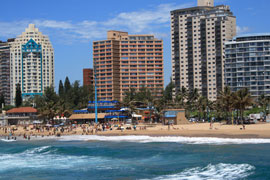
A short flight takes you to the historic city of Pietermaritzburg, gateway to the Natal Midlands and the charming Drakensberg resorts. No holiday in KwaZulu Natal would be complete without a visit to at least one of the KwaZulu Natal game reserves, renowned throughout the world. Appropriately enough, the Zulu name for Durban is Thekwini, meaning "The Place Where the Earth and the Ocean Meet". But apart from an effervescent ocean lined with golden beaches, KwaZulu Natal's capital city, Durban, offers a subtropical carnival atmosphere and summer sunshine all year round. From around the globe, day in, day out, pleasure-seekers converge on the city to play on the golden, palm-fringed sands. In addition to the attractions of sea, surf and sport, leisure options encompass an eclectic range.

At excellent one-stop shopping centres, you can buy anything from photographic equipment to couturier clothes and rare antiques. Flea markets and craft trails attract leisurely browsers, and discount stores offer quality merchandise at bargain basement prices. Within a stone's throw of the city centre, oriental bazaars, fragrant with spice and incense, offer silks, saris, unusual jewellery and ornaments. Pubs, discos and action bars are firm favourites.

Umlanga, KwaZulu Natal, South Africa
Umhlanga, KwaZulu Natal, South Africa
Theatres and concert halls present classical, avant-garde and ethnic programmes, and art galleries display works created by the internationally famous and up-and-coming local talents. KwaZulu Natal's restaurants represent every facet of the city's cosmopolitan nature and cater for every palate and pocket. At the end of the day, what could be better that strolling on the beach to the rhythm of the waves?

Throughout the year, holiday-makers flock to their favourite KwaZula Natal coastal haunts to cultivate a tan, ride the waves, eat, drink and generally have fun. Besides the sweeping beaches and calm lagoons where surfing, snorkelling, fishing and swimming are enjoyed, you can play golf, bowls and tennis or just soak up the sun. From Durban to Amanzimtoti, Ballito to Umhlanga Rocks, to the rugged Wild Coast, the highway links popular seaside resorts in rapid succession. The road snakes through subtropical bush, cane fields and hills garlanded with hibiscus blooms. North of Durban, the coastline stretching from the Tugela Mouth to the Umdloti River is aptly known as the Dolphin Coast. Close inshore, shoals of bottle-nose dolphins gambol in the waves, providing endless entertainment with their engaging antics.

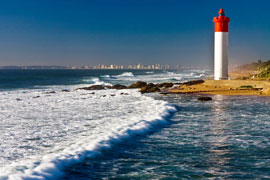
Arguably the gem of the entire Natal North Coast is the Umhlanga Coastline. The Umhlanga Coastline offers a combination of quiet village life with first world amenities and a cosmopolitan buzz. It also offers a diversity of activities in exotic and magnificent landscapes.

The Drakensberg in KwaZulu Natal, South Africa
Further north, KwaZulu Natal's game sanctuaries epitomise the best of the African wilderness. This is one of the few places where good game viewing can be enjoyed in close proximity to the pleasures of scuba diving and deep-sea fishing. Habitats from coastal dune forests to open bushveld support a wide diversity of wildlife, from the elephant to the tiny suni. Bird life is equally prolific. Most parks offer peaceful surroundings, comfortable accommodation, game drives, hiking and walking safaris.

The Elephant Coast forms the north-east region of South Africa's unique KwaZulu Natal Province, stretching northward from Lake St Lucia (a world heritage site), to the borders of Swaziland and Mozambique. The region is so named because it is home to South Africa's largest herd of indigenous African Elephants.

Between the coastal playgrounds and the majestic Drakensberg, there is an area of gentle pastoral beauty known as the Natal Midlands. The highway meanders through rolling wooded hills and grassy plains scattered with towns, villages and hospitable country inns. On lush farmlands, plump cattle and thoroughbred horses graze and game sanctuaries throughout the region support large numbers and varieties of wildlife.

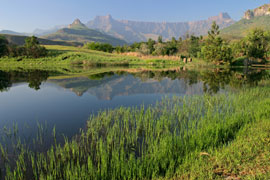
Nestling in the valleys, fine hotels and leisure resorts offer accommodation in KwaZulu Natal and recreational options second to none. Fast-flowing rivers are frequented by anglers hoping for a record-breaking rainbow trout. Climbers scale the jagged peaks where eagles and bearded vultures fly; hikers and horse-riders follow nature trails. The less energetic shrug off city stress by drinking in the birdsong, the crisp clean air and the stunning views.

KwaZulu Natal, South Africa
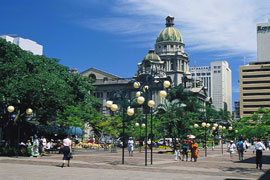
Set in the heart of Zulu country, the city of Pietermaritzburg is one of charm and dignity, at its loveliest in spring when masses of azaleas burst into bloom. When the first Voortrekkers arrived in 1837, they found a tranquil countryside graced by forests, hills and valleys. They settled on a fertile tract of land beside the Umsindusi River and named it after two of their leaders, Gerrit Maritz and Piet Retief. Six years later, the British upgraded the village to a military garrison town. Today, numerous Victorian and Edwardian buildings, quaint pedestrian lanes and other landmarks reflect the substantial British contribution to the development of the town. And in shady, tree-lined suburbs, spacious red brick bungalows and upper-crust boarding schools reinforce the colonial ambience of "The Last Outpost of the British Empire" as Maritzburg is affectionately known.

The city of Pietermaritzburg has a wide range of shops, Pietermaritzburg hotels and restaurants, providing the ideal gateway to the exceptional country inns, recreational resorts and game reserves of the Natal Midlands and the Drakensberg.

"Diolkos" and "Isthmus" Athens to Corinth...[ 784 ]

Corinth Canal, the "Isthmus" and the ancient "Diolkos"

( Reproduction-Αναδημοσίευση )

When traveling from Athens to Corinth - a distance of about 80 kilometers - you leave Attica to enter the Peloponnese while crossing an Isthmus, a narrow and fairly low-lying, 6 kilometers wide, tongue of land which links Central Greece (Sterea Hellas) with the Peloponnese as well as with the east parts of the Saronic Gulf.

Both economically and strategically, the
Isthmus of Corinth, as this narrow stretch of land is called, has played a very important role in the history of Greece. It is the only land bridge between the country's north and south. Populations, armies and commodities have got to move through it.

This basic fact let to the birth of an important city, Corinth, at its southern edge. There were times when the influence of Corinth extended beyond the Saronic Gulf to the Aegean Sea and beyond the Gulf of Corinth to the Adriatic.

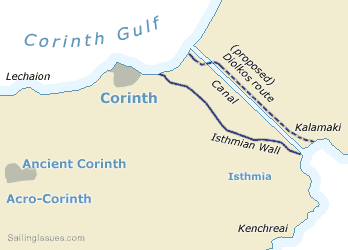
Hence, two important ports made their appearance in antiquity on both sides of the Isthmus - Lechaion on the Gulf of Corinth, and Kenchreai on the shores of the Saronic Gulf.
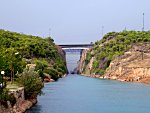
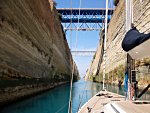
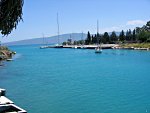
Cruising through  the Corinth Canal
Sailing Greece
Yacht charters - Corinth canal
Sailing vacations in the Corinthian gulf and  Saronic Gulf near Athens

The Diolkos

How to get your ship from the Gulf of Corinth to the Saronic Gulf and vice versa? The question plagued the seafaring Greeks since very early times. It was first solved towards the end of the 7th century BCE, or at the beginning of the 6th century, by a daring decision which led to the greatest of technical construction works in early Greece : the building of the Diolkos or Slipway.

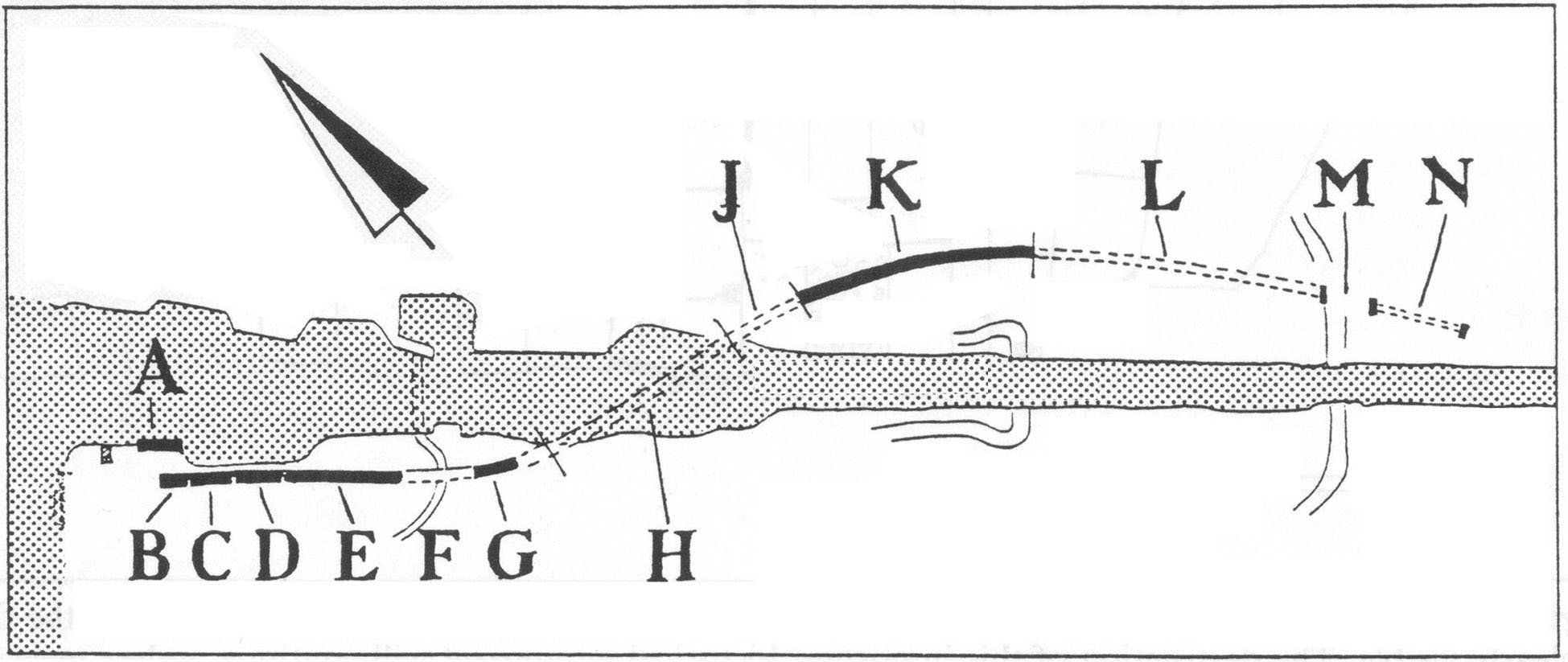
The course of Diolkos which is illustrated above is the one proposed by Raepsaet, yet Walter Werner and others suggest another route, which describes a large curve into the peloponnesian side on the modern canal, before ending in Kalamaki.

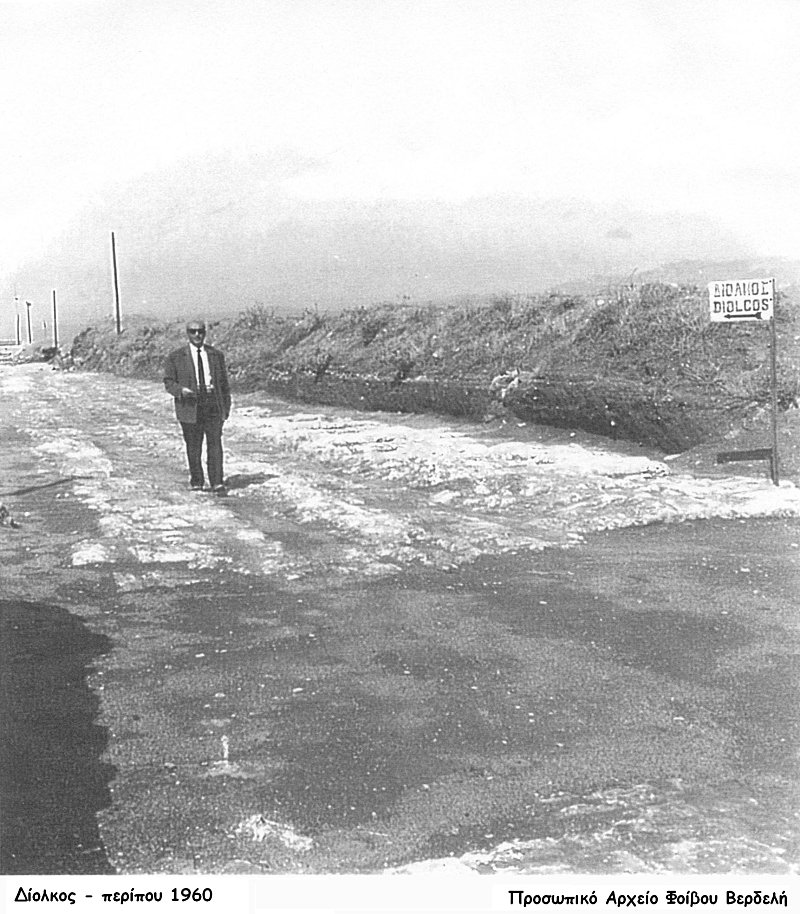
Between 1956 and 1959, the Greek Archaeological Society carried out excavations designed to trace the course of the Diolkos. The greater part of the Slipway, which in fact ran all the way from the Gulf of Corinth to the Saronic Gulf, was brought to light.

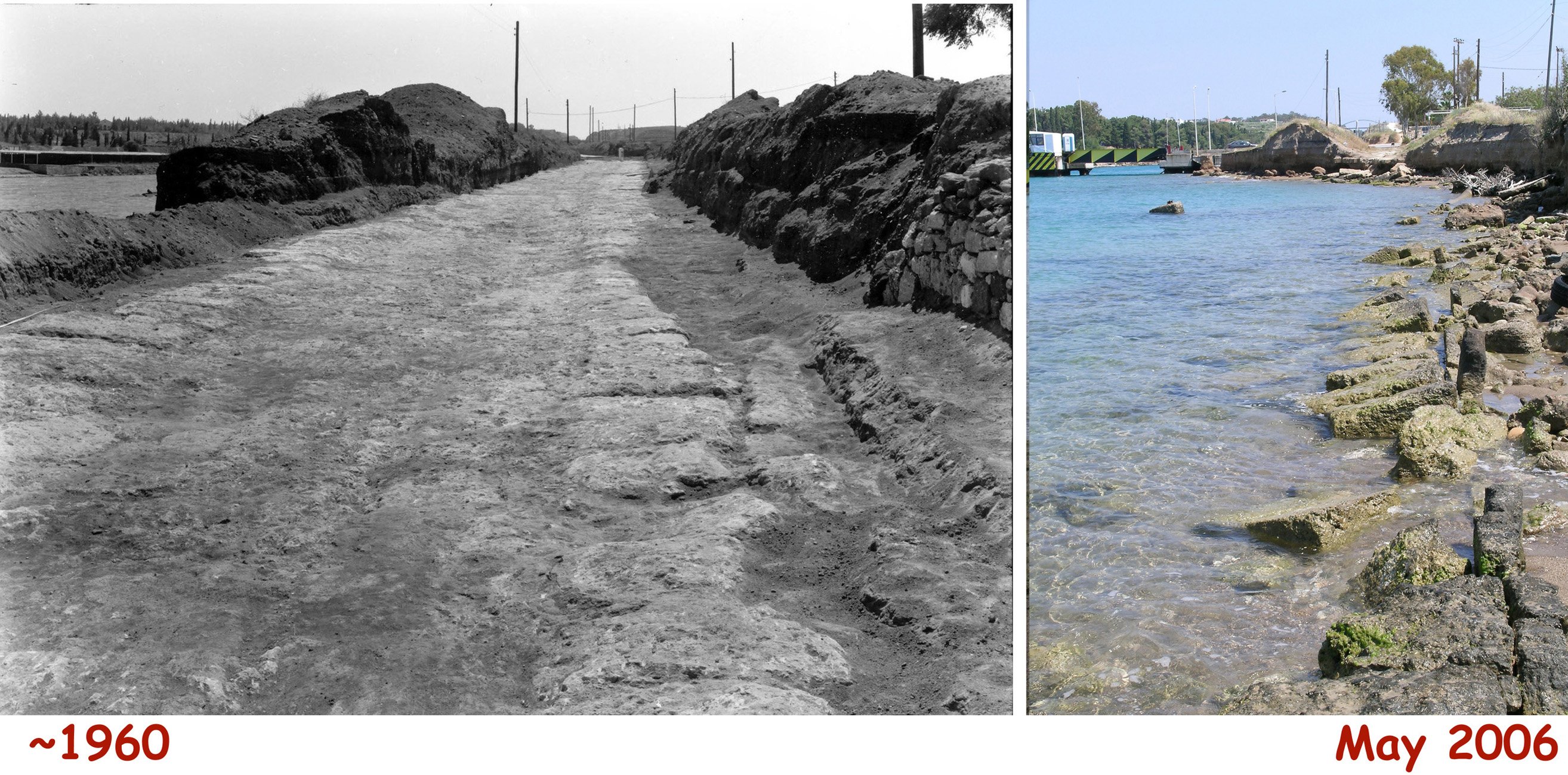
1960: The director of the excavation, Nikos Verdelis and the  Diolkos. The plan of the excavated parts of Diolkos has been made by the  German researcher Walter Werner The Diolkos has degraded over time
The Diolkos was a roadway with a width of 10 meters at the starting point on the Gulf of Corinth. The stone-paving began at the very edge of the sea. Ships were taken to this starting point and there dragged onto the Diolkos. These ships rested initially on wooden cylinders and were then transferred to a special wheeled vehicle. The corinth  canal is crossed on many yacht charters out of Athens

To reduce the weight of the ship as far as possible, it was unloaded before being hoisted onto the Diolkos and the unloaded commodities were taken by ordinary road to the other end of the Isthmus.

Narrowing to between 3.50 and 6 metres after its starting point the Slipway was paved with porous stone throughout its length. Two deep parallel grooves, which ran at a distance of 1.50 metres from each other, marked the Diolkos.

Thus, the ship was dragged all across the Isthmus. On reaching the Slipway's terminus on the Saronic Gulf, it was lowered into the sea, the cargo was loaded again, and the ship continued with its journey. This arrangement did not merely speed up traffic.

It also enabled ships moving between the Central and Eastern Mediterranean to avoid the rough seas almost unavoidable in a voyage round the Peloponnese.

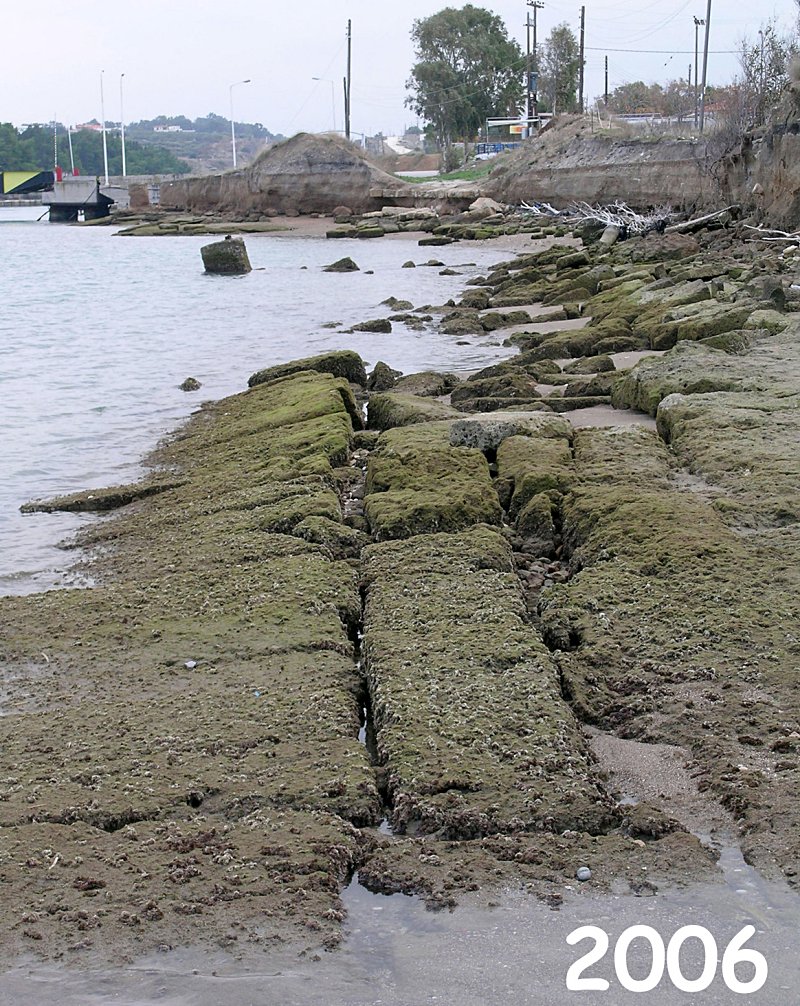
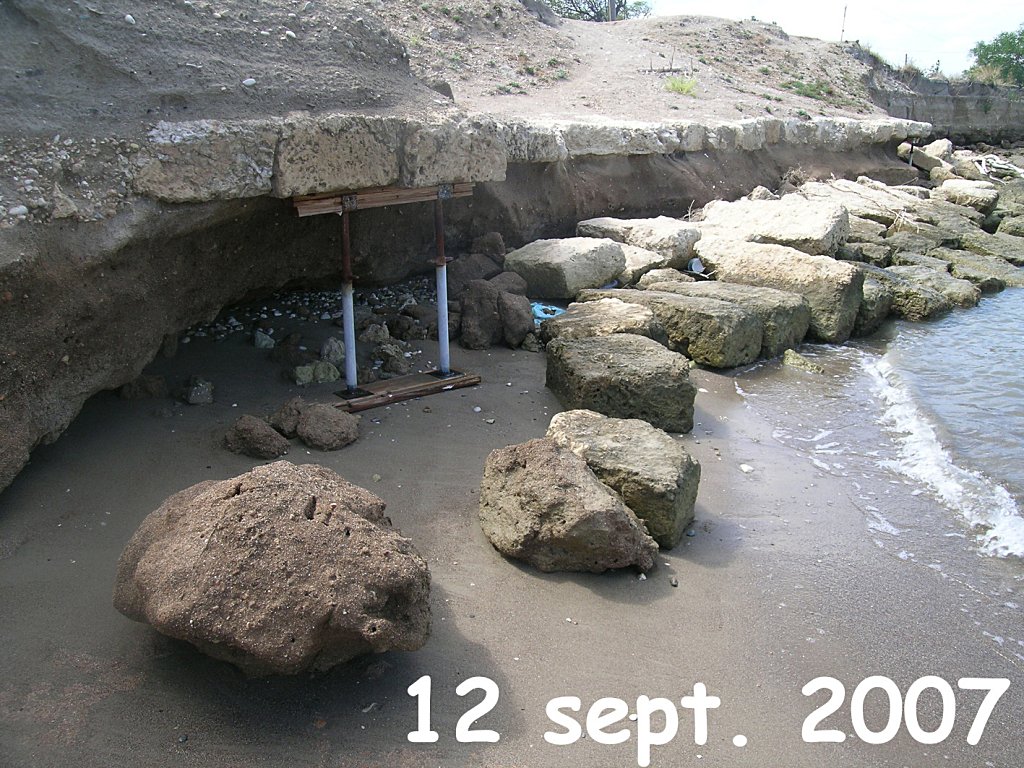
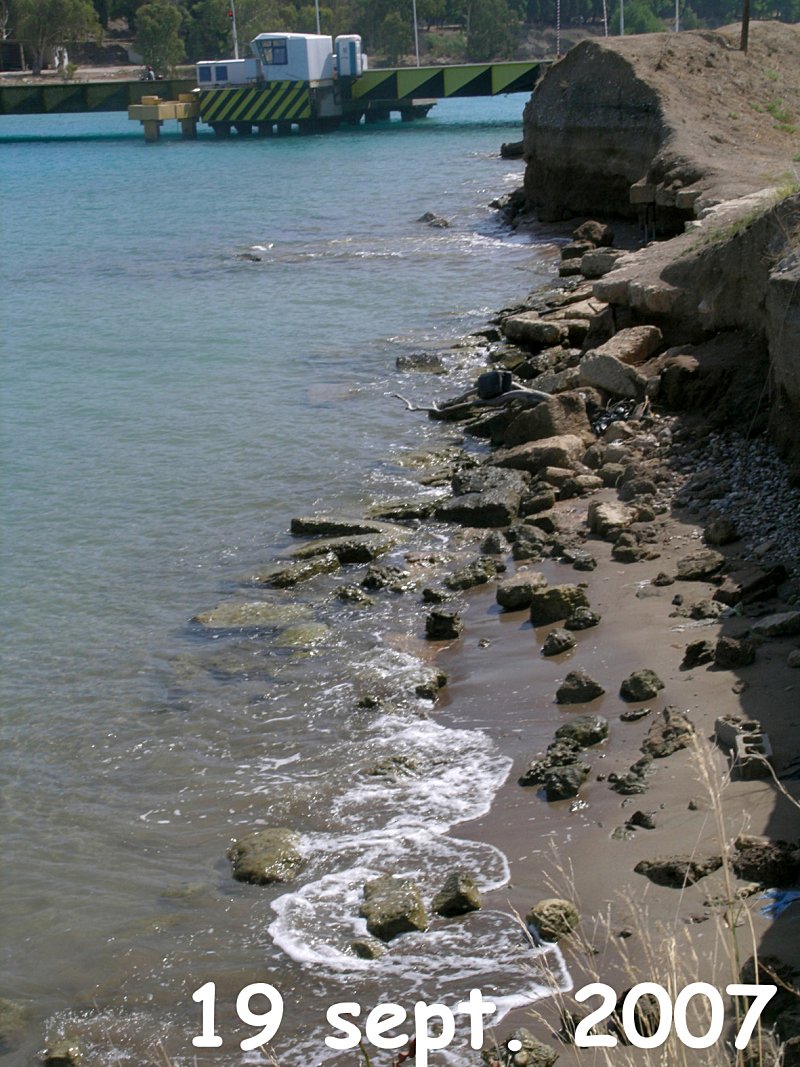
The  Diolkos in 2006 The Dhiolkos in 2007 The Diolkos in 2007
The Diolkos was repeatedly repaired in ensuing centuries and remained in use until the days of Augustus, though the appearance of ever-larger ships curtailed its usefulness. There is hardly any mention of its use in later centuries, and then only in connection with warlike activities.

Cutting through the Isthmus

The use of the Diolkos was difficult and expensive at all times and proved impossible with larger ships. Hence, in ancient days already, people envisaged cutting a canal across the Isthmus, so as to link the two Gulfs permanently and make it possible for all ships at all times to avoid the dangerous journey past Cape Maleas, off South Peloponnese.


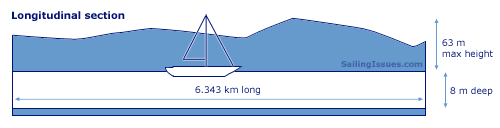
Cross section of the Corinth Canal


Yet, technical means then available made it in fact impossible to carry through such an ambitious scheme in those early days.

It was Emperor Nero who first attempted to cut a canal through the Isthmus. Feasibility studies were completed,
Sailing holidays through the Canal
The entrance of  the Canal
the necessary work force was gathered, and Nero in person started the digging with a little golden pickaxe.
Three months later, however, Nero died, and the project was abandoned.

Immediately after the liberation of Greece in the first half of the 19th century, the canal project was revived under Kapodistrias. Its execution hung fire until 1882, when a French firm took the work in hand. It was a Greek firm which completed it in 1893.

The Corinth Canal is 6,343 metres long. Its width amounts to 25 metres, its depth 8 metres and the earth cliffs flanking it reach a maximum height of 63 metres. Two large bridges - one for railway, and one for the National Road, both of them rebuilt
after World War Two - now link Central Greece with the Peloponnese, while below them fairly large ships are piloted directly from one sea to the other.
In 1975 a second road bridge was built to ease the increased volume of traffic.

Most reliable yacht charter firms will arrange all paperworks for your crossing through the canal. Instead of sailing the Corinth Gulf, there is the option of sailing around the Peloponese peninsula - compare the northern (Corinth Canal) route and the southern route.


Russian roulette wrong...[ 783 ]

Russian roulette wedding speech goes badly wrong as guest shoots himself

A Russian wedding has ended in tragedy after a game of Russian roulette went wrong, leaving one guest with a life-threatening gunshot wound to his head.

Russian roulette wedding speech goes wrong as guest shoots himself
The gunman, a 33 year-old Chechen man, insists he was sure that he had emptied the pistol's chamber

A home video of the wedding in Astrakhan, southern Russia, shows a grinning friend of the groom unexpectedly pulling a pistol from his waistband, putting it to his temple and squeezing the trigger. The gun emits only a clicking sound and the smiling gunman asks who else wants to try his luck.

Another guest is shown taking up the offer, but this time the trick goes wrong.

The second man pulls the trigger and immediately collapses to the floor as the gun releases a rubber bullet into his skull at point-blank range. He is now reported to be fighting for his life.

The gunman, a 33 year-old Chechen man, insists he was sure that he had emptied the pistol's chamber of every bullet and says he only wanted to enliven the wedding. But local police do not believe him and have opened a criminal investigation into the tragic incident.

Russian weddings are notoriously drunken and sometimes violent, with fist fights not uncommon.

The origins of Russian roulette are unclear, but it is thought to have started in the nineteenth century when sadistic Russian prison guards forced inmates to play and bet on the outcome.

The Red Arrows in Crete...[ 782 ]

Red Arrows planes collide in Crete

A pair of Red Arrows planes have collided in mid-air during a training exercise in Crete, according to reports.

One pilot is in hospital after ejecting from an aircraft while another member of the RAF aerobatic team landed safely, the Foreign Office said.

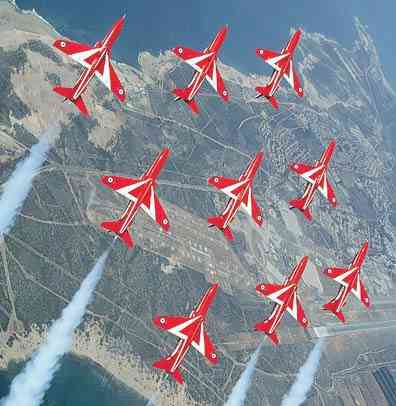
The Red Arrows team

A Foreign Office spokeswoman said: ''We can confirm that an incident has occurred involving the Red Arrows whilst undertaking pre-season training at Hellenic Air Force Base, Kastelli, in Crete, and one pilot ejected and has been taken to hospital and the other one landed safely.''

The unit, which comprises 10 pilots, currently includes the first female to fly with the Red Arrows, Flt Lt Kirsty Moore, but officials could neither confirm nor deny if she was involved.

A spokesman said: "We can confirm that an incident has occurred involving the Red Arrows whilst undertaking pre-season training at Hellenic Air Force Base Kastelli in Crete.

"A service inquiry will be convened to identify the cause of the crash."

The spokesman was unable to provide details of the injured pilot's condition.

Police in Crete said he suffered a dislocated shoulder after parachuting from his aircraft before it crashed, according to reports.

The Red Arrows team arrived on the Greek island on Sunday for the first stage of Exercise Springhawk, the RAF said.

Ten Hawks and a C130 Hercules left Scampton in Lincolnshire on Saturday and travelled to Crete via France and Italy.