The Hellenic Navy (HN) (Greek: Πολεμικό Ναυτικό, Polemikó Naftikó, abbreviated ΠΝ) is the naval force of Greece, part of the Greek Armed Forces. The modern Greek navy has its roots in the naval forces of various Aegean Islands, which fought in the Greek War of Independence. During the periods of monarchy (1833–1924 and 1936–1973) it was known as the Royal Navy (Βασιλικόν Ναυτικόν, Vasilikón Naftikón, abbreviated ΒΝ).The total displacement of all the navy's vessels is approximately 150,000 tons.The motto of the Hellenic Navy is "Μέγα το της Θαλάσσης Κράτος" from Thucydides' account of Pericles' oration on the eve of the Peloponnesian War. This has been roughly translated as "Great is the country that controls the sea". The Hellenic Navy's emblem consists of an anchor in front of a crossed Christian cross and trident, with the cross symbolizing Greek Orthodoxy, and the trident symbolizing Poseidon, the god of the sea in Greek mythology. Pericles' words are written across the top of the emblem. "The navy, as it represents a necessary weapon for Greece, should only be created for war and aim to victory."...............The Hellenic Merchant Marine refers to the Merchant Marine of Greece, engaged in commerce and transportation of goods and services universally. It consists of the merchant vessels owned by Greek civilians, flying either the Greek flag or a flag of convenience. Greece is a maritime nation by tradition, as shipping is arguably the oldest form of occupation of the Greeks and a key element of Greek economic activity since the ancient times. Nowadays, Greece has the largest merchant fleet in the world, which is the second largest contributor to the national economy after tourism and forms the backbone of world shipping. The Greek fleet flies a variety of flags, however some Greek shipowners gradually return to Greece following the changes to the legislative framework governing their operations and the improvement of infrastructure.Blogger Tips and Tricks
This is a bilingual blog in English and / or Greek and you can translate any post to any language by pressing on the appropriate flag....Note that there is provided below a scrolling text with the 30 recent posts...Αυτό είναι ένα δίγλωσσο blog στα Αγγλικά η/και στα Ελληνικά και μπορείτε να μεταφράσετε οποιοδήποτε ποστ σε οποιαδήποτε γλώσσα κάνοντας κλικ στη σχετική σημαία. Σημειωτέον ότι παρακάτω παρέχεται και ένα κινούμενο κείμενο με τα 30 πρόσφατα ποστς....This is a bilingual blog in English and / or Greek and you can translate any post to any language by pressing on the appropriate flag....Note that there is provided below a scrolling text with the 30 recent posts...Αυτό είναι ένα δίγλωσσο blog στα Αγγλικά η/και στα Ελληνικά και μπορείτε να μεταφράσετε οποιοδήποτε ποστ σε οποιαδήποτε γλώσσα κάνοντας κλικ στη σχετική σημαία. Σημειωτέον ότι παρακάτω παρέχεται και ένα κινούμενο κείμενο με τα 30 πρόσφατα ποστς.........

Friday, March 19, 2010

NASA image of the day, March 19th [ 756 ]

The latest NASA "Image of the Day"

Experience Hubble's Universe in 3-D

This image depicts a vast canyon of dust and gas in the Orion Nebula from a 3-D computer model based on observations by NASA's Hubble Space Telescope and created by science visualization specialists at the Space Telescope Science Institute (STScI) in Baltimore, Md. A 3-D visualization of this model takes viewers on an amazing four-minute voyage through the 15-light-year-wide canyon.

The model takes viewers through an exhilarating ride through the Orion Nebula, a vast star-making factory 1,500 light-years away. This virtual space journey isn't the latest video game but one of several groundbreaking astronomy visualizations created by specialists at STScI, the science operations center for NASA's Hubble Space Telescope. The cinematic space odysseys are part of the new Imax film Hubble 3D, which opens today at select IMAX theaters worldwide.

The 43-minute movie chronicles the 20-year life of Hubble and includes highlights from the May 2009 servicing mission to the Earth-orbiting observatory, with footage taken by the astronauts.

The giant-screen film showcases some of Hubble's breathtaking iconic pictures, such as the Eagle Nebula's "Pillars of Creation," as well as stunning views taken by the newly installed Wide Field Camera 3. While Hubble pictures of celestial objects are awe-inspiring, they are flat 2-D photographs. For this film, those 2-D images have been converted into 3-D environments, giving the audience the impression they are space travelers taking a tour of Hubble's most popular targets.

Based on a Hubble image of Orion released in 2006, the visualization was a collaborative effort between science visualization specialists at STScI, including Greg Bacon, who sculpted the Orion Nebula digital model, with input from STScI astronomer Massimo Roberto; the National Center for Supercomputing Applications at the University of Illinois at Urbana-Champaign; and the Spitzer Science Center at the California Institute of Technology in Pasadena.

For some of the sequences, STScI imaging specialists developed new techniques for transforming the 2-D Hubble images into 3-D. STScI image processing specialists Lisa Frattare and Zolt Levay, for example, created methods of splitting a giant gaseous pillar in the Carina Nebula into multiple layers to produce a 3-D effect, giving the structure depth. Image Credit: NASA, G. Bacon, L. Frattare, Z. Levay, and F. Summers (STScI/AURA)
Παρασκευή, 19 Μάρτιος 2010 6:00:00 πμ

“A sustainable battery for Europe.”... [ 755 ]

Rem Koolhaas sees the Sea

by William Menking


Courtesy Netherlands Society for Nature and the Environment

OMA and Rem Koolhaas have released an ambitious plan for the North Sea that would produce all the electricity for Dutch households via offshore wind power before 2020. Commissioned by the Netherlands Society for Nature and the Environment, the plan would create North Sea wind parks as a “sustainable battery for Europe.”

Further, OMA believes its plan would “bridge the divide” that separates the seven countries around the North Sea by exploring other potentials of the sea. By linking several different wind parks, OMA claims, “in a clever way, vast contiguous new nature areas can be created. Wind parks could provide a shelter to fish and other animals.

Since fishing is not allowed in wind parks, artificial reefs could enrich the sea life.” OMA and Koolhaas certainly never think small or rigidly about the limits of architectural practice, and their audacious explorations may offer suggestions to other practices seeking commissions in these hard times.

Tags: , , ,

Niagara Falls from the air... [ 754 ]

Aerial photographs of Niagara Falls by Navjot Singh

Niagara Falls
Niagara Falls

Niagara Falls in winter: ice all around

Niagara Falls
Niagara Falls

Navjot Singh, a British freelance journalist and photographer, took these beautiful aerial photographs of Niagara Falls recently

Picture: NAVJOT SINGH

The violence in Mexico[ 753 ]

Mexican violence scaring off American tourists

By Paul Vercammen and Ted Rowlands, CNN
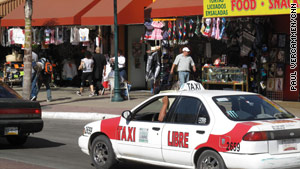
Up until a couple of years ago, the Mexican cities of Tijuana and  Ensenada would be filled with American tourists during spring break. But  persistant drug violence in Mexico has emptied the streets.
Up until a couple of years ago, the Mexican cities of Tijuana and Ensenada would be filled with American tourists during spring break. But persistant drug violence in Mexico has emptied the streets.

Tijuana, Mexico (CNN) ,, March 19, 2010 12:11 a.m. EDT--

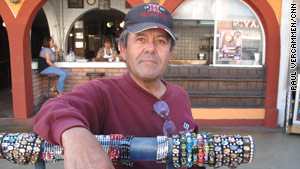
On Tijuana's Avenue de la Revolucion, street vendor and sidewalk philosopher Juan Ramon Rocha leaned on his coin and jewelry cart and waited.

But the tourists from across the border never rushed into the streets of T.J., as it's often called.

Rocha made one sale, to a local resident, in an hour.

"The business, you can see for yourself, it went down 95 percent," he said. "Please tell them, the Americans, it's safe to come here. We are all Americanos, North Americanos. Do you see any problems here?"

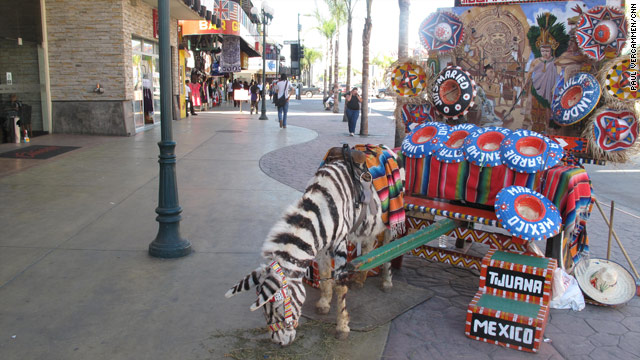
A few yards away, there was a donkey painted like a zebra, hitched to a cart full of sombreros, a Tijuana photo opportunity. But no smiling tourists stepped into the picture frame.

Visitors have been scared off because at least 18,000 people have been killed in Mexico since President Felipe Calderon dispatched the army to fight the drug cartels in December of 2006.

Tijuana's grisliest murders include decapitations, dismemberments, dozens of police killings and the deaths of three teenagers at school.

Fear of Tijuana's streets seeps deep into California.

Mexican drug violence that has left at least 18,000 dead since  2006 has hurt tourism in Tijuana.
Mexican drug violence that has left at least 18,000 dead since 2006 has hurt tourism in Tijuana.
"Please tell them, the Americans, it's safe to come  here," said Tijuana street vendor Juan Ramon Rocha.
"Please tell them, the Americans, it's safe to come here," said Tijuana street vendor Juan Ramon Rocha.
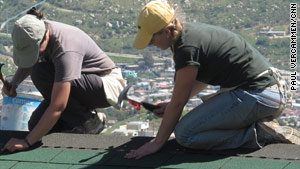
College student Hanna Walker spent her spring break building homes  in nearby Ensenada and skipped Tijuana altogether.
College student Hanna Walker spent her spring break building homes in nearby Ensenada and skipped Tijuana altogether.

As groups of 240 students from Westmont College near Santa Barbara, California, drove down the coast to do missionary work in Ensenada, Mexico, none ventured to Tijuana.

The missionaries doing spring break volunteer projects in poor neighborhoods were given a simple edict -- do not stop in T.J.

Hanna Walker kneeled, pounding nails into shingles, on a rooftop of a small house taking shape on a dirt road high above Ensenada.

"To be honest, I was a tiny bit nervous crossing the border," Walker said. "I've been to Mexico before but not for service projects. But now that I have been here (Ensenada) a couple days I am perfectly comfortable."

The Westmont students are taking precautions as part of their annual Potter's Clay missionary work.

"We are staying in a group," Walker explained. "We are making sure that I am with someone all the time. When we went downtown for dinner, we just paired up and walked around in twos, the buddy system. We locked cars. We're just being smart about it."

Ensenada welcomes any business it can get, as its tourism trade has also been choked off by concerns over border violence.

Fortunately, cruise ships still dock in Ensenada's Bahia de Los Santos, a daily divine arrival that spills cash-carrying tourists onto shore.

But we saw just two visitors who said they drove over the border to visit Ensenada.

All the other beer-wielding, trinket- buying tourists came from the ship.

"People are afraid of driving by Tijuana," said Papas and Beer manager Cesar Marquez. "That's what's hurting us (Ensenada) the most."

To be honest, I was a tiny bit nervous crossing the border.
--Hanna Walker

Later, in Tijuana, as the shadows stretched out with the dropping sun, we were approached by a man with an outdated nylon jacket. His cheeks were chipped by acne scars.The camera was far out of sight."I can help you find whatever you need," he said.

The Athenians walk...[ 752 ]


The forgotten anniversary and the Athenians walk

Issue No. 13381
Wine jars of the 1st-2nd centuries BC on display at Syntagma
Construction of an air vent near Syntagma revealed a well-preserved Roman bath
ATHENS NEWS 15/03/2010, page: 39

TENS OF thousands of Athenians walk by or through a series of fine archaeological exhibits every day, usually without noticing, while guidebooks largely ignore them. Similarly, their 10th anniversary last month passed without fanfare.

When Line 2 and Line 3 of the Athens Metro were inaugurated in 2000, the nicely displayed and well-labelled exhibitions of archaeological finds were one of the most striking features of the new stations, a great gift to all who yearn to learn about the history of this ancient city, and a relief to archaeologists.

When the mammoth project of building two new underground mass transportation lines under the historic centre began in 1991, it caused concern in archaeological circles worldwide. The project, enormous and difficult in any case, also represented a massive archaeological challenge.
Essentially, wherever you dig a hole in central Athens, you will find metres upon metres of antiquities, ranging from at least the Archaic period, through Classical and Hellenistic, via the Roman to the Byzantine.

Most of the tunnels themselves would be bored through bedrock, thus below any archaeological layers. But the building of every single station and every ventilation shaft would have to entail careful and time-consuming archaeological excavations of varying scale, often under difficult circumstances. The scale of the urban archaeological project was, for Greece, unprecedented.

To cut the long story short, the job was done, and done well. Under the supervision of the ministry of culture, dozens of excavations took place through up to 7m of archaeological deposits, revealing hundreds of thousands of ancient artifacts, hundreds of structures, roads, wells, houses, graves and so on from all periods, and thereby adding a huge amount of new information to the known history of the city.

But that’s not all. It was also decided to highlight these fascinating finds and display part of them to the public near where they had been found, at the various stations.

This ambitious and innovative approach has transformed the accessibility of Athenian archaeology and incorporated it into daily life. As there is no Museum of the Archaeology of Athens (the National Museum has much broader scope), up until then the city’s ancient past was only presented in fragments at the site museums of the Kerameikos, Agora and Acropolis.
The metro added no less than five such local exhibitions in a single year.
So what better way to celebrate this anniversary than to take a few rides under the city centre, hopping on and off the train to explore a whole array of windows on the past. Each station exhibit has its own focus, each displaying unique, interesting and intriguing things to see.
Metro, a window on the past

Monastiraki
The metro contains an especially spectacular feature. Beside the northbound platform of the Kifisia-Piraeus line, part of the ancient riverbed of the Ilissos has been revealed. The stone-built channel of the 5th century BC was covered with large tiles in the 2nd century AD. Unseen for the two intervening millennia, the river still flows within.
Panepistimio
The station is located outside the margins of the ancient city, where the cemeteries were located. The exhibition displays clay sarcophagi and very fine pottery of the Classical and Hellenistic periods.

Evangelismos
Another area outside the ancient city. The small display contains clay pipes from 6th century BC Peisistratid aqueduct that brought water from Mt Lykavitos to the city, and a well-preserved Roman pottery kiln.

Acropolis
Here, excavations revealed residential houses and streets from the Classical to the Byzantine period, but also Bronze Age graves dating back to the 2nd and 3rd millennia BC. The exhibition includes pots and many Classical or later household objects, as well as children’s toys.
Syntagma
The huge display at Syntagma works as a cross-section of Athenian history
As the station is the biggest hub of the network, excavations here were most extensive. Discoveries included graves from the Bronze Age to Byzantine periods, the ancient bed of the Eridanos River, various ancient road surfaces, Archaic and Roman water supply systems, and other structures, including a Classical workshop that produced bronze sculptures.

The exhibition is quite large and includes not only pottery, household objects, mosaics and gravestones from various periods, but also a huge display of a reconstructed section through the city’s ground, a fascinating panorama of millennia of activity, right under our feet. Some architectural remains are on open-air display on the eastern side of Syntagma Square.

It is worthwhile strolling a little further along Amalias, on the National Gardens side of the road. Here, excavations for one of the metro air vents have revealed a spectacularly well-preserved Roman bathhouse, now protected by a modern roof.

The building is preserved beyond the height of its ground floor, and many features of its elaborate heating systems are visible.

The exhibitions in the Athens Metro share the opening times of the Metro network: from early morning to late evening. All can be visited for free.
A closer look
(Syntagma Metro Station, Archaeological collection)
A late Hellenistic (2nd century BC) grave stele of an Athenian lady. The inscription identifies her as Zosarion, wife of Hermippos, the son of Zoeilos, from Kifisia. The material (limestone, not marble) and somewhat cursory execution of the stele probably indicate that her family could not afford a more elaborate memorial.