The Hellenic Navy (HN) (Greek: Πολεμικό Ναυτικό, Polemikó Naftikó, abbreviated ΠΝ) is the naval force of Greece, part of the Greek Armed Forces. The modern Greek navy has its roots in the naval forces of various Aegean Islands, which fought in the Greek War of Independence. During the periods of monarchy (1833–1924 and 1936–1973) it was known as the Royal Navy (Βασιλικόν Ναυτικόν, Vasilikón Naftikón, abbreviated ΒΝ).The total displacement of all the navy's vessels is approximately 150,000 tons.The motto of the Hellenic Navy is "Μέγα το της Θαλάσσης Κράτος" from Thucydides' account of Pericles' oration on the eve of the Peloponnesian War. This has been roughly translated as "Great is the country that controls the sea". The Hellenic Navy's emblem consists of an anchor in front of a crossed Christian cross and trident, with the cross symbolizing Greek Orthodoxy, and the trident symbolizing Poseidon, the god of the sea in Greek mythology. Pericles' words are written across the top of the emblem. "The navy, as it represents a necessary weapon for Greece, should only be created for war and aim to victory."...............The Hellenic Merchant Marine refers to the Merchant Marine of Greece, engaged in commerce and transportation of goods and services universally. It consists of the merchant vessels owned by Greek civilians, flying either the Greek flag or a flag of convenience. Greece is a maritime nation by tradition, as shipping is arguably the oldest form of occupation of the Greeks and a key element of Greek economic activity since the ancient times. Nowadays, Greece has the largest merchant fleet in the world, which is the second largest contributor to the national economy after tourism and forms the backbone of world shipping. The Greek fleet flies a variety of flags, however some Greek shipowners gradually return to Greece following the changes to the legislative framework governing their operations and the improvement of infrastructure.Blogger Tips and Tricks
This is a bilingual blog in English and / or Greek and you can translate any post to any language by pressing on the appropriate flag....Note that there is provided below a scrolling text with the 30 recent posts...Αυτό είναι ένα δίγλωσσο blog στα Αγγλικά η/και στα Ελληνικά και μπορείτε να μεταφράσετε οποιοδήποτε ποστ σε οποιαδήποτε γλώσσα κάνοντας κλικ στη σχετική σημαία. Σημειωτέον ότι παρακάτω παρέχεται και ένα κινούμενο κείμενο με τα 30 πρόσφατα ποστς....This is a bilingual blog in English and / or Greek and you can translate any post to any language by pressing on the appropriate flag....Note that there is provided below a scrolling text with the 30 recent posts...Αυτό είναι ένα δίγλωσσο blog στα Αγγλικά η/και στα Ελληνικά και μπορείτε να μεταφράσετε οποιοδήποτε ποστ σε οποιαδήποτε γλώσσα κάνοντας κλικ στη σχετική σημαία. Σημειωτέον ότι παρακάτω παρέχεται και ένα κινούμενο κείμενο με τα 30 πρόσφατα ποστς.........

Wednesday, March 10, 2010

Old Tree knocked down by wind [ 718 ]

The Mainichi Daily News

1,000-year old tree in front of Kamakura shrine knocked down by strong winds

The fallen giant ginkgo tree is pictured at Tsurugaoka Hachimangu in Kamakura, Kanagawa Prefecture, on Wednesday. (Mainichi)

KAMAKURA, Kangagawa -- A 1,000-year-old giant ginkgo tree in front of the main hall of Tsurugaoka Hachimangu shrine here has been knocked down, apparently by strong winds.

At around 4:40 a.m. on Wednesday, a security guard at the shrine found the famous tree -- designated as a natural monument by Kanagawa Prefecture in 1955 -- knocked down with its trunk snapped. It is believed to have been hit by a series of strong winds that continued from late Tuesday afternoon. There were no reports of injuries.

The giant ginkgo tree is pictured in December 2004. (Mainichi)

According to the shrine, the 30-meter-high ginkgo tree is estimated to be 1,000 years old. The security guard reportedly heard a loud thumping sound, like that of "heavy covering of snow falling to the ground," about three times at around 4:15 a.m. After hearing a sound like a lightening strike, he found the tree collapsed on the ground.

The maximum wind velocity at that time was 12 meters per second, according to the Fire Fighting Head Office in Kamakura.

Chikayasu Hamano, a professor at Tokyo University of Agriculture, attributed a blizzard from late Tuesday afternoon as the main cause of the tree's collapse, in addition to heavy rain from February that softened the ground. Hamano also commented that it is impossible to save the tree.

At the end of 2009, the shrine started to consider conservation steps for the giant tree, with inspections by Hamano finding no problems with the health of the tree.

Shigeho Yoshida, the chief priest of Tsurugaoka Hachimangu, is too shocked to comment on the matter, a shrine official said. Other priests, who are also in shock, made spiritual gestures by offering rice and sake to the collapsed tree.

The giant ginkgo tree, well known as a symbol of the shrine, was dubbed "Kakure Icho" (hidden ginkgo) since monk Kugyo hid behind the tree when he assassinated Minamoto no Sanetomo, the third shogun of the Kamakura Shogunate, in January 1219.

(Mainichi Japan) March 10, 2010

The 10/3 NASA "Image of the Day".[ 717 ]

NASA Image of the Day
The latest NASA "Image of the Day" image.

Snapshot of the International Space Station
On March 13, 2008, the International Space Station passed across the field-of-view of Germany's remote sensing satellite, TerraSAR-X, at a distance of 195 kilometers, or 122 miles, and at a relative speed of 34,540 kilometers per hour, or more than 22,000 mph. In contrast to optical cameras, radar does not 'see' surfaces. Instead, it is much more aware of the edges and corners which bounce back the microwave signal it transmits. Smooth surfaces such as those on the station's solar generators or the radiator panels used to dissipate excess heat, unless directly facing the radar antenna, tend to deflect rather than reflect the radar beam, causing these features to appear on the radar image as dark areas. The radar image of the station therefore looks like a dense collection of bright spots from which the outlines of the space station can be clearly identified. The central element on the station, to which all the modules are docked, has a grid structure that presents a multiplicity of reflecting surfaces to the radar beam, making it readily identifiable. This image has a resolution of about one meter (about 39 inches). In other words, objects can be depicted as discrete units--that is, shown separately--provided that they are at least one meter apart. If they are closer together than that, they tend to merge into a single block on a radar image. Since this image as taken, the station has expanded and is more than 90 percent complete, including a full complement of solar arrays. Image Credit: DLR


Τετάρτη, 10 Μάρτιος 2010 7:00:00 πμ

Afghanistan News..[716 ]

Soldier’s lunge for grenade saves comrades

Rifleman James McKie

Rifleman James McKie saved lives of two colleagues by picking up enemy grenade that had landed at his feet in firefight

Karzai 'blood money' for sons killed in raid

Afghan president handed over £1,300 for each victim of operation in which ten were killed on the basis of poor intelligence

Fifth Rifles Regiment soldier dies in a week

Deadly week for British forces in southern Afghanistan as Taleban step up sniper activity around town of Sangin

Special series: War in Afghanistan

Soviet soldiers begin the withdrawal

Afghan defiance lives on

In the last of six special reports, The Times looks at how wars in Afghanistan have proved a graveyard for foreign armies

How masters of chaos thrive on bombs and charity

In the fifth of six special reports, The Times examines the resurgence of the Taleban since they were ousted in 2001

Home Front: hearts and minds must be won

In the fourth of six special reports, The Times asks why the message given to a wavering public is not loud and clear

A losing battle, not a lost cause

In the third of six special reports The Times looks at what the British military mission has achieved and at what cost

Helmand province, Southern Afghanistan

Making the same mistakes?

Can America and Britain avoid Russia's fate in Afghanistan?

More News

How the dream of being a soldier led to jail

The story of how Joe Glenton, a shy and private man, came to occupy a public platform begins with his unorthodox schooling

Brown’s military cuts ‘cost lives of soldiers’

Former chief of the defence staff tells The Times lives were lost because Gordon Brown failed to fund the army properly

Death and swift revenge on Operation Dark Rest

A platoon of the Brigade Reconnaissance Force, with no time to grieve for a lost comrade, wipes out his killers

Law reserving seats for women MPs overturned

President Karzai decrees that seats reserved for women can be reallocated if there are not enough female candidates

Comment

Obama faces his own battle, on home turf

Millions of voters backed Obama last year, above all, as the candidate who would end the wars of the Bush Administration

We need good reasons for risking more British lives

it is time that Parliament insisted on regularly holding the Government accountable to a clear set of war aims in Afghanistan

We have kit and leadership. Let’s go

The war in Afghanistan will not be won with tanks but by the side that brings security to the people

MARJAH

On the frontline

Eye-witness guide to the troop surge in Afghanistan

Taleban sniping

Have insurgents got hold of Nato weapons?

Guerrilla delays

Advanced Taleban tactics slow armed progress

Afghanistan

Fallen servicemen

Interactive record of British casualties in Afghanistan

Tuesday, March 9, 2010

The latest NASA "Image of the Day" [ 715 ]

NASA Image of the Day,, March 9th, 2010
The latest NASA "Image of the Day" image.

A Mosaic of Cassiopeia
This mosaic of images from the Wide-Field Infrared Survey Explore, or WISE, in the constellation of Cassiopeia contains a large star-forming nebula within the Milky Way Galaxy, called IC 1805 or the Heart Nebula, a portion of which is seen at the right of the image.

IC 1805 (
or the Heart Nebula ) is more than 6,000 light-years from Earth.

Also visible in this image are two nearby galaxies, Maffei 1 and Maffei 2.

In visible light these galaxies are hidden by dust in IC 1805 and were unknown until 1968 when Paolo Maffei found them using infrared observations. Both galaxies contain billions of stars and are located some 10 million light-years away.

Maffei 1 is a lenticular galaxy, which has a disk-like structure and a central bulge but no spiral structure or appreciable dust content. Maffei 2 is a spiral galaxy that also has a disk shape, but with a bar-like central bulge and two prominent dusty spiral arms. Image Credit: NASA/JPL-Caltech/UCLA


Τρίτη, 9 Μάρτιος 2010 7:00:00 πμ

Monday, March 8, 2010

Deadly suicide blast, Taliban[ 714 ]

Taliban claims responsibility for deadly suicide blast

March 8, 2010 7:56 a.m. EST
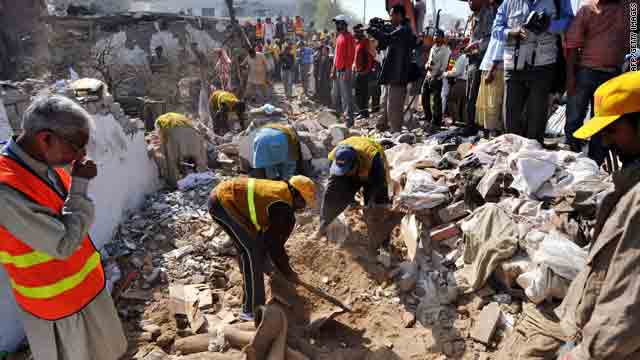
Volunteers search for blast victims in the rubble of a destroyed law enforcement building after a car bomb attack in Lahore, Pakistan, Monday.

(CNN) -- The Taliban said Monday it was behind a suicide bombing in Lahore that killed 11 people and wounded more than 60.

Azam Tariq, spokesman for the Pakistani Taliban, said the attack was in response to U.S. aggression against Muslims around the world.

"I am proud to accept the responsibility of the Lahore suicide blast," he wrote in a text message to CNN.

"We will follow U.S. and its allies all over the world, even if they are in Karachi, Peshawar, Lahore, Afghanistan or in U.S."

Government officials provided the death toll from the bomb in the eastern part of the country. Many of the wounded were in critical condition, and the death toll could rise, officials said.

The blast occurred in an affluent part of Model Town in Lahore, Pakistan's second-largest city.

The suicide bomber targeted the Special Investigation Agency, a provincial law-enforcement agency that investigates high-value detainees. It is where suspected militants have been interrogated, said Khusro Pervez, a senior government official in Lahore.

Journalists Nasir Dawar and Hasir Habib contributed to this report.