Central Nigeria attacks lead to 'at least 100 deaths' | |||
BBC ,22:28 GMT, Sunday, 7 March 2010 At least 100 people have been reported killed in suspected religious clashes near the central Nigerian city of Jos. Witnesses said several villages just outside of the city were attacked simultaneously overnight. Acting President Goodluck Jonathan has put security forces in central Nigeria on full alert. In January hundreds of people were killed in riots in Jos, which lies between the mainly Muslim north and the more Christian south. Ethnic and religious riots also broke out in 2008, killing hundreds. Military deployed The attack happened before dawn on Sunday morning when gangs of men descended on several communities, centred on the village of Dogo-Nahawa, and attacked people with machetes, reports say. A resident of Dogo-Nahawa said the attackers had fired guns as they entered the village. "The shooting was just meant to bring people from their houses and then when people came out they started cutting them with machetes," Peter Jang told Reuters.
An aid worker with the Christian charity Stefanus Foundation, Mark Lipdo, said at least 100 people had been killed. He told the BBC he went to the villages of Zot and Dogo-Nahawa after daylight on Sunday and recorded the names of 77 victims and said there were at least two dozen more bodies. "We saw mainly those who are helpless, like small children and then the older men, who cannot run, these were the ones that were slaughtered." He said Zot had been almost wiped out. Other witnesses said they had also seen at least 100 bodies and a Plateau state official told Reuters news agency that more than 300 people had died. A doctor at a hospital in Jos told news agencies that victims had been cut by machetes and burnt. The military, which already has a presence in Jos, has sent troops to Dogo-Nahawa. "The acting president has placed all the security forces in Plateau and neighbouring states on red alert so as to stem any cross-border dimensions to this latest conflict," Mr Jonathan's office said in a statement quoted by Reuters news agency. He also ordered those behind the violence to be found. Analysts say the attack seems to be in reprisal for the clashes between Christians and Muslims in January, which claimed the lives of at least 200 people and displaced thousands of others. Hundreds of people have fled from Jos in the aftermath of the fighting, the Red Cross says. Robin Waudo, a spokesman for the International Committee of the Red Cross, told the BBC his volunteers were assisting people wounded in the latest fighting. "We know that late this morning there was some fighting in the south part of the city and it seems like there are reprisal attacks from what happened a few weeks ago," he said. | |||

Monday, March 8, 2010
C.Nigeria: ''at least 100 deaths''[ 711 ]


Sunday, March 7, 2010
Blasts Shake Baghdad[ 710 ]
Deadly Blasts Shake Baghdad as Iraqis Vote
Sunday, March 07, 2010 

March 7: Rescuers search for bodies under the rubble, at the scene of a blast which leveled a building in northeastern Baghdad, Iraq.


Polls closed across Iraq on Sunday as the war-weary population awaits results from the national election that will decide the future of the country's still-fragile democracy.
The election tested the mettle of the country's shaky security as insurgents killed 31 people across Iraq, unleashing a barrage of mortars intent on disrupting the historic day.
About 19 million Iraqis are eligible to vote on a candidate to lead the country after U.S. forces pull out. The election is critical in determining whether Iraq can overcome the jagged sectarian divisions that have defined it since the U.S.-led invasion in 2003.
It could take months before the new parliament chooses a prime minister and forms a government.
SLIDESHOW: Iraqis Head to the Polls
One polling station in Baghdad was believed to have 45 percent voter turnout. Expectations prior to the national election were approximately 50 percent voter turnout.
Insurgents who vowed to disrupt the elections — which they see as validating the Shiite-led government and the U.S. occupation — launched a spate of attacks as polls opened across the city and country.
At least 14 people died in northeastern Baghdad after an explosion leveled a building, and mortar attacks in western Baghdad killed seven people in two different neighborhoods, police and hospital officials said.
In Baghdad's northeast Hurriyah neighborhood, where mosque loudspeakers exhorted people to vote as "arrows to the enemies' chest," three people were killed when someone threw a hand grenade at a crowd heading to the polls, according to police.
In the city of Mahmoudiya, about 20 miles south of Baghdad, a bomb inside a polling center killed a policeman, Iraqi Army Col. Abdul Hussein said. There were also explosions elsewhere in the country, but no further reports of fatalities.
An Associated Press photographer on the scene of the collapsed building in Baghdad's northeastern Ur neighborhood described rescuers pulling bodies from the rubble.
Insurgents also launched mortars toward the Green Zone — home to the U.S. Embassy and the prime minister's office — and in the Sunni stronghold of Azamiyah police reported at least 20 mortar attacks in the neighborhood since day break.
Yet voters still came. In Azamiyah, Walid Abid, a 40-year-old father of two, was speaking as mortars landed several hundreds yards away.
"I am not scared and I am not going to stay put at home. Until when? We need to change things. If I stay home and not come to vote, Azamiyah will get worse," he said.
About 6,200 candidates are competing for 325 seats in the new parliament, Iraq's second for a full term of parliament since the 2003 U.S.-led invasion seven years ago this month.
Many view the election as a crossroads at which Iraq will decide whether to adhere to politics along the Shiite, Sunni and Kurdish lines or move away from the ethnic and sectarian tensions that have emerged since the fall of Saddam Hussein's iron-fisted, Sunni minority rule.
Iraqis hope it will help them achieve national reconciliation at a time when the United States has vowed to withdraw combat forces by late summer and all American troops by the end of next year.
Prime Minister Nouri al-Maliki is fighting for his political future against a coalition led by mainly Shiite religious groups — the Supreme Islamic Iraqi Council and a party headed by anti-American cleric Muqtada al-Sadr. He also faces a challenge from secular alliance led by Ayad Allawi, a former prime minister and secular Shiite, who has teamed up with a number of Sunnis in a bid to claim the government.
"These acts will not undermine the will of the Iraqi people," al-Maliki said Sunday morning, speaking to reporters after casting his ballot.
Security was tight across the capital. The borders have been sealed, the airport closed and hundreds of thousands of Iraqi military and police have flooded the streets.
Extra checkpoints were set up across the city, and in some parts of central Baghdad, people could not go 50 yards without hitting another checkpoint.
A ban on small vehicles was lifted around the country, except in northern Ninevah province, to facilitate access to the polls, Maj. Gen. Ayden Khalid Qader, who's in charge of election security, on state-run Iraqiya television.
But many voters continued to proceed to the polling places on foot.
In keeping with the U.S. military's assertion that Iraqis are running the elections, the only visible American military presence was in the air or escorting election observers to and from the polls; four U.S. helicopter gunships could be seen in the sky over the Kazimiyah neighborhood.
The U.S., which has lost more than 4,300 troops in the nearly seven-year conflict, has fewer than 100,000 troops in the country — a number that is expected to drop to about 50,000 by the end of the summer.
Exiting the polls, Iraqis waved purple-inked fingers — the now-iconic image synonymous with voting in this oil-rich country home to roughly 28 million people.
Despite the violence and frustration that has set in after years of fighting and faulty government services, many Iraqis were still excited to vote.
In the city of Nasiriyah, in the Shiite south, crowds of people filled the streets — men in what appeared to be their best clothes were accompanied by women in long black cloaks and often children.
"I voted in 2005. There were a lot less people then," said Ahmed Saad Chadian. "Today participation is much higher."
In the Shiite holy city of Najaf, south of Baghdad, dozens of voters also lined up to cast their ballot.
"We came to participate in this national day, and we don't care about the explosions," said Sahib Jabr, a 34-year-old old taxi driver.
President Jalal Talabani was among the first to vote Sunday morning in the Kurdish city of Sulamaniyah. Talabani's party, the Patriotic Union of Kurdistan, is enmeshed in a tight race with an upstart political party called Change which is challenging the two Kurdish parties that have dominated Iraqi politics for years.
Fox News' Malini Wilkes and the Associated Press contributed to this report.
Saturday, March 6, 2010
NASA,The latest "Image of the Day"[ 709 ]

This is a composite image of NGC 1068, one of the nearest and brightest galaxies containing a rapidly growing supermassive black hole. The X-ray images and spectra obtained using Chandra's High Energy Transmission Grating Spectrometer show that a strong wind is being driven away from the center of NGC 1068 at a rate of about a million miles per hour. This wind is likely generated as surrounding gas is accelerated and heated as it swirls toward the black hole. A portion of the gas is pulled into the black hole, but some of it is blown away. High energy X-rays produced by the gas near the black hole heat the ouflowing gas, causing it to glow at lower X-ray energies. X-ray data from the Chandra X-ray Observatory are shown in red, optical data from the Hubble Space Telescope in green and radio data from the Very Large Array in blue. The spiral structure of NGC 1068 is shown by the X-ray and optical data, and a jet powered by the central supermassive black hole is shown by the radio data. This Chandra study is much deeper than previous X-ray observations. Using this data, researchers believe that each year several times the mass of our sun is being deposited out to large distances, about 3,000 light years from the black hole. The wind likely carries enough energy to heat the surrounding gas and suppress extra star formation. These results help explain how a supermassive black hole can alter the evolution of its host galaxy. It has long been suspected that material blown away from a black hole can affect its environment, but a key question has been whether such "black hole blowback" typically delivers enough power to have a significant impact. NGC 1068 is located about 50 million light years from Earth and contains a supermassive black hole about twice as massive as the one in the middle of the Milky Way Galaxy. Image Credit: X-ray (NASA/CXC/ MIT/C.Canizares, D.Evans et al), Optical (NASA/STScI), Radio (NSF/ NRAO/VLA)
Chile quake-area still shaking, [ 708 ]
Chile quake-area still shaking, death toll unclear

CONCEPCION, Chile (Reuters) - Strong aftershocks rattled south-central Chile on Friday, panicking residents nearly a week after one of the most powerful earthquakes on record devastated coastal towns and killed hundreds of people.
The government of outgoing President Michelle Bachelet, facing criticism for its slow response to the quake, said it was revising the death toll after authorities mistakenly tallied scores of missing people who later turned up alive.
Officials said they had now identified 452 victims. They did not give a number for unidentified bodies or missing people and backed off a previous figure of more than 800 deaths.
Many people who survived the 8.8-magnitude quake on February 27 were killed hours later by a massive tsunami, outraging Chileans who say there was no warning the waves were coming.
The Chilean Navy acknowledged there was a breakdown in its tsunami-alert system and on Friday it fired the head of the agency in charge of issuing catastrophe warnings.
In ravaged Concepcion, Chile's second-largest city, some people ran out of their houses or jumped out of the vehicles where they had been sleeping since the quake as seven intense aftershocks shook the area on Friday.
The strongest of the aftershocks was 6.6 in magnitude.
"Some chunks of buildings that were already in bad condition fell but nothing significant," the top government official in quake-hit Bio Bio region told local radio.
The February 27 quake and the giant waves destroyed hundreds of thousands of homes, wrecked bridges and roads and cracked modern buildings in half in the capital, Santiago.
The disaster also wreaked havoc on some of Chile's famous wineries, spilling millions of liters of wine from cracked barrels, and briefly shut down some of the world's richest copper mines.
The Navy said there was no risk of tsunamis from the new aftershocks. People did not stray too far into the streets of Concepcion because the army had imposed a curfew until midday to control sporadic looting.
"This was the strongest (aftershock) yet. As soon as I felt it, I thought 'Here we go again'," said Cristian Ruiz, 38, who works in the fishing industry in Concepcion.
GOVERNMENT CRITICIZED
The confusion over the death toll prompted harsh criticism of Chile's National Emergency Office, known as Onemi, which President-elect Sebastian Pinera has pledged to overhaul.
In a blog posted on the daily El Mercurio website, the former head of Onemi, Alberto Maturana, called the agency's handling of the disaster "a comedy of errors."
"The agency has no validity in public opinion, when it is supposed to be the most credible," he said.
The doubts over the death toll are likely to persist because an undetermined number of victims were washed out to sea in the tsunamis and some bodies may never be recovered.
"The number of disappeared is very difficult to determine," said Patricio Bustos, a government forensics specialist in Talca, a city in central Chile that was hit hard by the quake. "It can take a very long time."
In Concepcion, looting was mostly under control as hundreds of troops patrolled the streets and handed out food and water. Long lines formed at one of the few grocery stores finally opened to customers.
In Dichato, a small town just north of Concepcion, two large ships that were washed ashore by the tsunami sat in a field 2 km (1.2 miles) from the damaged coastline.
After meeting Bachelet on Friday in Santiago, United Nations Secretary-General Ban Ki-moon pledged $10 million and other aid supplies for the relief effort.
Ban is also scheduled to tour some of the quake areas and meet Pinera, who will take office on March 11 in a swearing-in ceremony that will be toned down because of the disaster.
Chile's biggest copper mines were mostly spared by the quake but its top two oil refineries were hit hard and are still offline, forcing the country to boost fuel imports. Other key industries such as pulp, fishing and fruit also took a hit.
The government has shied away from quantifying the damage, which according to one estimate could reach $30 billion, or about 15 percent of the gross domestic product of the world's leading copper producer.
Finance Minister Andres Velasco said on Friday the quake will weigh heavily on the economy in the coming months but predicted the rebuilding effort would help drive a robust recovery in the long term, echoing a pledge from the incoming government.
"We are not only going to rebuild what was destroyed, we are going to rebuild it with better technology and with better procedures," the silver-haired Pinera said on Friday, adding his government plans to revamp Chile's catastrophe-alert system in hopes of limiting the death toll from future disasters.
With reconstruction likely to draw billions of dollars into Chile, financial markets are already pricing in the expected flood of inflows.
Chile's peso gained more than 3 percent this week, while its main stock index rose on Friday for the second straight day.
(Additional reporting by Mario Naranjo in Concepcion, Esteban Israel and Alvaro Tapia in Santiago; writing by Mica Rosenberg and Todd Benson; Editing by John O'Callaghan)
28 pirates were taken into custody ,Friday..[ 707 ]
French warship team destroys pirate boats
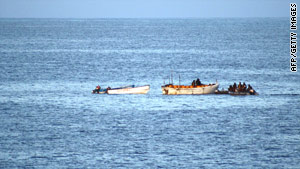
(CNN) -March 5, 2010 3:14 p.m. EST- : Twenty-eight suspected pirates were taken into custody Friday by the European Union Naval Force after a handful of failed attacks on fishing vessels in the Indian Ocean, the EU mission said.
In the first incident, the mission intercepted the a mother ship and two skiffs early Friday in the southern Indian Ocean between the Seycelles and Mombasa, Kenya. The mission said the suspected pirates were in an area where an earlier attack had occurred.
A helicopter from the French warship FS Nivose then tracked the vessels and saw the suspects throwing things overboard, the mission said.
When a French team arrived at the scene, it found 11 suspected pirates and "pirate paraphernalia" in the skiffs: a rocket launcher, grappling hooks and several fuel barrels.
The forces destroyed the pirate ship and a skiff and took the suspected pirates into custody. The fate of the second skiff was not immediately known.
Soon after, pirates tried to attack a French fishing vessel near two other fishing boats, said Cmdr. John Harbour, spokesman for the EU Naval Force.
The French fishing vessel collided with the suspected pirates' vessel and sank it, Harbour said. Six suspected pirates were picked out of the water by the EU force, he said. It was not immediately clear if they had been transported to the FS Nivose, although that had been planned, he said.
Later, pirates tried to attack a Spanish fishing vessel, Harbour said. The boat alerted the EU Naval Force, and air and naval units intervened, he said.
Eleven suspected pirates were taken into custody and were on board the Nivose, Harbour said.
Harbour said an increase in pirate attacks was likely over the next few weeks as the monsoon season was ending and the ocean was becoming calmer, he said.
"The pirates have been preparing for it. ... We are prepared as well," he said.
On Thursday, pirates on two skiffs in the Indian Ocean attacked the Spanish fishing vessel Albacan, the EU Naval Force said. The pirates fired a rocket-propelled grenade, which exploded on the Albacan's deck and burst into flames, force said.
Armed guards on the Albacan fired shots at the skiffs and repelled the attack, it said. No crew members were injured, and the small fire was extinguished.
The EU mission tries to deter and stop piracy off Somalia, which has been mired in chaos since the early 1990s. It escorts vessels in the Gulf of Aden and Indian Ocean carrying World Food Program humanitarian aid to displaced people in Somalia.
It also seeks to protect "vulnerable vessels" in the Gulf of Aden and off the Somali coast, according to the mission's Web site.