
TEHRAN, Iran (CNN) -- Long lines of voters massed at many Iranian polling stations early Friday in an heavy turnout believed to be unprecedented for the hotly contested presidential election.
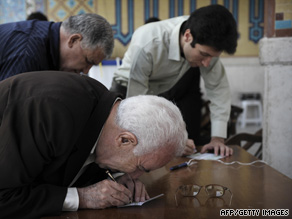
Men choose their candidates before voting Friday at a mosque in Tehran, Iran.


Voters were lining up, standing in the blistering sun, even before the polls opened at 8 a.m.
The polling stations were to stay open for 12 hours after officials extended the polling time to accommodate the high turnout.
The election is pitting incumbent President Mahmoud Ahmadinejad against reformist Mir Hossein Moussavi, and two other candidates.
Kamran Daneshjoo, head of the election office, said the turnout was unprecedented, and that several polling places had already requested to stay open for two more hours.
But text messaging was not working in Iran on Friday, an issue that could affect Moussavi, who has used technology to inform his supporters.
In addition to Moussavi, two other challengers -- former parliament Speaker Mehdi Karrubi, another reformist, and hard-liner Mohsen Rezaie, secretary of Iran's Expediency Council -- hope to unseat Ahmadinejad in the election.
Don't Miss
If no single candidate reaches a simple majority, a runoff election will be held on Friday, June 19.
Raucous, lively political rallies filled the streets of Tehran as the campaign season ended Thursday.
The streets were quiet late Thursday as posters bearing the faces of the top candidates were torn down, and graffiti proclaiming "Change, Change, Change" was washed away.
It was a strange contrast to the scene in Tehran a day before, when tens of thousands of Iranians took part in the final rallies Wednesday. Most of the rallies were in support of Moussavi.
As far as the eye could see, people walked for hours from east of the city to the west, converging on Tehran's Freedom Square, which became the symbol of the Islamic revolution that swept this country back in 1979.
Some Ahmadinejad supporters were taking part in the rallies, but most were wearing the color green, the symbol of Moussavi's campaign. The Moussavi supporters stayed out well past the midnight deadline, dancing, chanting, driving and honking their horns. The rallies were largely peaceful. At one point, police fired tear gas to disperse a crowd, but the situation did not get out of control.
People who are old enough to remember the Islamic revolution 30 years ago say this week's rallies in the capital were the largest they had seen since then.
Moussavi has energized Iran's women and young people, and his supporters hope that will be enough to sweep him into victory.
But much of his support is coming from those frustrated with Ahmadinejad's four years in office, during which prices of goods have skyrocketed and personal freedoms have plummeted.
Candidate profiles
"Thirty years of frustration is exploding," said Mohamed, a mechanical engineer student who took part in Wednesday's march to Freedom Square. "Even if Ahmadinejad wins, we are here just to express our opposition."
The Iranian president still has staunch support, especially among the poor in the provinces to whom he has doled out money, benefits and favors.  CNN's Christiane Amanpour reports emotions on the street »
"Honestly we have never seen anyone as courageous as Ahmadinejad," said one of Ahmadinejad's supporters, who took part in this week's rallies.
Moussavi's supporters hope that he follows in the same footsteps as Mohammed Khatami, a reformist candidate who overwhelmingly won the presidency in 1997, raising hopes that the reformist movement would bring religious and democratic freedoms to the Islamic republic. But the real power in Iran rests in the hands of the Supreme Leader, Ayatollah Ali Khamenei.
By the time Khatami left office in 2005, he was unable to make major changes because of the opposition of hardline elements in Iran's clerical establishment.

No comments:
Post a Comment