The Hellenic Navy (HN) (Greek: Πολεμικό Ναυτικό, Polemikó Naftikó, abbreviated ΠΝ) is the naval force of Greece, part of the Greek Armed Forces. The modern Greek navy has its roots in the naval forces of various Aegean Islands, which fought in the Greek War of Independence. During the periods of monarchy (1833–1924 and 1936–1973) it was known as the Royal Navy (Βασιλικόν Ναυτικόν, Vasilikón Naftikón, abbreviated ΒΝ).The total displacement of all the navy's vessels is approximately 150,000 tons.The motto of the Hellenic Navy is "Μέγα το της Θαλάσσης Κράτος" from Thucydides' account of Pericles' oration on the eve of the Peloponnesian War. This has been roughly translated as "Great is the country that controls the sea". The Hellenic Navy's emblem consists of an anchor in front of a crossed Christian cross and trident, with the cross symbolizing Greek Orthodoxy, and the trident symbolizing Poseidon, the god of the sea in Greek mythology. Pericles' words are written across the top of the emblem. "The navy, as it represents a necessary weapon for Greece, should only be created for war and aim to victory."...............The Hellenic Merchant Marine refers to the Merchant Marine of Greece, engaged in commerce and transportation of goods and services universally. It consists of the merchant vessels owned by Greek civilians, flying either the Greek flag or a flag of convenience. Greece is a maritime nation by tradition, as shipping is arguably the oldest form of occupation of the Greeks and a key element of Greek economic activity since the ancient times. Nowadays, Greece has the largest merchant fleet in the world, which is the second largest contributor to the national economy after tourism and forms the backbone of world shipping. The Greek fleet flies a variety of flags, however some Greek shipowners gradually return to Greece following the changes to the legislative framework governing their operations and the improvement of infrastructure.Blogger Tips and Tricks
This is a bilingual blog in English and / or Greek and you can translate any post to any language by pressing on the appropriate flag....Note that there is provided below a scrolling text with the 30 recent posts...Αυτό είναι ένα δίγλωσσο blog στα Αγγλικά η/και στα Ελληνικά και μπορείτε να μεταφράσετε οποιοδήποτε ποστ σε οποιαδήποτε γλώσσα κάνοντας κλικ στη σχετική σημαία. Σημειωτέον ότι παρακάτω παρέχεται και ένα κινούμενο κείμενο με τα 30 πρόσφατα ποστς....This is a bilingual blog in English and / or Greek and you can translate any post to any language by pressing on the appropriate flag....Note that there is provided below a scrolling text with the 30 recent posts...Αυτό είναι ένα δίγλωσσο blog στα Αγγλικά η/και στα Ελληνικά και μπορείτε να μεταφράσετε οποιοδήποτε ποστ σε οποιαδήποτε γλώσσα κάνοντας κλικ στη σχετική σημαία. Σημειωτέον ότι παρακάτω παρέχεται και ένα κινούμενο κείμενο με τα 30 πρόσφατα ποστς.........

Thursday, June 4, 2009

Air France jet may have broken up in ocean, [72]

RIO DE JANEIRO, Brazil (CNN) -- A 12-mile oil slick near where an Air France jet crashed Monday into the Atlantic Ocean indicates the plane likely didn't break up until it hit the water, Brazil's defense minister said Wednesday.
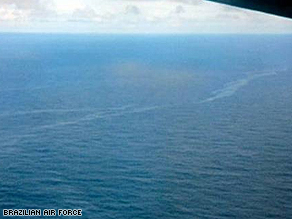
Image released by the Brazilian Air Force shows oil slicks in the water near a debris site.

Image released by the Brazilian Air Force shows oil slicks in the water near a debris site.

Click to view next image ..full text

If true, that would argue against an in-flight explosion as the cause of the crash of Air France Flight 447, Defense Minister Nelson Jobim told reporters.

Jobim said currents had strewn the debris widely and that the search area had been expanded to 300 square miles.

The Airbus A330, carrying 228 people, went down about three hours after beginning what was to have been an 11-hour flight from Rio de Janeiro to Paris, France. No survivors have been found. Map of Flight AF 447's flight path »

Investigators have not determined what caused the plane to crash. The flight data recorders have not been recovered, and the plane's crew did not send any messages indicating problems before the plane disappeared. Video Watch as high seas hamper recovery »

The Brazilian Air Force said it found the oil slick and four debris fields Wednesday, but rain and rough seas kept searchers from plucking any of the debris from the water.

Among Wednesday's finds were objects in a circular 5-kilometer (3-mile) area, including one object with a diameter of 7 meters (23 feet) and 10 other objects, some of which were metallic, Brazilian Air Force spokesman Jorge Amaral said.

Searchers had found two debris fields Tuesday and identified the wreckage as coming from Flight 447. The debris was found about 650 kilometers (400 miles) northeast of the Fernando de Noronha Islands, an archipelago 355 kilometers (220 miles) off the northeast coast of Brazil. It included an airplane seat and an orange float.

Wednesday's debris find was about 90 kilometers (56 miles) south of Tuesday's discoveries, Amaral said.

Eleven aircraft and five ships are engaged in the search, including airplanes from France and the United States. Video Watch as experts question whether recovery is possible »

No comments: