The Hellenic Navy (HN) (Greek: Πολεμικό Ναυτικό, Polemikó Naftikó, abbreviated ΠΝ) is the naval force of Greece, part of the Greek Armed Forces. The modern Greek navy has its roots in the naval forces of various Aegean Islands, which fought in the Greek War of Independence. During the periods of monarchy (1833–1924 and 1936–1973) it was known as the Royal Navy (Βασιλικόν Ναυτικόν, Vasilikón Naftikón, abbreviated ΒΝ).The total displacement of all the navy's vessels is approximately 150,000 tons.The motto of the Hellenic Navy is "Μέγα το της Θαλάσσης Κράτος" from Thucydides' account of Pericles' oration on the eve of the Peloponnesian War. This has been roughly translated as "Great is the country that controls the sea". The Hellenic Navy's emblem consists of an anchor in front of a crossed Christian cross and trident, with the cross symbolizing Greek Orthodoxy, and the trident symbolizing Poseidon, the god of the sea in Greek mythology. Pericles' words are written across the top of the emblem. "The navy, as it represents a necessary weapon for Greece, should only be created for war and aim to victory."...............The Hellenic Merchant Marine refers to the Merchant Marine of Greece, engaged in commerce and transportation of goods and services universally. It consists of the merchant vessels owned by Greek civilians, flying either the Greek flag or a flag of convenience. Greece is a maritime nation by tradition, as shipping is arguably the oldest form of occupation of the Greeks and a key element of Greek economic activity since the ancient times. Nowadays, Greece has the largest merchant fleet in the world, which is the second largest contributor to the national economy after tourism and forms the backbone of world shipping. The Greek fleet flies a variety of flags, however some Greek shipowners gradually return to Greece following the changes to the legislative framework governing their operations and the improvement of infrastructure.Blogger Tips and Tricks
This is a bilingual blog in English and / or Greek and you can translate any post to any language by pressing on the appropriate flag....Note that there is provided below a scrolling text with the 30 recent posts...Αυτό είναι ένα δίγλωσσο blog στα Αγγλικά η/και στα Ελληνικά και μπορείτε να μεταφράσετε οποιοδήποτε ποστ σε οποιαδήποτε γλώσσα κάνοντας κλικ στη σχετική σημαία. Σημειωτέον ότι παρακάτω παρέχεται και ένα κινούμενο κείμενο με τα 30 πρόσφατα ποστς....This is a bilingual blog in English and / or Greek and you can translate any post to any language by pressing on the appropriate flag....Note that there is provided below a scrolling text with the 30 recent posts...Αυτό είναι ένα δίγλωσσο blog στα Αγγλικά η/και στα Ελληνικά και μπορείτε να μεταφράσετε οποιοδήποτε ποστ σε οποιαδήποτε γλώσσα κάνοντας κλικ στη σχετική σημαία. Σημειωτέον ότι παρακάτω παρέχεται και ένα κινούμενο κείμενο με τα 30 πρόσφατα ποστς.........

Monday, October 15, 2012

Turkey will ban its air space...[ 2965 ]

Turkey has announced that it will ban all Syrian aircraft from its air space


Published on Oct 14, 2012 by

Turkey has announced that it will ban all Syrian aircraft from its air space from Sunday. It follows a similar move by Damascus on Saturday, closing Syrian air space to Turkish planes. 
-
The Syrian government took the decision after Turkey forced a Syrian passenger plane to land on Wednesday, on suspicion that it was carrying Russian-made weapons. The plane carrying 35 passengers and 2 crew was allowed to leave Turkey, but the suspected cargo was seized. Syria's Foreign Ministry has denied the plane was carrying illegal military supplies and demanded Turkey return the cargo.

 Russia says the cargo consisted of radar equipment, and not weapons. 

Sunday, October 14, 2012

A nuclear submarine has collided with a cruiser...[ 2964 ]

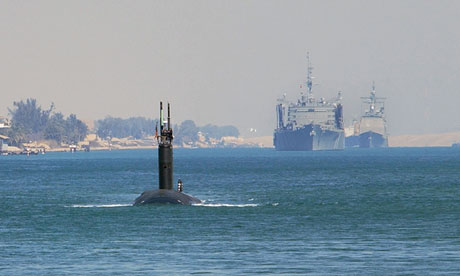
Nuclear submarine collides with cruiser off US coast

Investigation under way as LA-class submarine USS Montpelier collides with cruiser USS San Jacinto on Saturday
USS Boise, Los Angeles-class nuclear submarine
A Los Angeles-class submarine similar to USS Montpelier, which collided with USS San Jacinto on Saturday. Photograph: Jim Hampshire/Getty Images
-
A nuclear submarine has collided with a cruiser during routine operations off the east coast of the US.
The US Fleet Forces Command said the Los Angeles-class submarine USS Montpelier and the Aegis cruiser USS San Jacinto collided at about 3:30pm on Saturday.
No one was injured, and the extent of any damage to the vessels was not clear on Saturday evening, said Lieutenant Commander Brian Badura.
-
"We have had circumstances where navy vessels have collided at sea in the past, but they're fairly rare as to how often they do take place," Badura told the Associated Press.
Navy officials said the collision was under investigation, but declined to give details on where the incident took place or what happens next.
-
"If we do have an incident that does take place, there are folks that swing into action … to help us make a better, more conclusive explanation of exactly what happened," Badura said.
-
The news release said overall damage to both ships was being evaluated and that the sub's propulsion plant was unaffected by the collision.
Both ships are based at Norfolk, Virginia, and are operating on their own power.
The Pentagon said late on Saturday it was investigating how the collision had taken place.

Tensions between Syria & Turkey...[ 2963 ]


Syria bans Turkey civilian flights over its territory

Tanks in Sanliurfa province 12 Oct 2012  
Turkish tanks have taken up position near the border following the rise in tensions
Turkish civilian planes are no longer allowed to fly over Syria, Damascus has said, amid growing tensions between the two neighbouring countries.
-
The ban took effect at midnight (2100GMT) on Saturday.
This comes just days after Turkey intercepted a Syrian-bound plane, claiming it carried Russian-made munitions for the Syrian army.
-
Syria has described the claim as a lie, challenging Ankara to put the seized goods on public view.
The Syrian foreign ministry said its ban on Turkish flights was in retaliation for a similar move from Ankara. 
-
Turkey has not announced such a measure, although it has said it will continue to ground Syrian civilian planes it suspects are carrying military cargo.

Cluster bomb claim Tensions have been recently rising between the two countries after a series of cross-border incidents.
Last week, there were several days of firing across the border after five Turkish civilians were killed by Syrian shelling.
Turkey's government has backed the Syrian opposition and called for the resignation of President Bashar al-Assad.
In Syria itself, there were reports on Saturday that rebels had shot down a Syrian military jet outside Aleppo - the town at the centre of recent fighting.
Footage posted online showed the burning wreckage of what appeared to be an aircraft, but the claim has not been independently verified.
Meanwhile, Human Rights Watch has accused the government of President Assad of dropping cluster bombs - which are banned by more than 100 countries - into populated areas.
The group said there was a number of credible reports that the number of cluster bomb strikes had increased dramatically in recent days.
Syria refuses to join the Convention on Cluster Munitions, which bans the use of such weapons.
In a separate development, Turkish Prime Minister Recep Tayip Erdogan told a conference in Istanbul that the UN's failure to act in Syria gave President Assad the green light to kill tens or hundreds of people every day.
Turkey may not be at war with Syria, but it is now increasingly involved in its neighbour's conflict, the BBC's James Reynolds in Turkey reports.
Mr Erdogan's comments come as the UN-Arab League envoy for Syria, Lakhdar Brahimi, had talks in Istanbul with Turkish Foreign Minister Ahmet Davutoglu to hear Ankara's perspective on the crisis.
No breakthroughs were expected, and none were reported after the meeting, our correspondent says.

How a cluster bomb works

cluster bomb graphic
1. The cluster bomb, in this case a CBU-87, is dropped from a plane and can fly about nine miles before releasing its load of about 200 bomblets.
2. The canister starts to spin and opens at an altitude between 1,000m and 100m, spraying the bomblets across a wide area.
3. Each bomblet is the size of a drink can and contains hundreds of metal pieces. When it explodes, it can cause deadly injuries up to 25m away.
More than 100 countries have signed a treaty banning the use of cluster munitions through the Convention on Cluster Munitions.

Thursday, October 11, 2012

''Pioneer I '' Launch...[ 2962 ]

Image of the  ''Pioneer I '' Launch

Wednesday, October 10, 2012

Keep Greece in Europe ? ...[ 2961 ]

Why Angela Merkel may not be able to keep Greece in Europe

Chancellor Merkel, who faces elections next year, has tied her political fate to the survival of the common currency. But despite her efforts, Greece's economy continues to reel.

By Michael Steininger, Correspondent / October 10, 2012 
 The Christian Science Monitor
Greece's Prime Minister Antonis Samaras (r.) talks with Germany's Chancellor Angela Merkel in Athens, Tuesday, Oct. 9.//Thanassis Stavrakis/AP


Mrs. Merkel has tied her political fate to the survival of the common currency. “If the euro fails, Europe will fail,” she keeps repeating in every speech she gives about the eurocrisis. With general elections in Germany less than a year away, the chancellor needs some progress in the solution of this crisis, but a Greek sovereign default and subsequent exit from the eurozone would be a huge setback for her.
-
The problem is this is still a likely scenario. After three years of countless emergency summits, two bailout packages worth €240 billion ($308 billion), and a debt write-off of 75 percent by private creditors as well as heavy cuts in public spending, Greece is still not safe.
“Greece will exit, and Merkel will be proven wrong – I’m willing to bet on it,” says Hans-Werner Sinn, president of the Munich-based Ifo Institute for Economic Research. Mr. Sinn believes that Greece would need financial support for many more years if it were to remain in the common currency – a prospect that German voters and taxpayers would see very critically. “A Greek exit would be better for all.”
-
The current rescue measures for Greece are scheduled to end in 2014. By 2015, the country is meant to get access to private capital again. But few believe that this can be achieved. “Greece’s sovereign debt is still extremely high,” says Jens Boysen-Hogrefe of the Kiel Institute for the World Economy. “It will be very difficult to borrow fresh money at sustainable interest rates.”

High debt rate

This year the country's debt rose to 169 percent of GDP, so the country's liabilities surpassed its economic performance by two thirds. The debt rate is expected to rise to 179 percent in 2013 and decline to 152 percent in 2017, according to the International Monetary Fund (IMF). Economists regard sovereign debts which exceed 120 percent of GDP as unsustainable.
At the same time the Greek economy keeps declining. Within the last four years it shrank by 20 percent, this year a further reduction by 6.5 percent is estimated. Without growth Greece will be unable to reduce its debts, in spite of severe cuts in public spending.
Merkel is widely perceived by Greeks as the main force behind the tough austerity measures the country has been going through in the past few years. Even though Mr. Samaras proclaimed the chancellor’s visit meant an “end to Greece’s international isolation,” it is unlikely she won over any of the protesters, given that she had warm words – “My wish is for Greece to stay in the eurozone” – but no announcements of further financial help for the Greeks.
-
At home Merkel has just entered the battle for re-election next year. The Social Democrats, her main opposition in Germany’s political landscape, have nominated their candidate for the chancellery, Peer Steinbrück. A former finance minister in Merkel’s first cabinet between 2005 and 2009, Mr. Steinbrück is widely credited with steering the German economy relatively unscathed through the global banking crisis of 2008.
-
And Merkel faces increasing opposition to her eurozone policy within her own ranks. Alexander Dobrindt, general secretary of the CSU party, part of Merkel’s coalition government, was the latest of her allies to forecast an imminent Greek exit from the eurozone. “There is no other way,” Mr. Dobrindt told popular tabloid newspaper Bild. “Greece will exit in 2013.”
-
But Merkel fears the ripple effect of such an exit. “As a trained scientist, she knows a thing or two about chain reactions,” says Michael Spreng, blogger and political analyst. “She likes to be in control. And Greece has become an risk factor on her way to re-election."