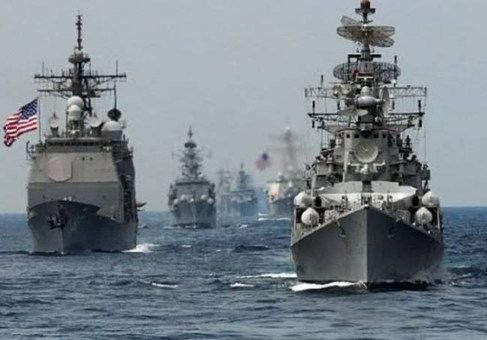
The Hellenic Navy (HN) (Greek: Πολεμικό Ναυτικό, Polemikó Naftikó, abbreviated ΠΝ) is the naval force of Greece, part of the Greek Armed Forces. The modern Greek navy has its roots in the naval forces of various Aegean Islands, which fought in the Greek War of Independence. During the periods of monarchy (1833–1924 and 1936–1973) it was known as the Royal Navy (Βασιλικόν Ναυτικόν, Vasilikón Naftikón, abbreviated ΒΝ).The total displacement of all the navy's vessels is approximately 150,000 tons.The motto of the Hellenic Navy is "Μέγα το της Θαλάσσης Κράτος" from Thucydides' account of Pericles' oration on the eve of the Peloponnesian War. This has been roughly translated as "Great is the country that controls the sea". The Hellenic Navy's emblem consists of an anchor in front of a crossed Christian cross and trident, with the cross symbolizing Greek Orthodoxy, and the trident symbolizing Poseidon, the god of the sea in Greek mythology. Pericles' words are written across the top of the emblem. "The navy, as it represents a necessary weapon for Greece, should only be created for war and aim to victory."...............The Hellenic Merchant Marine refers to the Merchant Marine of Greece, engaged in commerce and transportation of goods and services universally. It consists of the merchant vessels owned by Greek civilians, flying either the Greek flag or a flag of convenience. Greece is a maritime nation by tradition, as shipping is arguably the oldest form of occupation of the Greeks and a key element of Greek economic activity since the ancient times. Nowadays, Greece has the largest merchant fleet in the world, which is the second largest contributor to the national economy after tourism and forms the backbone of world shipping. The Greek fleet flies a variety of flags, however some Greek shipowners gradually return to Greece following the changes to the legislative framework governing their operations and the improvement of infrastructure.Blogger Tips and Tricks
This is a bilingual blog in English and / or Greek and you can translate any post to any language by pressing on the appropriate flag....Note that there is provided below a scrolling text with the 30 recent posts...Αυτό είναι ένα δίγλωσσο blog στα Αγγλικά η/και στα Ελληνικά και μπορείτε να μεταφράσετε οποιοδήποτε ποστ σε οποιαδήποτε γλώσσα κάνοντας κλικ στη σχετική σημαία. Σημειωτέον ότι παρακάτω παρέχεται και ένα κινούμενο κείμενο με τα 30 πρόσφατα ποστς....This is a bilingual blog in English and / or Greek and you can translate any post to any language by pressing on the appropriate flag....Note that there is provided below a scrolling text with the 30 recent posts...Αυτό είναι ένα δίγλωσσο blog στα Αγγλικά η/και στα Ελληνικά και μπορείτε να μεταφράσετε οποιοδήποτε ποστ σε οποιαδήποτε γλώσσα κάνοντας κλικ στη σχετική σημαία. Σημειωτέον ότι παρακάτω παρέχεται και ένα κινούμενο κείμενο με τα 30 πρόσφατα ποστς.........

Friday, January 6, 2012

Turkey: A former military chief jailed on Friday, ...[ 2615 ]

Turkey: Ex-military chief arrested over plot


Gen, Ilker Basbug speaks in Balikesir, Turkey. (AP Photo/Burhan Ozbilici, File)
-
By SUZAN FRASER | AP
ANKARA, Turkey: A former military chief was jailed Friday, accused of leading a terror organization and conspiring to bring down the government, his lawyer said, becoming the most senior officer to face trial in a series of investigations into alleged anti-government plots.
-
Gen. Ilker Basbug was arrested and placed in a prison near Istanbul overnight after seven hours of questioning by prosecutors investigating allegations that the military funded dozens of websites aimed at discrediting the Islamic-rooted government of Prime Minister Recep Tayyip Erdogan in 2009.
Some of the suspects already charged in the case, including senior generals and admirals, have said they acted in a chain of command. Basbug, who retired in August 2010, led the military at the time.
-
The jailing of a former military chief — unimaginable a few years back — comes as the government, which has won three successive elections, has sharply reduced the political clout of the military. Military leaders have staged three coups and forced an Islamist prime minister to quit in 1997.
Basbug’s lawyer, Ilkay Sezer said his client has denied accusations during questioning. NTV television said the former general told court officials the charges were “tragicomical.”
-
“If I am being accused of bringing down the government with a couple of press statements and one or two Internet stories, this is very bitter,” the Hurriyet newspaper quoted Basbug as saying, citing court papers.
“If I had such bad intentions, as the commander of a 700,000-strong force, there would have been other ways of doing it.”
-
Basbug told journalists before being taken to prison: “The 26th Chief of Military Staff of the Turkish Republic is being accused of forming and leading a terror organization. I leave it up to the great Turkish people to decide.”
-
The alleged conspiracy was first reported by a Turkish newspaper in 2009, which printed a photocopy of an alleged plan to damage the reputation of the government by portraying it as corrupt. Investigations into the reported conspiracy were inconclusive because the original document, allegedly signed by a navy colonel, could not be found. The probe was revived last year after an unidentified military officer allegedly sent the original document to Istanbul’s chief prosecutor.
-
Hundreds of people, including civilians, retired generals and active-duty officers, are already on trial accused of terrorism charges for alleged involvement in separate plots that prosecutors say were aimed at destabilizing Turkey and bringing the government down. The military says 58 serving generals or admirals are in jail.
-
Erdogan’s opponents see the trials as a government effort to intimidate them through the courts while the long imprisonments without verdicts and alleged irregularities in the handling of evidence have cast doubts over the legal process.
-
Kemal Kilicdaroglu, the leader of the pro-secular opposition party, criticized the arrest saying courts prosecuting the anti-government plots were “not distributing justice” but “approving decisions taken by the political authorities.”
-
Deputy Prime Minister Besir Atalay said he could not comment on a legal process but said he hoped the trial would be “fair and quick.”
Last year, the nation’s top four military commanders, including the chief of staff that succeeded Basbug, resigned in protest against the arrests and prosecutions of military officers.
VIDEO /Former head of Turkish army in court
 

Thursday, January 5, 2012

US-Iran ...In a collision course...[ 2614 ]


In the final armed rift seems to go to Iran and US-Israel and possibly European countries after the first agreement reached by European governments to impose an embargo on Iranian oil

At the entrance of the Strait of Hormuz has assembled an impressive U.S. military air power, which is certainly not going to encounter any serious resistance from the respective Iranian forces in case we have "warm" escalation.


The aircraft carrier battle group CVN USS John C. Stennis consisting of the cruiser USS Antietam (CG-54) Class Ticonderoga, the destroyers USS Wayne E. Meyer (DDG-108), USS Dewey (DDG-105), USS Kidd (DDG-100), USS Milius (DDG-69) Arleigh Burke class and the frigate USS Jarrett (FFG-33) class Oliver Hazard Perry, is a firepower just can not deal with the Iranian Navy

With three old British frigates built frigate and a small domestic building poses no threat to the U.S. Navy. Greater threat missiles onshore defense placed the islands Abu Musa at the mouth of the Gulf.

Tin news confirms the embargo and the CNBC while the Bloomberg, citing a telephone statement by EU representative Michael Mann, refers to an agreement on the European embargo on Iranian oil.

Iran has repeatedly stressed that during any embargo on Iranian oil exports would cause an immediate reaction. And the reaction will be the exclusion of the Strait of Hormuz.

This has also said the leader of the Iranian Navy who also has stressed that Iran is able to block the narrow too easily, and operational; said Admiral Habibollah Sayyari? The company does not exclude a particular challenge to Iran.

The scene of the final rupture supplemented by the statements of the 5th Fleet spokesman Lieutenant Rebecca Rebarich had made ​​the threats of Iran blocking the Straits of Hormuz that the "U.S. Navy is always ready to face hostile actions to ensure freedom of navigation in Gulf '


Already, American F/A-18E/F fighters patrolling in the Gulf within the limits of Iranian FIR.

To make the scene even more bleak just a few hours the Iranian Fars news-agency announced that Iran has decided that no warship of any country can not enter the Gulf unless authorized in Iran.

The basic idea of the bill is that to enter a warship in the Persian Gulf should be allowed Iran's different ships of the Iranian Navy will block it.
While continuing preparations for making the largest military exercises in the history of US-Israeli relations that are scheduled for Spring.

Meanwhile amerikanoisrailini great exercise to begin immediately. Lieutenant General Frank Gorenc commander of U.S. Air Force stationed in Europe (USAFE) visited Israel and finalized the last details that include the provision and development in Israel several thousand American soldiers as it has become known.


The scale of the upcoming exercise is unprecedented, as reported features the international media and U.S. forces will deploy command center in Israel, and to transfer elements of anti-ballistic system THAAD, which will act jointly with the relevant Israeli Iron Dome and Arrow.

Department news defencenet.gr

Action to curb piracy...[ 2613 ]

British government report calls for action to curb piracy

By the CNN Wire Staff
January 5, 2012 -- Updated 1122 GMT (1922 HKT)
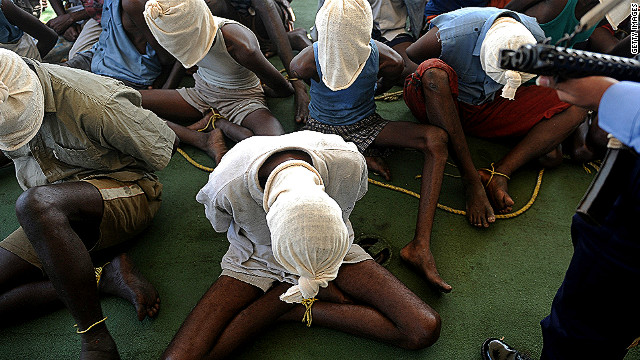
Suspected pirates sit with their faces covered on an Indian coast guard ship in this file picture dated February 10, 2011.


(CNN) -- A British report issued Thursday called for "decisive action" to contain the growing problem of piracy off the coast of Somalia.

"We conclude that for too long there has been a noticeable gap between the government's rhetoric and its action," said the 210-page report, issued by the House of Commons Foreign Affairs Committee. "Despite nine U.N. Security Council resolutions and three multinational naval operations, the counter-piracy policy has had limited impact. The number of attacks, the costs to the industry and the price of the ransoms have all increased significantly since 2007."

Over the past four years, the average ransom has risen from $600,000 to $4.7 million per vessel, with 2011's total outlay reaching $135 million, the report said.

Those payments "should be a matter of deep concern to the British government and to the entire international maritime community," said the report, which described the government as "disappointingly slow to track financial flows from piracy."

Though some ships have begun taking "more robust" measures to defend themselves, pirates still face few repercussions for their actions, it said. In those cases where pirates are detained, some 90% are released without charge, it said, noting that there is no reason why Britain could not assert jurisdiction over suspected pirates.

The cost of piracy
Simply returning suspected pirates to their boats or to land "provides little long-term deterrence and has demonstrably failed to prevent annual increases in both the number of pirates going to sea and in the number of attacks."

The report cited Saferworld, a nongovernmental organization that works with grass-roots organizations in Somalia, in estimating that 1,500 to 3,000 pirates operate off Somalia's coast. They typically range in age from 15 to 30 and are almost all male, uneducated and unskilled -- many of them from rural areas, it said.

They often carry small arms and travel in one or two skiffs, the report said, citing Capt. David Reindorp, head of the Defense Crisis Management Center at the Ministry of Defense, as its source. "They will maneuver one of the skiffs to come alongside the vessel and they will throw up a line on a hook, a grappling rope or some form of apparatus by which they can climb up on to the freeboard of the ship. If they are detected during that, they will usually fire at the ship, generally in and around the bridge, aiming either to get the master to slow down or to clear their way on to the freeboard. Once they have got on to the ship, they will proceed to the bridge and take it over."

Negotiations are typically carried out by satellite phone and usually take three months to a year, it said.

Pirates have begun working from larger vessels, mother ships, which are stocked with food and fuel and have extended the areas vulnerable to attack, it said.

Though most hostages are released unharmed, 15 died last year, it said. Over the past four years, 3,500 seafarers have been taken hostage and 62 have been killed, it said.

The report applauded the government's practice of using a number of different departments to tackle the problem, but said it "lacks clear leadership" and urged the government to "provide a statement clarifying which department has the overall lead on countering piracy."

There is no lack of targets. Some 90% of the world's traded materials are shipped by sea, and 40% of that -- 28,000 ships per year -- goes through the Indian Ocean, Gulf of Aden and Arabian Sea, the report said.

The report put the annual cost of piracy -- including insurance, prosecutions, security and ransoms -- at $7 billion to $12 billion.

In a statement, Foreign Secretary William Hague said the report will be discussed next month at a meeting in London. "We will use the London Conference on Somalia to chart a way forward on the future political direction of Somalia, the vital humanitarian effort and the international community's approach to tackling piracy."

Mexico : 31 inmates killed in prison fight..[ 2612 ]

Bloody Riots in Mexican Prison !

31 inmates killed in northern Mexico prison fight


CIUDAD VICTORIA, Mexico (AP) -- A vicious fight among inmates armed with makeshift knives, clubs and even stones left 31 people dead in a prison in a drug cartel-plagued state in northern Mexico, authorities said.
-
Another 13 prisoners were wounded in the brawl in the penitentiary in the Gulf Coast city of Altamira, Tamaulipas state's Public Safety Department said in a statement.
The fight started when a group of inmates burst into a section of the prison they were banned from and attacked the prisoners housed there, the department said.
Local media said the fight was between members of the rival Gulf and Zetas drug cartels but authorities wouldn't confirm the reports. Tamaulipas state has been the scene of bloody turf battles between the two former allies.
-
Tamaulipas state officials said many of the dead were killed by makeshift knives. A state official who spoke on condition of anonymity because of the ongoing investigation said several of the inmates were beaten to death with clubs or stones.
Soldier and marines managed to take control of the prison, the official said.
The safety department said 22 of the inmates killed were serving sentences for state crimes and nine for federal offenses. It gave no other details.
-
The port of Altamira in southern Tamaulipas, near the border with the state of Veracruz, is in a region that has seen a spike in drug-violence in the last two months. Authorities say the port is used to bring in cocaine and precursor chemicals used to make methamphetamine into Mexico.
-
In 2010, four inmates at the Altamira prison were killed when an armed gang stormed the penitentiary as 11 inmates were being transferred. Authorities did not confirm reports that the raid was an attempt to free prisoners. Gang raids on prisons are common in Tamaulipas.

Wednesday, January 4, 2012

EU moves towards crude oil ban ...[ 2611 ]

Iran nuclear crisis: EU moves towards crude oil ban

Iranian President Mahmoud Ahmadinejad in Iran's nuclear enrichment facility in Natanz in 2007  
The Iranian leadership insists the country's nuclear programme is entirely peaceful
-
BBC, Wed,4 Janiary 2012 

EU member states have agreed in principle to ban imports of Iranian crude oil to put pressure on the country over its nuclear programme.

The move is expected to be announced formally at an EU foreign ministers' meeting at the end of January.

The US, which recently imposed fresh sanctions on Iran, welcomed the news.

Iran has dismissed the threat of new sanctions and denies Western claims that it is trying to develop a nuclear weapons programme.
-

Iran has also denied that a record low of its currency this week was linked to punitive US measures against its banks.

Oil prices on international markets rose on news of the EU agreement.

"We have an [EU] foreign ministers' meeting on January 30, and on this occasion I hope we will be able to take the decision on the embargo of oil and petrol from Iran", said French Foreign Minister Alain Juppe.
-

"We have to reassure some of our European partners who purchase Iranian oil. We have to provide them with alternative solutions", he added.

On Tuesday France had called for "stricter sanctions" on Iran.

However, even if sanctions are adopted at the end of the month, it may be several months before they are implemented.
'Tightening the noose'
"These are the kinds of steps that we would like to see not just from our close allies and partners in places like Europe but from countries around the world", said US State Department spokeswoman Victoria Nuland.
-

"We do believe that this is consistent with tightening the noose on Iran economically", she added.

The Iranian state gets more than half of its revenue through the export of crude oil, says the BBC's James Reynolds.

If Europe does stop buying, Iran will have to turn to countries in Asia to replace its lost trade, who will demand a discount, he adds.
-

The EU currently accounts for around 17% of Iranian oil exports.

In November, the US, Canada and the UK announced new sanctions against Iran in the wake of a report from the UN nuclear watchdog, the International Atomic Energy Agency (IAEA), that said Iran had carried out tests related to the "development of a nuclear device".

But Iran was not referred to the UN Security Council because Russia and China were opposed to the move.
-

The Security Council has already passed four rounds of sanctions against Iran for refusing to halt uranium enrichment. Highly enriched uranium can be processed into nuclear weapons.

Iran has been holding a series of naval exercises in the Gulf in recent days, test-firing several missiles.
-

The exercises were held near the Strait of Hormuz, through which around 20% of the world's traded oil passes.

Tehran said on Monday that "mock" exercises on shutting the strait had been carried out, although there was no intention of closing it.