The Hellenic Navy (HN) (Greek: Πολεμικό Ναυτικό, Polemikó Naftikó, abbreviated ΠΝ) is the naval force of Greece, part of the Greek Armed Forces. The modern Greek navy has its roots in the naval forces of various Aegean Islands, which fought in the Greek War of Independence. During the periods of monarchy (1833–1924 and 1936–1973) it was known as the Royal Navy (Βασιλικόν Ναυτικόν, Vasilikón Naftikón, abbreviated ΒΝ).The total displacement of all the navy's vessels is approximately 150,000 tons.The motto of the Hellenic Navy is "Μέγα το της Θαλάσσης Κράτος" from Thucydides' account of Pericles' oration on the eve of the Peloponnesian War. This has been roughly translated as "Great is the country that controls the sea". The Hellenic Navy's emblem consists of an anchor in front of a crossed Christian cross and trident, with the cross symbolizing Greek Orthodoxy, and the trident symbolizing Poseidon, the god of the sea in Greek mythology. Pericles' words are written across the top of the emblem. "The navy, as it represents a necessary weapon for Greece, should only be created for war and aim to victory."...............The Hellenic Merchant Marine refers to the Merchant Marine of Greece, engaged in commerce and transportation of goods and services universally. It consists of the merchant vessels owned by Greek civilians, flying either the Greek flag or a flag of convenience. Greece is a maritime nation by tradition, as shipping is arguably the oldest form of occupation of the Greeks and a key element of Greek economic activity since the ancient times. Nowadays, Greece has the largest merchant fleet in the world, which is the second largest contributor to the national economy after tourism and forms the backbone of world shipping. The Greek fleet flies a variety of flags, however some Greek shipowners gradually return to Greece following the changes to the legislative framework governing their operations and the improvement of infrastructure.Blogger Tips and Tricks
This is a bilingual blog in English and / or Greek and you can translate any post to any language by pressing on the appropriate flag....Note that there is provided below a scrolling text with the 30 recent posts...Αυτό είναι ένα δίγλωσσο blog στα Αγγλικά η/και στα Ελληνικά και μπορείτε να μεταφράσετε οποιοδήποτε ποστ σε οποιαδήποτε γλώσσα κάνοντας κλικ στη σχετική σημαία. Σημειωτέον ότι παρακάτω παρέχεται και ένα κινούμενο κείμενο με τα 30 πρόσφατα ποστς....This is a bilingual blog in English and / or Greek and you can translate any post to any language by pressing on the appropriate flag....Note that there is provided below a scrolling text with the 30 recent posts...Αυτό είναι ένα δίγλωσσο blog στα Αγγλικά η/και στα Ελληνικά και μπορείτε να μεταφράσετε οποιοδήποτε ποστ σε οποιαδήποτε γλώσσα κάνοντας κλικ στη σχετική σημαία. Σημειωτέον ότι παρακάτω παρέχεται και ένα κινούμενο κείμενο με τα 30 πρόσφατα ποστς.........

Friday, March 19, 2010

The violence in Mexico[ 753 ]

Mexican violence scaring off American tourists
By Paul Vercammen and Ted Rowlands, CNN
Up until a couple of years ago, the Mexican cities of Tijuana and  Ensenada would be filled with American tourists during spring break. But  persistant drug violence in Mexico has emptied the streets.
Up until a couple of years ago, the Mexican cities of Tijuana and Ensenada would be filled with American tourists during spring break. But persistant drug violence in Mexico has emptied the streets.

Tijuana, Mexico (CNN) ,, March 19, 2010 12:11 a.m. EDT--

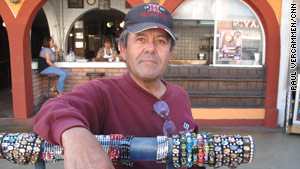
On Tijuana's Avenue de la Revolucion, street vendor and sidewalk philosopher Juan Ramon Rocha leaned on his coin and jewelry cart and waited.

But the tourists from across the border never rushed into the streets of T.J., as it's often called.

Rocha made one sale, to a local resident, in an hour.

"The business, you can see for yourself, it went down 95 percent," he said. "Please tell them, the Americans, it's safe to come here. We are all Americanos, North Americanos. Do you see any problems here?"

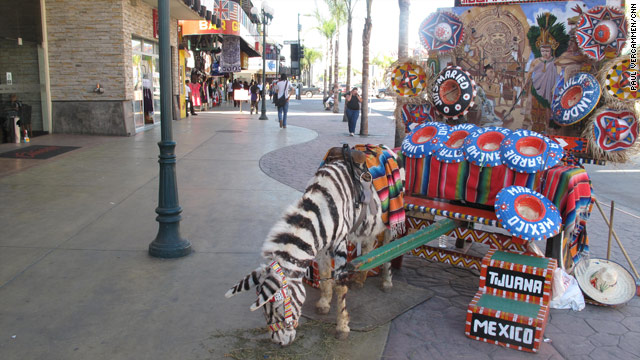
A few yards away, there was a donkey painted like a zebra, hitched to a cart full of sombreros, a Tijuana photo opportunity. But no smiling tourists stepped into the picture frame.

Visitors have been scared off because at least 18,000 people have been killed in Mexico since President Felipe Calderon dispatched the army to fight the drug cartels in December of 2006.

Tijuana's grisliest murders include decapitations, dismemberments, dozens of police killings and the deaths of three teenagers at school.

Fear of Tijuana's streets seeps deep into California.
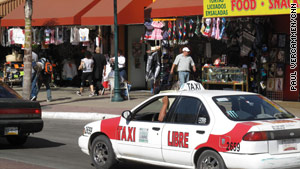
Mexican drug violence that has left at least 18,000 dead since  2006 has hurt tourism in Tijuana.
Mexican drug violence that has left at least 18,000 dead since 2006 has hurt tourism in Tijuana.
"Please tell them, the Americans, it's safe to come  here," said Tijuana street vendor Juan Ramon Rocha.
"Please tell them, the Americans, it's safe to come here," said Tijuana street vendor Juan Ramon Rocha.
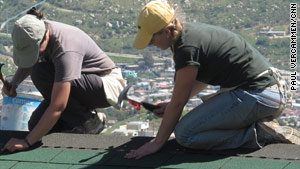
College student Hanna Walker spent her spring break building homes  in nearby Ensenada and skipped Tijuana altogether.
College student Hanna Walker spent her spring break building homes in nearby Ensenada and skipped Tijuana altogether.

As groups of 240 students from Westmont College near Santa Barbara, California, drove down the coast to do missionary work in Ensenada, Mexico, none ventured to Tijuana.

The missionaries doing spring break volunteer projects in poor neighborhoods were given a simple edict -- do not stop in T.J.

Hanna Walker kneeled, pounding nails into shingles, on a rooftop of a small house taking shape on a dirt road high above Ensenada.

"To be honest, I was a tiny bit nervous crossing the border," Walker said. "I've been to Mexico before but not for service projects. But now that I have been here (Ensenada) a couple days I am perfectly comfortable."

The Westmont students are taking precautions as part of their annual Potter's Clay missionary work.

"We are staying in a group," Walker explained. "We are making sure that I am with someone all the time. When we went downtown for dinner, we just paired up and walked around in twos, the buddy system. We locked cars. We're just being smart about it."

Ensenada welcomes any business it can get, as its tourism trade has also been choked off by concerns over border violence.

Fortunately, cruise ships still dock in Ensenada's Bahia de Los Santos, a daily divine arrival that spills cash-carrying tourists onto shore.

But we saw just two visitors who said they drove over the border to visit Ensenada.

All the other beer-wielding, trinket- buying tourists came from the ship.

"People are afraid of driving by Tijuana," said Papas and Beer manager Cesar Marquez. "That's what's hurting us (Ensenada) the most."

To be honest, I was a tiny bit nervous crossing the border.
--Hanna Walker

Later, in Tijuana, as the shadows stretched out with the dropping sun, we were approached by a man with an outdated nylon jacket. His cheeks were chipped by acne scars.The camera was far out of sight."I can help you find whatever you need," he said.

The Athenians walk...[ 752 ]


The forgotten anniversary and the Athenians walk

Issue No. 13381
Wine jars of the 1st-2nd centuries BC on display at Syntagma
Construction of an air vent near Syntagma revealed a well-preserved Roman bath
ATHENS NEWS 15/03/2010, page: 39

TENS OF thousands of Athenians walk by or through a series of fine archaeological exhibits every day, usually without noticing, while guidebooks largely ignore them. Similarly, their 10th anniversary last month passed without fanfare.

When Line 2 and Line 3 of the Athens Metro were inaugurated in 2000, the nicely displayed and well-labelled exhibitions of archaeological finds were one of the most striking features of the new stations, a great gift to all who yearn to learn about the history of this ancient city, and a relief to archaeologists.

When the mammoth project of building two new underground mass transportation lines under the historic centre began in 1991, it caused concern in archaeological circles worldwide. The project, enormous and difficult in any case, also represented a massive archaeological challenge.
Essentially, wherever you dig a hole in central Athens, you will find metres upon metres of antiquities, ranging from at least the Archaic period, through Classical and Hellenistic, via the Roman to the Byzantine.

Most of the tunnels themselves would be bored through bedrock, thus below any archaeological layers. But the building of every single station and every ventilation shaft would have to entail careful and time-consuming archaeological excavations of varying scale, often under difficult circumstances. The scale of the urban archaeological project was, for Greece, unprecedented.

To cut the long story short, the job was done, and done well. Under the supervision of the ministry of culture, dozens of excavations took place through up to 7m of archaeological deposits, revealing hundreds of thousands of ancient artifacts, hundreds of structures, roads, wells, houses, graves and so on from all periods, and thereby adding a huge amount of new information to the known history of the city.

But that’s not all. It was also decided to highlight these fascinating finds and display part of them to the public near where they had been found, at the various stations.

This ambitious and innovative approach has transformed the accessibility of Athenian archaeology and incorporated it into daily life. As there is no Museum of the Archaeology of Athens (the National Museum has much broader scope), up until then the city’s ancient past was only presented in fragments at the site museums of the Kerameikos, Agora and Acropolis.
The metro added no less than five such local exhibitions in a single year.
So what better way to celebrate this anniversary than to take a few rides under the city centre, hopping on and off the train to explore a whole array of windows on the past. Each station exhibit has its own focus, each displaying unique, interesting and intriguing things to see.
Metro, a window on the past

Monastiraki
The metro contains an especially spectacular feature. Beside the northbound platform of the Kifisia-Piraeus line, part of the ancient riverbed of the Ilissos has been revealed. The stone-built channel of the 5th century BC was covered with large tiles in the 2nd century AD. Unseen for the two intervening millennia, the river still flows within.
Panepistimio
The station is located outside the margins of the ancient city, where the cemeteries were located. The exhibition displays clay sarcophagi and very fine pottery of the Classical and Hellenistic periods.

Evangelismos
Another area outside the ancient city. The small display contains clay pipes from 6th century BC Peisistratid aqueduct that brought water from Mt Lykavitos to the city, and a well-preserved Roman pottery kiln.

Acropolis
Here, excavations revealed residential houses and streets from the Classical to the Byzantine period, but also Bronze Age graves dating back to the 2nd and 3rd millennia BC. The exhibition includes pots and many Classical or later household objects, as well as children’s toys.
Syntagma
The huge display at Syntagma works as a cross-section of Athenian history
As the station is the biggest hub of the network, excavations here were most extensive. Discoveries included graves from the Bronze Age to Byzantine periods, the ancient bed of the Eridanos River, various ancient road surfaces, Archaic and Roman water supply systems, and other structures, including a Classical workshop that produced bronze sculptures.

The exhibition is quite large and includes not only pottery, household objects, mosaics and gravestones from various periods, but also a huge display of a reconstructed section through the city’s ground, a fascinating panorama of millennia of activity, right under our feet. Some architectural remains are on open-air display on the eastern side of Syntagma Square.

It is worthwhile strolling a little further along Amalias, on the National Gardens side of the road. Here, excavations for one of the metro air vents have revealed a spectacularly well-preserved Roman bathhouse, now protected by a modern roof.

The building is preserved beyond the height of its ground floor, and many features of its elaborate heating systems are visible.

The exhibitions in the Athens Metro share the opening times of the Metro network: from early morning to late evening. All can be visited for free.
A closer look
(Syntagma Metro Station, Archaeological collection)
A late Hellenistic (2nd century BC) grave stele of an Athenian lady. The inscription identifies her as Zosarion, wife of Hermippos, the son of Zoeilos, from Kifisia. The material (limestone, not marble) and somewhat cursory execution of the stele probably indicate that her family could not afford a more elaborate memorial.

GEORGE CROSS Britain's highest award..[ 751 ]

George Cross award for Army Afghanistan bomb heroes

Advertisement

Staff Sergeant Olaf Schmid's widow, Christina, received his posthumous George Cross citation

BBC 21:31 GMT, Thursday, 18 March 2010

Two Army bomb disposal experts have been awarded the George Cross for their heroics in Afghanistan.

A posthumous honour goes to Staff Sergeant Olaf Schmid, 30, who made safe 70 devices before his death in October while defusing a bomb near Sangin.

The GC, one of the UK's highest awards for gallantry, was also conferred on his comrade in the Royal Logistic Corps, Staff Sergeant Kim Hughes, 30.

Last August, he cleared a minefield to enable the rescue of five soldiers.

His efforts were described in the Ministry of Defence citation as "the single most outstanding act of explosive ordnance disposal ever recorded in Afghanistan".

'Rare award'

He dismantled seven linked Taliban bombs by hand without any protective clothing so the seriously wounded soldiers as well as the bodies of two dead comrades could be recovered.

GEORGE CROSS
Britain's highest award for gallantry, along with Victoria Cross
It is the top bravery award that civilians can receive
Also presented to members of the military for heroism not in the presence of the enemy
Introduced in 1940 by Winston Churchill to recognise the courage of civilians during the aerial bombing of the UK
The honour has been awarded 161 times

The George Cross is the country's highest award for gallantry by civilians, or by military personnel not in the presence of the enemy.

The George Cross has now been awarded a total of 161 times.

At a ceremony in the City of London, Chief of the Defence Staff Air Chief Marshal Sir Jock Stirrup said: "The actions of Staff Sgt Hughes and the late Staff Sgt Schmid meet this most demanding test in full measure.

"Their selfless commitment, unswerving devotion to duty and unsurpassed courage are both awe-inspiring and humbling."

Both recipients were deployed to Helmand Province as part of 19 Light Brigade. Their duties coincided with Operation Panther's Claw, a counter-insurgency operation which saw an increase in Taliban actvity.

Staff Sgt Schmid, who had been in the Army for 13 years and was a member of the Oxfordshire-based 11 Explosive Ordnance Disposal Regiment, deployed to Afghanistan in June 2009.

He was born in Cornwall, and lived in Winchester with his wife and five-year-old stepson.

At the time of his death he was a week away from flying back to the UK for a two-week break.

Air Chief Marshal Sir Jock Stirrup, SSgt Kim Hughes
Staff Sgt Hughes was said to have defused 80 bombs

He was killed last October during an operation during a day in which he had already dealt with three devices.

His citation said his actions "probably saved the lives of his team".

It added: "These occasions are representative of the complexity and danger that Schmid had faced daily throughout his four month tour.

"His selfless gallantry, his devotion to duty, and his indefatigable courage displayed time and time again saved countless military and civilian lives and is worthy of the highest recognition."

Staff Sgt Schmid's wife, Christina, was presented with his citation at the ceremony.

She later paid tribute to the work of her husband and Staff Sgt Hughes and said she was "massively proud" of the awards.

Jonathan Beale, BBC defence correspondent
Jonathan Beale
Defence Correspondent
It was a simple, sober ceremony to honour two men of extraordinary courage. The Chief of the Defence Staff - Air Chief Marshall Sir Jock Stirrup - summed it up describing both men as "the bravest of the brave".

Staff Sergeant Olaf Schmid and his good friend Staff Sergeant Kim Hughes had been doing the most dangerous jobs in one of the most lethal places on earth. As bomb disposal experts their actions saved many lives.

It's worth remembering that IEDs, or roadside bombs, have been the single biggest killer of British troops in Afghanistan. The unseen weapon remains the Taliban's favoured method of waging war.

Of the 275 British soldiers killed in Afghanistan, 151 have died as a result of roadside bombs. Eight bomb disposal experts have also lost their lives.

Olaf Schmid's wife Christina has kept his memory alive, and glowed with pride as she received his citation. There's no doubt that these bomb disposal experts are "the few" in this war.

A record number of awards are being made this year to British soldiers - more than 150 medals. It's also a telling reminder that last year was the deadliest yet for British troops in Afghanistan.

"They're usually under fire... they're absolutely working at such a tempo to keep our forces safe and moving around, and also for civilians," she said.

Their George Cross medals will be presented at a royal investiture at a future date.

Staff Sgt Hughes, from Telford, Shropshire, is credited with defusing 80 devices during his tour.

On 18 August 2009, he was deployed to secure an emergency helicopter landing site south west of Sangin.

Staff Sgt Hughes told the BBC he had "just being doing his job".

"It was just a day that had an horrendous ending and we just cracked on and dealt with what we needed to do.

"There were casualties, fallen soldiers, my rest and myself had to go and clear the injured soldiers and extract the fallen. In doing so, we came across a number of devices."

In October, he made the news when he told Defence Secretary Bob Ainsworth, during a visit to Afghanistan, that more troops were needed on the ground.

On Friday, more than 150 other medals are expected to be announced by the Ministry of Defence recognising the efforts of British service personnel in Afghanistan, Iraq and other parts of the world.

Royal Marines reservist Lance Corporal Matthew Croucher, who risked his life to save his comrades by throwing himself on a live grenade in Afghanistan in February 2008, was the last recipient of the George Cross.

Nigeria senator called Gaddafi a "mad man". [ 750 ]

Nigeria recalls Libya ambassador in Gaddafi row

Muammur Gaddafi, file image
Muammar Gaddafi's comments have sparked anger in Nigeria

BBC,,18:30 GMT, Thursday, 18 March 2010

Nigeria has recalled its ambassador to Libya after leader Muammar Gaddafi suggested Nigeria be divided into two states - one Christian and one Muslim.

The foreign ministry said the Libyan leader's statement was "irresponsible". Earlier in the week a senator had called Col Gaddafi a "mad man".

Col Gaddafi had suggested the split to prevent any more bloodshed between rival groups in central Nigeria.

Hundreds have died this year in ethnic and religious violence around Jos.

Although the violence in Nigeria generally takes place between Muslim and Christian communities, the underlying causes are a complex mix of political, social and economic grievances.

Nigeria is roughly split between its largely Muslim north, and a Christian-dominated south.

In a statement, the foreign ministry said it was recalling its Tripoli ambassador for "urgent negotiations" because of the "irresponsible utterances of Colonel Gaddafi".

"His theatrics and grandstanding at every auspicious occasion have become too numerous to recount," said the statement.

Col Gaddafi, until recently head of the African Union, praised the partition of India in 1947 as the kind of "historic, radical solution" that could benefit Nigeria.

Splitting India in 1947 caused a breakdown of law and order in which at least 200,000 people died. Some estimates say one million people were killed.

About 12 million people were left homeless and thousands were raped.

An attempt by the Igbo people of south-eastern Nigeria to secede in 1967 sparked a war which left more than one million people dead.

Thursday, March 18, 2010

Social Media a Tool in Crime-Fighting ..[ 749 ]

Caught Web-Handed: Social Media Become Valuable Tool in Crime-Fighting

By Diane Macedo

- FOXNews.com,,Updated March 18, 2010

Law enforcement agencies are increasingly using social media to fight crime – and some criminals are making that task very easy.

Most people use social media sites to keep in touch with old friends and to make new ones. But more and more, law enforcement agencies are using them to fight crime – and some criminals are making that task very easy.

Chris Crego

Take Chris Crego, a fugitive on the run from police in New York. Police who arrested him in Indiana say he all but turned himself in by posting his workplace on his MySpace and Facebook pages.

  • Take Robert Powell, a Florida man convicted of murdering of his friend Joseph Duprey. He posted pictures of Duprey on his MySpace page next to the words "rest in peace" and "live through me" -- hours before Duprey's death was even reported to police.

And it's hard to forget Jonathan G. Parker, a 19-year-old from Pennsylvania who was arrested and charged with burglary after a woman found her home ransacked and her jewelry stolen. Police say the woman found something else, too -- Parker's Facebook account open on her home computer.

Click here for more suspects caught web-handed.

The trend has authorities often skipping the squad cars for the keyboards in hopes of finding leads in investigations.

"People all the time brag about their exploits. You'd be surprise how many cases have been solved throughout the nation…where they've mentioned how they've successfully solved a crime using information retrieved off of a Web site," Jack Rinchich, President of the National Association of Chiefs of Police, told FoxNews.com.

Rinchich of West Virginia says police around the country are finding success using social media as an investigative tool --even if they don't find a smoking gun.

"Sometimes it [the information] may not be incriminating enough to affect an arrest, but it supplies enough information from an investigator's standpoint that it points them in the right direction in terms of solving the crime or researching the crime," Rinchich said. "It can be a valuable tool in solving and preventing crime."

Michael Fertik, CEO and founder of ReputationDefender.org and an adviser to the FBI, says he hears stories like these from agents all the time.

"Basically they tell me that they sit on the Internet all day and look for information on suspects and potential suspects," Fertik told FoxNews.com.

FBI agents are even creating fake Internet identities to deceive suspected criminals into befriending them online in hopes that they'll disclose incriminating information, a new Justice Department document obtained by the legal advocacy group Electronic Frontier Foundation shows.

According to the document, agents scan suspects' profiles for helpful information such as location, potential motive to commit a crime, and photographs containing guns, stolen goods or any other evidence of criminal behavior. If they can't get to the suspect's profile, sometimes getting to their list of friends is enough.

Seattle bank fraud fugitive Maxi Sopo had a private Facebook page, but detectives found him anyway after he posted messages boasting about his new life in Mexico. Unfortunately for Sopo, one of his Facebook friends just happened to be a former Justice Department employee, who turned him in.

Fertik says social media have aided crime-fighting in the private sector, as well.

"Not only are law enforcement using it, not only can you count on law enforcement using it, not only are law enforcement delighted that these pieces of information, these bread crumbs, are being left everywhere, but also people can do it yourself now," he said. "People can use technologies to either make themselves vulnerable or help find the thief who's trying to do them harm."

Police say that's exactly what happened in the case of Daniel Gill, an Oregon man arrested on burglary charges after he allegedly tried to sell the equipment he stole from an Oregon extermination company on Craigslist.

"In this case it was one of the business owners that went on Craigslist and was shopping around to see if she could find her property on Craigslist, and lo and behold she found it," Linn County Sheriff Tim Mueller told FoxNews.com.

Mueller says the owner's discovery enabled detectives to obtain a search warrant to search Gill's house, where they found even more than what they were looking for.

"We found all kinds of good stuff there out there -- that he'd been stealing not only from that neighbor but other neighbors as well!" he said.

Fertik calls cases like these the start of a "do-it-yourself movement" in busting criminals.

Pat Brosnan, a retired NYPD detective and the founder of the private security firm the Brosnan Group, agrees.

"We utilize data posted on blogs and various social networking sites like Facebook, MySpace and Twitter to validate and corroborate information we have developed regarding the target of an investigation," Brosnan told FoxNews.com. "…These sites are a potential treasure trove."

But Rinchich says people still have to remember not only to be careful about what they put on the Internet, but also about what they do with the information they find there.

"I wouldn't necessarily want to take it on the face of it as prime evidence, because sometimes people say things and they're boastful and they didn't really do it, they're just showboating for their friends," he said. "So you have to be really cautious… because you might get the wrong person."

Still, Rinchich says, if people are "dumb enough" to leave a criminal trail to their wrongdoings on the Internet, he's happy to pick up the pieces.

"If there's any technological resource that would benefit law enforcement, as long as it's legally achieved, I say go for it, utilize whatever resources necessary, to prevent and to solve crime."