The Hellenic Navy (HN) (Greek: Πολεμικό Ναυτικό, Polemikó Naftikó, abbreviated ΠΝ) is the naval force of Greece, part of the Greek Armed Forces. The modern Greek navy has its roots in the naval forces of various Aegean Islands, which fought in the Greek War of Independence. During the periods of monarchy (1833–1924 and 1936–1973) it was known as the Royal Navy (Βασιλικόν Ναυτικόν, Vasilikón Naftikón, abbreviated ΒΝ).The total displacement of all the navy's vessels is approximately 150,000 tons.The motto of the Hellenic Navy is "Μέγα το της Θαλάσσης Κράτος" from Thucydides' account of Pericles' oration on the eve of the Peloponnesian War. This has been roughly translated as "Great is the country that controls the sea". The Hellenic Navy's emblem consists of an anchor in front of a crossed Christian cross and trident, with the cross symbolizing Greek Orthodoxy, and the trident symbolizing Poseidon, the god of the sea in Greek mythology. Pericles' words are written across the top of the emblem. "The navy, as it represents a necessary weapon for Greece, should only be created for war and aim to victory."...............The Hellenic Merchant Marine refers to the Merchant Marine of Greece, engaged in commerce and transportation of goods and services universally. It consists of the merchant vessels owned by Greek civilians, flying either the Greek flag or a flag of convenience. Greece is a maritime nation by tradition, as shipping is arguably the oldest form of occupation of the Greeks and a key element of Greek economic activity since the ancient times. Nowadays, Greece has the largest merchant fleet in the world, which is the second largest contributor to the national economy after tourism and forms the backbone of world shipping. The Greek fleet flies a variety of flags, however some Greek shipowners gradually return to Greece following the changes to the legislative framework governing their operations and the improvement of infrastructure.Blogger Tips and Tricks
This is a bilingual blog in English and / or Greek and you can translate any post to any language by pressing on the appropriate flag....Note that there is provided below a scrolling text with the 30 recent posts...Αυτό είναι ένα δίγλωσσο blog στα Αγγλικά η/και στα Ελληνικά και μπορείτε να μεταφράσετε οποιοδήποτε ποστ σε οποιαδήποτε γλώσσα κάνοντας κλικ στη σχετική σημαία. Σημειωτέον ότι παρακάτω παρέχεται και ένα κινούμενο κείμενο με τα 30 πρόσφατα ποστς....This is a bilingual blog in English and / or Greek and you can translate any post to any language by pressing on the appropriate flag....Note that there is provided below a scrolling text with the 30 recent posts...Αυτό είναι ένα δίγλωσσο blog στα Αγγλικά η/και στα Ελληνικά και μπορείτε να μεταφράσετε οποιοδήποτε ποστ σε οποιαδήποτε γλώσσα κάνοντας κλικ στη σχετική σημαία. Σημειωτέον ότι παρακάτω παρέχεται και ένα κινούμενο κείμενο με τα 30 πρόσφατα ποστς.........

Saturday, February 27, 2010

CHILE Massive earthquake kills 82 insofar[ 688 ]

Massive earthquake kills 82 in Chile

SANTIAGO
Sat Feb 27, 2010 10:14am EST

SANTIAGO (Reuters) - A huge magnitude-8.8 earthquake struck Chile early on Saturday, killing at least 82 people, knocking down homes and hospitals, and triggering a tsunami that rolled menacingly across the Pacific.

World | Natural Disasters

TV Chile reported that a 15-storey building collapsed in the hardest-hit city of Concepcion, where buildings caught fire, bridges collapsed and cracks opened up in the streets. Cars turned upside down lay scattered on one damaged highway bridge.

Residents huddled in streets full of rubble of masonry and glass from destroyed homes. Many were terrified by powerful aftershocks and desperately trying to call friends and family.

Tsunami warnings were posted around the Pacific, including the U.S. state of Hawaii, Japan and Russia.

Interior Minister Edmundo Perez said 82 people were confirmed dead, and that more deaths were possible, but he didn't expect the toll to rise much higher. Telephone and power lines were down, making it difficult to assess the full extent of the damage close to the epicenter.

Chile is the world's No. 1 copper producer, and the quake halted operations at two major mines.

"Never in my life have I experienced a quake like this, it's like the end of the world," one man told local television from the city of Temuco, where the quake damaged homes and forced staff to evacuate the regional hospital.

The U.S. Geological Survey said the earthquake struck 70 miles northeast of Concepcion at a depth of 22 miles at 3:34 a.m. (1:34 a.m. EST).

The capital Santiago, about 200 miles north of the epicenter, was also badly hit. The international airport was closed for at least 24 hours as the quake destroyed passenger walkways and shook glass out of doors and windows.

Chile's main copper producing region and some of the world's largest copper mines are in the far north of the country near its border with Peru, but there are also major copper deposits near Santiago.

Production was halted at the Los Bronces and El Soldado copper mines, owned by Anglo American Plc following the quake, but Chile's biggest copper mine, Escondida, was operating normally.

Chile produces about 34 percent of world supply of copper, which is used in electronics, cars and refrigerators.

TSUNAMI

Bachelet said a huge wave hit the Juan Fernandez islands. Radio stations reported serious damage on the archipelago, where Scottish sailor Alexander Selkirk was marooned in the 18th Century inspiring the novel Robinson Crusoe.

Bachelet, who flew over the worst-affected area, said residents were also being evacuated from coastal areas of Chile's remote Easter Island, a popular tourist destination in the Pacific famous for its towering Moai stone statues.

The Pacific Tsunami Warning Center issued a Pacific-wide tsunami warning for countries in Latin America, and as far away as the U.S. state of Hawaii as well as Japan, Russia, Philippines, Indonesia and the South Pacific. French Polynesia was also put on alert.

"Chile probably got the brunt force of the tsunami already. So probably the worst has already happened in Chile," said Victor Sardina, geophysicist at the warning center.

"The tsunami was pretty big too. We reported some places around 8 feet. And it's quite possible it would be higher in other areas," he added.

An earthquake of magnitude 8 or over can cause "tremendous damage," the USGS says. The quake that devastated Haiti's capital Port-au-Prince on January 12 was measured as magnitude 7.0.

Bachelet urged people to stay calm and to remain at home to avoid road accidents. "With a quake of this size we undoubtedly can't rule out more deaths and probably injuries," she said.

FLAMES, LOOTING

Local television showed a building in flames in Concepcion, one of Chile's largest cities with around 670,000 inhabitants. Some residents looted pharmacies and a collapsed grains silo, hauling off bags of wheat, television images showed.

Broken glass and chunks of concrete and brick were strewn across roads and several strong aftershocks rattled jittery residents in the hours after the initial quake.

In the moments after the quake, people streamed onto the streets of the capital, hugging each other and crying.

"My house is completely destroyed, everything fell over ... it has been totally destroyed. Me and wife huddled in a corner and after hours they rescued us," said one elderly man in central Santiago.

There were blackouts in parts of Santiago and communications were still down in the area closest to the epicenter. Emergency officials said buildings in the historic quarters of two southern cities had been badly damaged and local radio said three hospitals had partially collapsed.

In 1960, Chile was hit by the world's biggest earthquake since records dating back to 1900. The 9.5 magnitude quake devastated the south-central city of Valdivia, killing 1,655 people and sending a tsunami which battered Easter Island 2,300 miles off Chile's Pacific seaboard and continued as far as Hawaii, Japan and the Philippines.

Saturday's quake shook buildings as far away as Argentina's Andean provinces of Mendoza and San Juan. A series of strong aftershocks rocked Chile's coastal region from Valdivia in the south to Valparaiso, about 500 miles to the north.

(Additional reporting by Doina Chiacu in Washington, Helen Popper, Kevin Gray and Guido Nejamkis in Buenos Aires; Editing by Kieran Murray)

CHILE: Offshore Earthquake Magnitude 8.8, [ 687 ]

Magnitude 8.8 - OFFSHORE MAULE, CHILE

2010 February 27 06:34:14 UTC

Versión en Español

Earthquake Details

Magnitude8.8
Date-Time
Location35.846°S, 72.719°W
Depth35 km (21.7 miles) set by location program
RegionOFFSHORE MAULE, CHILE
Distances100 km (60 miles) NNW of Chillan, Chile
105 km (65 miles) WSW of Talca, Chile
115 km (70 miles) NNE of Concepcion, Chile
325 km (200 miles) SW of SANTIAGO, Chile

Location Uncertaintyhorizontal +/- 7.2 km (4.5 miles); depth fixed by location program

ParametersNST=255, Nph=255, Dmin=988 km, Rmss=1.12 sec, Gp= 36°,
M-type=teleseismic moment magnitude (Mw), Version=7
Source
  • USGS NEIC (WDCS-D)
Event IDus2010tfan
  • This event has been reviewed by a seismologist.

Massive earthquake strikes Chile

Advertisement

The aftermath of the earthquake

NASA "Image of the Day"[ 686 ]

The latest NASA "Image of the Day"

Blasting Off Into History
NASA's Space Shuttle Program conducted the final test firing of a reusable solid rocket motor Feb. 25 in Promontory, Utah. The flight support motor, or FSM-17, burned for approximately 123 seconds--the same time each reusable solid rocket motor burns during an actual space shuttle launch. Preliminary indications show all test objectives were met. After final test data are analyzed, results for each objective will be published in a NASA report. The test--the 52nd conducted for NASA by ATK Launch Systems, a unit of Alliant Techsystems Inc.--marks the closure of a test program that has spanned more than three decades. The first test was in July 1977. The ATK-built motors have successfully launched the space shuttle into orbit 129 times. Image Credit: NASA

Friday, February 26, 2010

More raids in Turkey[ 685 ]

More raids in Turkey over 'Sledgehammer plot'

By Ivan Watson and Yesim Comert, CNN
February 26, 2010 11:38 a.m. EST
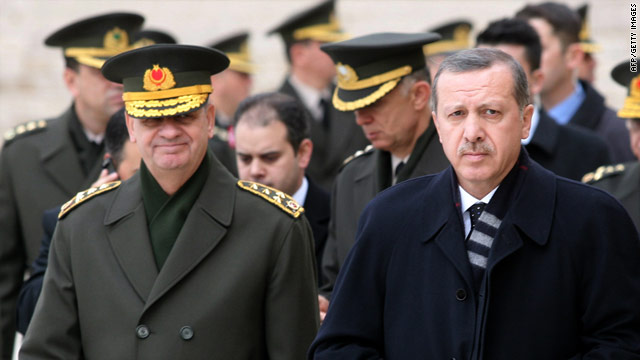
Turkey's top soldier Gen. Illker Basbug, left, has defended the military over allegations senior figures plotted to destabilize Prime Minister Recep Tayyip Erdogan's government.

Istanbul, Turkey (CNN) -- Turkish police launched a second wave of raids rounding up military officers tied to the alleged "Sledgehammer" coup plot.

Turkey's semi-official Anatolian Agency reports one retired officer and 17 active duty soldiers were detained in operations conducted on Friday in 13 cities.

Among the suspects is Col. Huseyin Ozcoban, the commander of the paramilitary gendarme force in the central province of Konya. Anatolian reports he was arrested while on holiday in Istanbul on Friday morning.

Scores of military leaders have been imprisoned or charged as part of "Sledgehammer," an alleged plot hatched by the staunchly secular military to plant bombs in mosques to destabilize the country's elected and Islamist-inspired government.

When contacted directly by CNN, Turkish police and prosecutors refused to comment on the investigations and arrests.

Full coverage in Turkish: CNN Turk

An on-duty officer answered the phone when CNN called the gendarme headquarters at Konya provincial headquarters, but then hung up the phone before answering any questions.

An officer at the gendarme headquarters in Istanbul also refused to comment on the latest detentions.

Turkey's president held crisis talks Thursday with the prime minister and top military general and sought to calm tensions following the detention of around 50 high-ranking active duty and retired military commanders in connection to the alleged coup plot.

President Abdullah Gul tried to reassure the population. His office released a short statement urging the public to "be confident that the matters on the agenda are going to be resolved within the constitutional order... and everyone will act responsibly to ensure our institutions will not be hurt."

As the private meeting was underway in the Turkish capital, the retired commanders of Turkey's air force and navy along with the former general in charge of Turkey's 1st Army were taken in for questioning in an Istanbul court.

However, later Thursday, former commander of Air Force, Gen. Halil Ibrahim Firtina, former Commander of Navy, Gen. Ozden Ornek, and former 1st Army Commander Gen. Ergin Saygun were all released.

Assistant Chief Prosecutor Turan Colakkadi said the generals were released after questioning was completed. He added, "the investigation is ongoing, but the generals are released for now." General Ergin Saygun was forbidden to travel abroad.

CNN Turk reported that three high-ranking generals -- Suha Tanyeri, Semih Cetin and Turgay Erdag -- were arrested as part of the investigation.

Turkey's Taraf newspaper first published reports about the "Sledgehammer" last January.

The commander of the armed forces, General Ilker Basbug, angrily denied the accusations in a fist-pounding performance.

Video: Police arrest Turkey's generals
RELATED TOPICS

"How on earth could the Turkish Armed Forces plan to bomb mosques?" he asked on January 25. "The Turkish Armed Forces has limits to its patience. I denounce these claims. ...We order our soldiers to attack [enemies] exclaiming,

'Allah, Allah!' ...Such claims are unjust."

"It's a first in Turkey's history," said Yasemin Congar, the deputy editor-in-chief of Taraf, in an interview with CNN.

"The high-ranking military officers have almost always been deemed untouchable and now this is changing... it sends them a message that first, intervening in politics will not be tolerated. Coup plans will not be tolerated."

The military has a long history of dominating Turkish politics.

Generals overthrew at least four civilian governments over the course of the last half century.

But the armed forces have seen their influence gradually eclipsed since Prime Minister Recep Tayyip Erdogan's Justice and Development Party swept to power after winning parliamentary elections in 2002.

Since then, the generals, as well as other elements of Turkey's traditional secular establishment, have periodically clashed with Erdogan, whose party has its roots in political Islam.

But the prime minister repeatedly has outflanked the secularists by continuing to win big in popular elections.

And, more then a year ago, prosecutors began detaining hundreds of suspects, including several retired generals, as part of an investigation into another alleged secular plot against the government.

The credibility of that investigation has been questioned, however, after journalists, academics and civil society leaders have been detained for months at a time. Some appeared to have done little more then criticize Erdogan's government.

"There are some concerns that perhaps some of the allegations may be too far fetched and seem to be getting more dramatic with the passage of time," said Fadi Hakura, a Turkey expert at the British foreign policy institute the Chatham House.

"The emerging pattern seems to be a power struggle between two groups who are trying to control the state," Hakura added. "One is the Islamic-rooted Justice and Development Party and the other is the military establishment. At the present time it is the civilian government that has the upper hand."

Turkey's semi-official Anatolian Agency reported Thursday that a low-ranking naval officer had been arrested for allegedly allowing soldiers to use insults against the prime minister as a password for entering a military base.

CNN's Talia Kayali and Barbara Starr contributed to this report.

Measuring Snow[ 684 ]

Earth Observatory

Archive for ‘The Uphill Road to Measuring Snow’

February 25th, 2010 by Ed Kim

Last night, we took load #1 of equipment down the mountain. Today was dedicated to packing up & hauling the rest of the equipment down with the snowcat. A bit of a snowstorm is in the forecast, and we need to get our equipment down before it hits. Sound familiar? Friday, a truck will take the radiometer home to NASA Goddard…to be prepared for its next adventure.

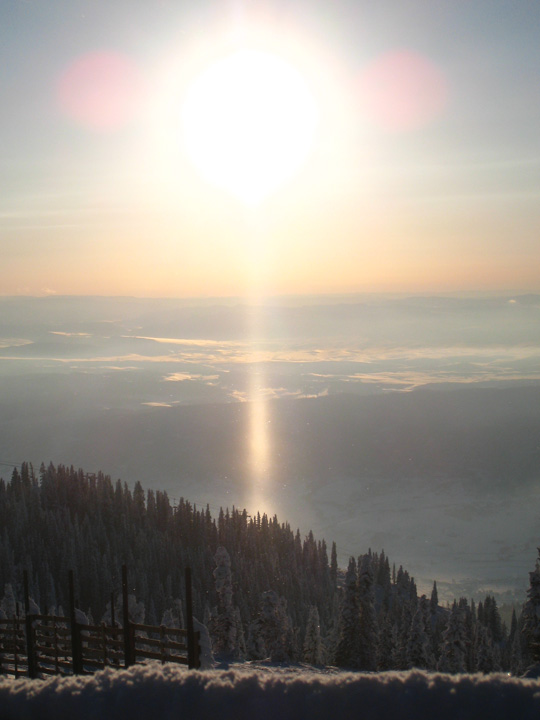
Here is a closing photo of a sun pillar we saw a few days ago.

Photo by Dan Berisford.

Last day of measurements

February 23rd, 2010 by Ed Kim

Today is our last day of measurements. We took a radiometer measurement in the morning, and then dug the final snowpit in the exact spot that the radiometer was viewing during the whole experiment. That way, we will know exactly what the radiometer was seeing. The pit measurements took hours and it was cold today with the wind blowing. Ty spent nearly the entire day in the pit. Volunteer Michael Harvey, MD, helped. Still it took until sundown. The data appear to be OK for the whole experiment. What a huge relief!

Last week, our primary instrument (the radiometer) arrived barely in time & wasn’t even complete because of the big Washington DC snowstorm. But after many days of hard work by the whole experiment team & our great Storm Peak Lab hosts, we managed to get our measurements.

Snow measurements by satellite radiometers are the key to estimating how much water is held by snow across the globe.

snow water equivalent march 2005

Satellite-based map of water content of snow in March 2005. More snow water maps available from the NEO Website.

The radiometer we used in this experiment makes measurements the same way as radiometers on satellites such as the AMSR-E radiometer on the Aqua satellite. But since we are observing a much smaller area in this experiment than the space-based radiometers view (meters instead of kilometers), we have much less variability to deal with, *and* we took detailed measurements of the actual snow characteristics.

That means we should be able to develop a more accurate relationship between what a radiometer sees and the true snow water content. A more accurate relationship is what we need to improve satellite snow observations, and the most direct way to find that relationship is by doing a carefully-controlled field experiment…only it takes a lot of hard work by teams of scientists, engineers, and technicians to do one…plus a little luck. So many things have to come together, especially when the weather doesn’t fully cooperate.

In the pit

February 22nd, 2010 by Ed Kim

Here is how we “commute’” to the lab each morning.

Ed Kim at Storm Peak

Ed Kim "commuting" to the Storm Peak Lab on Steamboat Mountain.

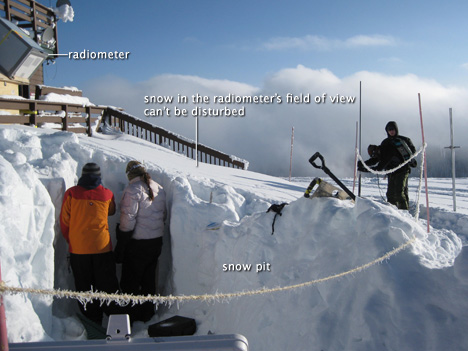
Dr. Noah Molotch (U. Colorado), Dr. Dan Berisford (JPL) Jen Petrzelka (U. Colorado), and Ty Atkins spent all day today (and the previous 2 days) making snowpit measurements using both traditional and new high-tech methods. In this photo, you can see how deep the snowpit is.

researchers in snow pit on Storm Peak

Scientists stand in a snow pit downhill and to the side of the radiometer's field of view.

We’ll be comparing the snowpit measurements with the radiometer measurements. Right now, we have to be very careful not to disturb the snow that the radiometer is looking at, so the pit is off to one side.

Radiometer is perfectly perched

February 21st, 2010 by Ed Kim

A big milestone today: after the DC snowstorm, the cross-country shipping, the snowcat trip up the mountain, and the days of wiring, we finally got radiometer data today. Dr. Mike Durand and Ty Atkins (U. Colorado) worked really hard to set up a stand built by Goddard engineers to hold the radiometer at just the right angle…without sliding off into the snow. We don’ t want the radiometer to get any ideas just because the Olympics are going on.

Sheltered by the radiometer platform, Mike Durand takes notes.

Morning at Storm Peak Laboratory

February 19th, 2010 by Ed Kim

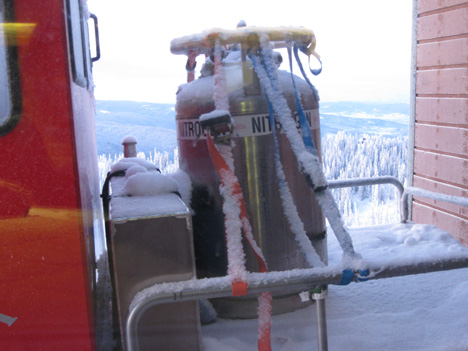
Sunrise on top of the mountain was beautiful—even the LN2 tank was glowing.

liquid N2 tank

Liquid nitrogen tank coated with rime. When it is released from the tank into the atmosphere, pure liquid nitrogen boils. The boiling point is -196 degrees C (-320 F). The team uses it as a temperature standard to calibrate the radiometer.