The Hellenic Navy (HN) (Greek: Πολεμικό Ναυτικό, Polemikó Naftikó, abbreviated ΠΝ) is the naval force of Greece, part of the Greek Armed Forces. The modern Greek navy has its roots in the naval forces of various Aegean Islands, which fought in the Greek War of Independence. During the periods of monarchy (1833–1924 and 1936–1973) it was known as the Royal Navy (Βασιλικόν Ναυτικόν, Vasilikón Naftikón, abbreviated ΒΝ).The total displacement of all the navy's vessels is approximately 150,000 tons.The motto of the Hellenic Navy is "Μέγα το της Θαλάσσης Κράτος" from Thucydides' account of Pericles' oration on the eve of the Peloponnesian War. This has been roughly translated as "Great is the country that controls the sea". The Hellenic Navy's emblem consists of an anchor in front of a crossed Christian cross and trident, with the cross symbolizing Greek Orthodoxy, and the trident symbolizing Poseidon, the god of the sea in Greek mythology. Pericles' words are written across the top of the emblem. "The navy, as it represents a necessary weapon for Greece, should only be created for war and aim to victory."...............The Hellenic Merchant Marine refers to the Merchant Marine of Greece, engaged in commerce and transportation of goods and services universally. It consists of the merchant vessels owned by Greek civilians, flying either the Greek flag or a flag of convenience. Greece is a maritime nation by tradition, as shipping is arguably the oldest form of occupation of the Greeks and a key element of Greek economic activity since the ancient times. Nowadays, Greece has the largest merchant fleet in the world, which is the second largest contributor to the national economy after tourism and forms the backbone of world shipping. The Greek fleet flies a variety of flags, however some Greek shipowners gradually return to Greece following the changes to the legislative framework governing their operations and the improvement of infrastructure.Blogger Tips and Tricks
This is a bilingual blog in English and / or Greek and you can translate any post to any language by pressing on the appropriate flag....Note that there is provided below a scrolling text with the 30 recent posts...Αυτό είναι ένα δίγλωσσο blog στα Αγγλικά η/και στα Ελληνικά και μπορείτε να μεταφράσετε οποιοδήποτε ποστ σε οποιαδήποτε γλώσσα κάνοντας κλικ στη σχετική σημαία. Σημειωτέον ότι παρακάτω παρέχεται και ένα κινούμενο κείμενο με τα 30 πρόσφατα ποστς....This is a bilingual blog in English and / or Greek and you can translate any post to any language by pressing on the appropriate flag....Note that there is provided below a scrolling text with the 30 recent posts...Αυτό είναι ένα δίγλωσσο blog στα Αγγλικά η/και στα Ελληνικά και μπορείτε να μεταφράσετε οποιοδήποτε ποστ σε οποιαδήποτε γλώσσα κάνοντας κλικ στη σχετική σημαία. Σημειωτέον ότι παρακάτω παρέχεται και ένα κινούμενο κείμενο με τα 30 πρόσφατα ποστς.........

Saturday, February 13, 2010

New Orleans, 5 years after Hurricane Katrina [642]

New Orleans: finding its feet, five years on from Hurricane Katrina

Nearly five years after Hurricane Katrina, Helena de Bertodano sees New Orleans gear up for Mardi Gras.

New Orleans: finding its feet, five years on from Hurricane Katrina
This year the partying started early, thanks to the New Orleans Saints which last weekend won the Super Bowl for the first time, symbolising ? to some extent ? post-Hurricane recovery Photo: GETTY

Telegraph co.uk.By Helena de Bertodano
Published: 11:00PM GMT 12 Feb 2010

"New Orleans is coming back – slowly but surely," cries Kermit Ruffins, the jazz trumpeter. The crowd packing Vaughan's Lounge, a jazz and blues club on the seedy side of cool, waves beer bottles and cheers. Between sets members of the audience load their plates with red beans, rice and spicy sausage. The band is not called The Barbecue Swingers for nothing. "When you put music and food together, you have the biggest party ever," says Ruffins, summing up the essence of the city too. It is late on a Thursday night and, judging by the atmosphere here, the city is still vibrant.

Elsewhere, it is a more complicated story. New Orleans is still struggling to get back on its feet after the devastation of Hurricane Katrina, followed by the wallop of the recession. Even now, nearly five years later, thousands of people are still displaced and parts of Lower Ninth Ward, which bore the brunt of the flooding, are a tangle of weeds. Throughout the city, many properties are boarded up and businesses have limped to a standstill. Signs advertising "75 per cent closing down sales" are almost as rampant as the weeds.

Yet New Orleans has always been a city that knows how to party – and today marks the beginning of Mardi Gras celebrations, with more than 50 parades scheduled between now and Fat Tuesday. For weeks the locals have been preparing fantastic costumes and masks and decking the city out in purple, gold and green, the festival colours.

This year the partying started early, thanks to the success of the New Orleans Saints, the local football team, which last weekend won the Super Bowl for the first time, symbolising – to some extent – post-Hurricane recovery. The Louisiana Superdome housed thousands seeking shelter from the storm; winds peeled off the stadium's outer covering and photographs of the damage became iconic Katrina images. One year and $185 million later, the Superdome reopened.

At Jackson Square in the French Quarter, there is little of the usual bustle – partly because it is a cold, rainy day. A beaten-up red Chevrolet from Alabama, full of elderly tourists, bumps down the steps into the pedestrian area. "Whoa," shouts a trombonist playing outside Café du Monde. The car does a three-point turn and bumps back up the steps, careering off.

Even Bourbon Street, a party artery during Mardi Gras, is almost deserted. Only a handful of tourists stroll the street, drinking Huge Ass beers. "Two drinks for the price of one," shouts a barman at a tawdry daiquiri bar. "THREE for one here," calls a barman from a neighbouring bar, equally empty. Both men collapse laughing: it takes a lot to dampen the "Nawlins" sense of humour.

In stately St Charles Avenue, where Mardi Gras parades pass, "For Sale" signs sprinkle the driveways of several of the showiest mansions. Even the landmark Brown House, a 14,000 sq ft Romanesque Revival monster, is on the market.

A potential bargain? Not exactly: I find out later the price is $6 million.

For this is one of the ironies of the hurricane: it has helped cushion New Orleans against the worst of the recession. On almost every street, you hear the sound of hammering: reconstruction work means that unemployment is lower than elsewhere and house prices have dipped less too.

So today, as Jackson Square throngs with revellers, the city's old catchphrase feels almost genuine again: "Laissez le bon temps rouler."

Afghanistan,Major offensive against Taliban[ 641 ]

Afghan surge begins

Thousands of US-led troops have begun a major offensive against one of the Taliban insurgents' last bastions in southern Afghanistan, a Nato official has said.

Afghanistan: US forces close in on Taliban town before Operation Moshtarak
Photo: JULIAN SIMMONDS

The assault on Marjah, in one of the world's biggest opium-producing regions of Helmand province, is the first phase of a major operation to re-establish Afghan government control over the region.

"The first wave of choppers has landed inside Marjah. The operation has begun," said Capt Joshua Winfrey, commander of Lima Company, 3rd Battalion, 6th Marines, which was at the forefront of the attack.

Many of Marjah's population of around 80,000 fled ahead of the offensive to escape the violence.

But in recent days, militants who have moved into Marjah have prevented many others from leaving.

Nato helicopters dropped leaflets on the town and surrounding area – which has an estimated total population of 125,000 – warning people to remain indoors once the offensive began.

Radio broadcast messages telling people that the Afghan and international troops had come to rid their area of insurgents and that no civilians would be harmed.


Spain: 511 troops to Afghanistan,Total 1600...[ 640 ]

Spain plans more troops for Afghanistan


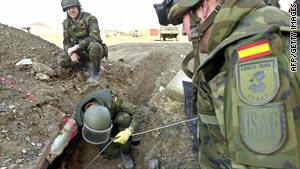
A file photo shows Spanish troops at work in Afghanistan.


By Al Goodman, CNN Madrid Bureau Chief
February 12, 2010 11:58 a.m. EST

CNN- The Spanish government will send up to 511 more troops to Afghanistan for the NATO-led security force, pending approval from parliament, the Defense Ministry said Friday.

The move was expected after Socialist government officials here recently discussed possible troop increases in response to requests, including from the Obama administration in the United States, for additional troops to fight the Taliban.

The increase would boost Spain's overall troop level in Afghanistan to 1,600, a Defense Ministry spokeswoman told CNN.

Defense Minister Carme Chacon is to appear next Wednesday before parliament's defense committee to formally request the troop increase.

Some of the additional Spanish troops would be focused on training Afghan troops and security forces to help them take over security of their own country, a ministry statement said.

Spain has had troops in Afghanistan since 2002 and more than 23 Spanish soldiers have died there, including a soldier last week. That soldier was killed when his military vehicle, on patrol, struck a mine. The blast wounded six other Spanish troops.

Friday, February 12, 2010

The German economics..... [ 639 ]

German economic recovery falters

VW cars ready for export
Germany has recently seen a recovery in exports

BBC,11:00 GMT, Friday, 12 February 2010

Germany's recovery from recession faltered in the final quarter of 2009, according to preliminary figures released on Friday.

The German economy failed to grow at all in the last three months of the year, with GDP unchanged compared with the previous quarter.

Meanwhile, France reported a 0.6% rise in GDP for the same three-month period - better than analysts expected.

Figures also showed the eurozone economy grew 0.1% in the same quarter.

ANALYSIS
Hugh Pym, BBC chief economics correspondent

Economic growth in the eurozone has slowed to a crawl - and that's bad news for the UK as much as it is for member states.

The 0.1% growth figure for the fourth quarter of 2009 was worse than expected and puts into perspective the UK's similarly anaemic performance over the same period.

Germany has hit the buffers after relatively strong growth in the second and third quarters - its performance then may have been over-dependent on stimulus measures such as the car scrappage scheme, since withdrawn. Italy, meanwhile, has lurched back to declining output.

Double-dip recession is the fear. That cannot help UK exporters who sell more than half their goods and services in other EU economies.

This represents a slowdown in the economies of the 16-nation zone, which grew by 0.4% between July and September last year.

Official first estimates indicated that the Italian economy shrank by 0.2% after growing by 0.6% in the previous quarter.

They also showed that Spain and Greece remained in recession, with the Greek economy contracting by 0.8%.

On Thursday after a summit in Brussels, EU leaders said Greece had to take further measures to tackle its huge debts and cut its budget deficit by 4% this year.

They agreed in principle on Thursday to support Greece, but no specific commitments on aid were agreed.

Greece's debt crisis has put pressure on the euro, making markets nervous. Following the German GDP figures, the euro fell further against both the pound and the dollar.

Worse than feared

The stall in German growth follows two consecutive quarters of growth in Europe's largest economy.

Germany emerged from recession last summer thanks to a recovery in its exports - on which it largely relies.

We no longer have a slump, but rather a very weak recovery
Gerd Hassel, economist, BHF Bank

"Exports were the only positive contribution," said the Federal Statistical Office.

The BBC's Tristana Moore in Berlin said the figures were "worse than expected".

Analysts were surprised by the figures, with the majority expecting modest growth in the last three months of the year.

Year-on-year, the economy shrank by 1.7%, the figures showed.

"We no longer have a slump, but rather a very weak recovery," said Gerd Hassel, economist at BHF Bank. "The first quarter will probably turn out weak too."

Data earlier this month showed a strong rebound in German exports, with exports up for the fourth month in a row in December.

That was despite an 18.4% fall in exports for 2009 as a whole - the biggest year-on-year fall since 1950, losing it the title of world's biggest exporter to China.

Meanwhile another quarter of growth in the French economy added to optimism over the strength of France's recovery from recession.

"I think [0.6%] is really a satisfactory result that proves that the stimulus measures we took ... were efficient," said Christine Lagarde, the French economy minister, speaking to a French radio station.

EU ready to help Greece over debts[ 638 ]

EU ready to help Greece over debts

Mr Van Rompuy: "We fully support the efforts of the Greek government"

BBC18:52 GMT, Thursday, 11 February 2010

EU leaders say they are ready to act to shore up Greece's finances and ensure stability in the eurozone - but they have made no specific promise of aid.

Greece must take further measures to tackle its huge debts and cut its budget deficit by 4% this year, the EU leaders said after a Brussels summit.

The statement did not spell out what was meant by "determined and co-ordinated action, if needed".

Greece's debt crisis has put pressure on the euro, making markets nervous.

Financial markets initially rose on the news of EU support for Greece, then fell back as analysts questioned the lack of detail.

Gavin Hewitt
There was a sense that painful decisions will have to wait
Gavin Hewitt
BBC Europe editor

Other countries with big deficits in the 16-nation eurozone, such as Portugal and Spain, are seen as vulnerable if Greece's problems are not tackled resolutely.

Greece's deficit is, at 12.7%, more than four times higher than eurozone rules allow. For years Greek spending has ballooned while tax revenue has diminished.

The President of the European Council, Herman Van Rompuy, stressed that Greece had not asked for financial aid.

The summit statement said: "We fully support the efforts of the Greek government and their commitment to do whatever is necessary, including adopting additional measures to ensure that the ambitious targets set in the stability programme for 2010 and the following years are met.

"We call on the Greek government to implement all these measures in a rigorous and determined manner to effectively reduce the budgetary deficit by 4% in 2010."

Greek Prime Minister George Papandreou said his country was ready to take the extra action needed to reduce its deficit.

"If it is necessary we are committed to take these additional measures to achieve our targets," Mr Papandreou told reporters in Brussels after the summit.

Unpopular measures

German Chancellor Angela Merkel said Greece "will not be left on its own, but there are rules and these rules must be adhered to".

ANALYSIS
Nigel Cassidy
By Nigel Cassidy
Europe business reporter

If the financial market riposte to the Greek bailout is anything to go by, we're not yet out of the woods.

The euro gained... but then fell back more. European currency traders soon twigged that this was only an accord in principle, with most of the costly details still to be worked out.

Many, including Britain, would have preferred the IMF to have brokered some kind of rescue.

But here the reputation of the euro was on the line. For heads of state, avoiding armageddon for Brussels' single most important achievement took priority over the unfortunate side-effect - our old friend moral hazard.

The unfortunate but potent side effect of this rescue is that it sends the message to the rest of the pack that if euro nations keep spending beyond their means for long enough, Germany and France will ride to the rescue.

The BBC's Dominic Hughes in Brussels says the details of any EU help for Greece may not emerge until Monday, when eurozone finance ministers will meet.

It is the first big test for Mr Van Rompuy, who wanted the summit to focus on a new strategy for jobs and growth - a blueprint for the next 10 years. But defending the euro is now a more pressing issue.

EU rules prevent the eurozone from collectively bailing out Greece, but the debt crisis has forced EU leaders to seek ways to help nevertheless.

UK Prime Minister Gordon Brown stressed that "the discussions at the moment are within the euro area", when asked if UK taxpayers' money would be part of any EU aid.

The markets remain sceptical that Greece will be able to pay its debts.

Any EU budget support for Greece is likely to come with stringent conditions, to ensure that Athens fulfils its austerity plans and to reassure European voters that their taxes will not be diverted to propping up Greece.

Thursday's talks followed a public sector strike that brought many services to a standstill in Greece.

GREEK AUSTERITY PLAN
Cut budget deficit below EU ceiling of 3% of GDP by 2012, from 12.7% in 2009
Freeze public sector salaries and cut bonuses
Replace only one in five of people leaving civil service
Raise average retirement age by two years to 63, by 2015
Raise taxes on fuel, tobacco, alcohol and property

The government's decision to freeze public sector salaries and raise the retirement age are among the austerity measures that have angered Greek trade unions.

Its debt is about 300bn euros ($419bn; £259bn), and the government estimates it will need to borrow about 53bn euros this year to cover budget shortfalls.

Debt servicing is now costing Greece 11.6% of its gross domestic product and it has to pay more interest on loans now because its credit rating has been downgraded.

Wary of IMF help

Analysts say that powerful eurozone members such as Germany may be able to help by buying Greek government debt or by providing loan guarantees.

HAVE YOUR SAY
Since the Greek debt problem put them some three times over what the EU is supposed to allow I can't see the justice in this
nothins_ever_easy, Belfast

In addition, the European Commission may decide to disburse regional aid to Greece earlier than planned.

But EU leaders appear reluctant to call on the International Monetary Fund to shore up the Greek economy. That would be a big blow to pride in the single currency.

They have asked the European Commission to draft additional measures to be taken by Greece, "drawing on the expertise of the IMF". The EU will assess Greece's implementation of the austerity plan next month.

The Commission is also working on a blueprint for the EU's long-term recovery and growth, called Europe 2020, which is expected by early March.

It will replace the Lisbon Strategy, launched in 2000, which became a victim of the global financial crisis and of fiscal rule-breaking by EU governments