Iranians rally to mark revolution | |||||
| People gather at Tehran's Azadi square BBC, 14:02 GMT, Thursday, 11 February 2010 Hundreds of thousands of pro-government Iranians are rallying to mark the 31st anniversary of the nation's revolution. President Mahmoud Ahmadinejad used the rally to attack the West, and said Iran had produced its first stock of 20% enriched uranium. The opposition is trying to mount counter-demonstrations, but faces a huge security crackdown and two of its leaders have reportedly been attacked. The anniversary is the most important day in Iran's political calendar. The government has warned protesters will be dealt with. Official events are being held across Iran, but the main gathering is at Tehran's Azadi Square. State TV showed tens of thousands of people filling the streets. Mr Ahmadinejad told the crowds Iran was now a "nuclear state" and would soon treble output of 20% enriched uranium.
He added that Western countries were hampering genuine reform in Iran. BBC Tehran correspondent Jon Leyne says the anniversary could be the largest confrontation since the disputed election last June, and the government and opposition have chosen to make the day a huge trial of strength. Our correspondent says the government is very nervous about the opposition demonstrations, but its own supporters have drawn a good crowd. Meanwhile, reports from the micro-blogging site Twitter and pro-opposition websites said opposition Green Movement supporters were holding rallies, one of them in the city's Saddeqiya Street. The opposition is trying to bring more people into central Tehran but is being confronted by a large number of the government's Basij militia, the reports say. Security forces are armed with tear gas, live rounds - which they are firing into the air - and paint balls to mark protesters. Witnesses say they have been loading opposition supporters onto buses. Amateur footage purportedly showing opposition protests has been appearing on the video-sharing website YouTube, including at least one rally in the Tehran underground.
Opposition leader Mehdi Karroubi had been intending to attend the Saddeqiya street rally, reports say, but his bodyguards were attacked by members of the Basij as he emerged from his car. His son was arrested as he tried to intervene. The reformist former President Mohammad Khatami was also reportedly attacked. His brother, Mohammed Reza Khatami, and his wife, Zahra Eshraghi, the granddaughter of the late Supreme Leader Ayatollah Ruhollah Khomeini, were arrested but later released. Other opposition sources said security forces had fired shots and tear gas at supporters of Mir-Hossein Moussavi, Mr Ahmadinejad's main rival in last June's elections. Advertisement Protesters thought to be in Tehran - This video, posted on YouTube, has not been verified by the BBC There are also reports of opposition protests in the cities of Tabriz, Shiraz and Isfahan. Anti-government websites urged marchers to display green emblems or clothes - the colour adopted by the opposition movement after the disputed election on 12 June last year. 'Ready for trouble' Deadly clashes erupted after the poll, and have taken place sporadically since then. Ahead of the commemorations, police chief Esmail Ahmadi Moghaddam said the Revolutionary Guards and Basij Islamic militia were ready for any trouble.
"We are fully prepared for holding a safe and glorious rally," he told the semi-official Fars news agency, according to Reuters news agency. "We are closely watching the activities of the sedition movement, and several people who were preparing to disrupt the 11 February rallies were arrested," he said. Our correspondent says the situation is now a stalemate, with the opposition showing it is still around and cannot be kept off the streets. The government is not used to such protests and is infuriated by this, he adds, although opposition support appears not to be enough to overthrow the government. There are reports that internet access has been restricted. Web giant Google says its e-mail traffic in Iran has dropped sharply, even though its networks were working properly. Google said users of its Gmail service had experienced difficulties following a newspaper report about official restrictions. "Whenever we encounter blocks in our services we try to resolve them as quickly as possible," the California-based company said in a statement. "Sadly, sometimes it is not within our control." Twitter and other social networking sites were used extensively during the post-election protests. | |||||

Thursday, February 11, 2010
Iranians are rallying....[637 ]


Wednesday, February 10, 2010
Greece hit by nationwide strike...[ 636 ]
Greece hit by nationwide strike over austerity measures
Protesters take to the streets in Athens
(BBC)14:57 GMT, Wednesday, 10 February 2010
Thousands of Greeks have rallied against deficit-cutting measures during a national public sector strike.
Flights have been grounded, many schools are closed and hospitals are operating an emergency-only service.
The prime minister, who wants to freeze pay, gather more taxes and reform pensions, insisted that the proposals would be fully implemented.
EU leaders will discuss Greece's difficulties on Thursday amid concern the crisis could threaten the euro.
European finance ministers are also due to hold a teleconference on Wednesday to talk about the issue.
Public anger
Despite heavy rain, there have been rallies across Greece throughout the day, with thousands of striking workers and pensioners gathering in the capital, Athens.
Several thousand people were also reported to have protested in Greece's second city, Thessaloniki.
The rallies have been mainly peaceful, but in one incident police fired tear gas at rubbish collectors who tried to drive through a police cordon.
 | It's a war against workers and we will answer with war  Union member Christos Katsiotis   |
Some demonstrators threw stones at the police but the trouble was quickly defused.
The unions regard the austerity programme as a declaration of war against the working and middle classes, the BBC's Malcolm Brabant reports from the capital.
He says their resolve is strengthened by their belief that this crisis has been engineered by external forces, such as international speculators and European central bankers.
"It's a war against workers and we will answer with war, with constant struggles until this policy is overturned," said Christos Katsiotis, a union member affiliated to the Communist Party, at the Athens rally.
Others in the capital either see the cuts as necessary or argue that the strike is politically motivated.
"We have to implement the austerity measures, or the country will not be able to get out of this crisis," said Katerina, a private sector employee. "We have to pay for the mistakes of the past."
On Tuesday, Prime Minister George Papandreou's socialist government announced that it intends to raise the average retirement age from 61 to 63 by 2015 in a bid to save the cash-strapped pensions system.
The move comes on top of other planned austerity measures, including a public sector salary freeze and a hike in petrol prices, announced last week.
Deficit and debt
Further government measures include the non-replacement of departing civil servants, and tax collectors recovering billions of euros lost to tax evasion.
Mr Papandreou, who was in Paris on Wednesday for talks with President Nicolas Sarkozy, pledged to "take any necessary measures" to reduce Greece's deficit.
"The stability programme will be implemented in every measure," he said.
Mr Papandreou has already faced down a three-week protest by farmers demanding higher government subsidies.
 These protesters referred to "The Pigs" - Portugal, Italy, Greece and Spain |
Public sector workers will not be hit as hard as they have been in the Irish Republic, but they complain that some of the lowest paid will suffer while the rich dodge tax with impunity, says BBC Europe correspondent Jonny Dymond.
Financial markets around the world and politicians from across Europe will be watching the situation carefully, he reports from Athens.
Greece's deficit is, at 12.7%, more than four times higher than eurozone rules allow. Its debt is about 300bn euros ($419bn; £259bn).
The markets remain sceptical that Greece will be able to pay its debts and many investors believe the country will have to be bailed out.
The uncertainty has recently buffeted the euro and the problems have extended to Spain and Portugal, which are also struggling with their deficits.
The possibility of Greece or one of the other stricken countries being unable to pay its debts - and either needing an EU bailout or having to abandon the euro - has been called the biggest threat yet to the single currency.
Ahead of the talks between EU leaders in Brussels on Thursday, some business media reported that Germany is preparing to lead a possible bail-out, supported by France and other eurozone members.
USA:attempts to call Iran's bluff[ 635 ]
U.S. ready to offer Iran alternative to nuclear plan
Washington (CNN) -- In what appears to be an attempt to call Iran's bluff on its nuclear program, the United States is poised to offer Tehran a way to obtain medical isotopes that Iran says it desperately needs to treat cancer patients, according to the State Department.
The United States, along with "other countries," will present a new proposal to the International Atomic Energy Agency to provide Iran with those isotopes, State Department spokesman P.J. Crowley said Tuesday.
"Our point is, if Iran feels it has a specific need, we are willing to engage constructively and try to identify ways in which the international community and potentially the United States can meet that need," Crowley said.
The move appeared to be a response to Iran's announcement Monday that it will carry out its own uranium enrichment to 20 percent to provide fuel to make the isotopes. The United States, along with other countries, questioned Iran's motives for that enrichment, saying it increases Iran's ability to produce fuel for a nuclear weapon.
Crowley told reporters that under the new proposal, the international community would "facilitate Iran's procurement of medical isotopes from third countries."
"There are alternatives," Crowley said. "The Iranian decision to improve their processing to 20 percent is an unnecessary step." Providing the opportunity to buy the isotopes directly, Crowley said, would be the "fastest and cheapest" way for Iran to avoid running out of isotopes and could help "build confidence."
Tehran separately has rejected an IAEA proposal under which it would ship most of its low-enriched uranium out of the country for further enrichment by Russia. France would process that uranium into fuel rods that would then be returned to Iran.
The new offer from the United States comes as Washington and other major countries move closer to imposing harsh new sanctions on Iran over its nuclear program, which those countries say is designed to develop a nuclear weapon. Iran says its nuclear program is exclusively for peaceful purposes.
President Obama told reporters on Tuesday that the international community will try to pressure Iran more if Iran is not willing to cooperate.
"What we are going to be working on over the next several weeks is developing a significant regime of sanctions that will indicate to them how isolated they are from the international community as a whole," Obama said.
Presenting details of the latest proposal, the State Department spokesman said, "We stand ready to work with Iran, we stand ready to address its legitimate needs, but we need to see Iran come to the table prepared to address our concerns and the concerns of the international community regarding its nuclear ambitions."
Tuesday, February 9, 2010
In the...streets with 70 million yen...[ 634 ]

Elderly wooman walks around streets with 70 million Yen in shopping cart.

OTSU, (Mainichi Japan) February 9, 2010 -- Local police have taken into custody an elderly woman with dementia and found a total of 70 million yen in a shopping cart she was pushing around, it has been learned.
At around 8 a.m. on Saturday, police in Shiga Prefecture received an emergency call from a passerby saying that an elderly woman was wandering about the streets, investigative sources said. Police then took the woman in her 80s into custody, and found a total of 70 million yen in cash and a significant number of share certificates in her shopping cart.
The woman appears to have carried around her savings whenever she took a stroll. Police officers said she was lucky not to have been the victim of a crime.
At first, the woman reportedly told police that only 10 million yen belonged to her, causing a panic among investigators as to where the rest of the money came from. However, her relatives later confirmed that all the money and stock certificates were her own property.
"She never trusted banks or family," police quoted her relatives as saying.
The woman has been living alone since her husband died. She apparently started carrying around the money she withdrew from her bank account a few years ago.
Yanukovich: I'm no Kremlin stooge...[ 633 ]
CNN exclusive: Ukraine's Yanukovich: I'm no Kremlin stooge
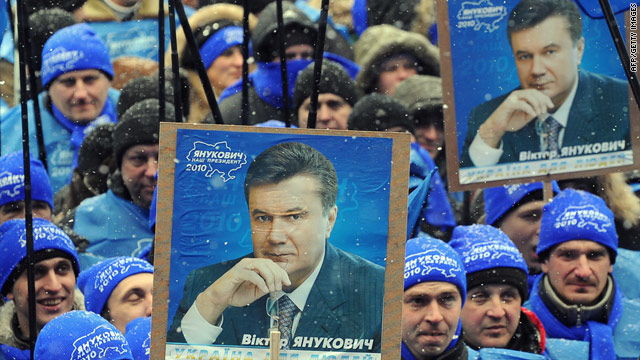
Kiev, Ukraine (CNN) -- The man leading Ukraine's presidential election called on his rival Tuesday to accept defeat, and he vowed to unite Ukraine after an election that has split the country in two.
In an exclusive interview with CNN, Victor Yanukovich also said any decisions he makes as president will be in the national interest of Ukraine, not Russia.
With 99.98 percent of the votes from Sunday's election counted, Yanukovich has 48.96 percent. Prime Minister Yulia Tymoshenko has 45.47 percent, according to the country's Central Election Commission.
Tymoshenko refuses to concede defeat and plans to demand a recount in some districts where, she says, voting irregularities took place, officials from her party said Tuesday.
Yanukovich called on his rival to accept the election result.
"This country has been democratic for five years and that's been proven again by this election," he told CNN. "Yulia Tymoshenko is betraying the principles of her Orange Revolution" by failing to acknowledge defeat.
Yanukovich was declared the winner of the presidential election in 2004, but after a pro-Western uprising known as the Orange Revolution, his win was annulled. The election was run again, and current President Victor Yushchenko won.
Compared to the Western-leaning Yushchenko, Yanukovich has been seen as having close ties to Russia. That opinion was helped in 2004 when then-Russian President Vladimir Putin became the first world leader to congratulate Yanukovich on his victory, a full two days before the electoral commission declared him president-elect.
Yanukovich told CNN on Tuesday that he would not do the bidding of Russia while he is president of Ukraine, and said he is no Kremlin stooge.
His policy, he said, "would be a policy based on mutual interest and good relations with both Russia and the European Union."
His priority with Russia, he said, would be to focus on stable energy supplies. With the EU, he said, he wants to take steps toward a free trade agreement and bring European standards of living to Ukraine.
In the past, Yanukovich has strongly opposed attempts by Ukraine to join the NATO alliance -- something Yushchenko favored. Tuesday, however, Yanukovich opened the door to NATO, even if just a little.
He would "continue to cooperate with NATO, but joining the alliance must be decided by the people of Ukraine in a referendum," he said.
The priorities of his administration will be to overcome the economic crisis in the country through economic reforms and overcoming corruption, he said.
Yanukovich has already called on Tymoshenko to begin preparations to step down and accept defeat.
Pro-Western Orange leaders like Tymoshenko talked a great deal but did very little, he said, accounting for her defeat.
Yanukovich accounted for his dramatic comeback by saying voters remembered how he was able to improve the economy in the past. He said people voted for him because they believe he can improve the economy.
Though accused of corruption in the past, Yanukovich said he offers the changes that Ukrainians want.
Asked about his vision for the country over the next decade, Yanukovich said he aims to unite Ukraine and make it one of the top 20 economies in the world.